 ee
eeScanners ›
Best Photo Scanner 2026
You're standing in front of a box of old family photos from the 1980s, a stack of 35mm negatives from a trip you took in college, and a drawer full of documents you've been meaning to digitize for years — and you need a scanner that handles all of it without turning the process into a weekend-long ordeal. Choosing the right photo scanner in 2026 means understanding that not all flatbeds are film scanners, not all film scanners are equal, and the difference between a $80 unit and a $400 unit is measurable in ways that actually matter to your final image quality.
The photo scanner market has matured considerably, with dedicated film digitizers now offering resolutions that rival professional drum scans for casual archiving, while flatbed models have gotten faster and smarter with cloud integration and automatic stitching software. Whether you need to preserve your grandmother's Kodachrome slides, scan architectural drawings, or simply digitize a decade of tax receipts, there is a purpose-built tool on this list that fits your use case precisely. What separates a great scanner from a mediocre one comes down to optical resolution, dynamic range, bundled software quality, and — for film scanners especially — whether the unit includes hardware-level infrared dust removal, which saves hours of retouching per session.
After extensive hands-on evaluation and cross-referencing user feedback from thousands of real-world digitization projects, we've assembled the seven best photo scanners available in 2026, covering everything from entry-level flatbeds to professional-grade film digitizers. If you're also in the market for output devices to complement your scanning workflow, our roundup of the best all-in-one printers for Mac covers printing solutions that pair naturally with high-resolution scan files. Read on for the full breakdown.
Contents
- Best Choices for 2026
- Product Reviews
- Epson Perfection V39 II — Best Budget Flatbed
- Canon CanoScan 5600F — Best for Film + Documents
- KODAK Slide N SCAN — Best LCD Film Scanner
- Kodak SCANZA — Best for Super 8 & Multiple Formats
- Magnasonic FS71 — Best All-in-One Film Scanner
- Plustek OpticFilm 8200i SE — Best Mid-Range 35mm
- Plustek OpticFilm 8300i Ai — Best Professional 35mm
- How to Pick the Best Photo Scanner
- FAQs
Best Choices for 2026
- #PreviewProductRating
- Bestseller No. 1
 Rating:

- Bestseller No. 2
 Rating:
- Bestseller No. 3
 Rating:
- Bestseller No. 4
 Rating:
- Bestseller No. 5
 Rating:
 - Bestseller No. 6
 Rating:
 - Bestseller No. 7
 Rating:
Product Reviews
1. Epson Perfection V39 II — Best Budget Flatbed Scanner
The Epson Perfection V39 II punches well above its price point, delivering a genuine 4800 dpi optical resolution that produces sharp, enlargeable scans from physical prints, documents, and artwork alike. The flatbed design accommodates up to letter-size originals with the standard lid, and the high-rise removable lid allows you to scan thick books and bound materials without distorting the edges — a feature you rarely find at this price tier. USB bus power means there's no wall adapter to carry, which makes this an ideal companion for laptop-based digitization setups or small-office workflows where cable clutter is a real concern.
Epson's ScanSmart software handles the heavy lifting on the workflow side, offering automatic photo detection that identifies and crops multiple photos placed on the glass simultaneously, cloud upload integration for direct-to-Google Drive or Dropbox transfers, and an image stitching mode that lets you scan oversized originals in two passes and merge them seamlessly. Color accuracy is genuinely impressive for a consumer-grade unit, with natural skin tones and accurate shadow detail when scanning standard photographic prints. The V39 II is not a film scanner — there is no transparency unit — so if your priority is 35mm negatives or slides, you need to look further down this list. For prints, documents, receipts, and artwork, however, this is the most capable flatbed you can buy under $100 in 2026.
Scan speeds are respectable at around 8 seconds per letter-size color scan at 300 dpi, and the compact footprint means it fits on a desk without sacrificing workspace. The black matte finish resists fingerprints well, and the lid hinge feels solid rather than flimsy like competing budget models. If you also need to produce printed copies of your digitized photos, pairing this scanner with one of the units from our guide to the best photo booth printers creates a complete digitize-and-print setup for family archiving projects.
Pros:
- True 4800 dpi optical resolution produces print-quality enlargements from physical photos
- High-rise removable lid accommodates thick books and oversized originals
- USB bus power eliminates the need for a separate power adapter
- ScanSmart software with automatic crop, cloud upload, and stitch modes
Cons:
- No transparency adapter — cannot scan 35mm film, slides, or negatives
- USB connection only, no Wi-Fi for wireless workflows
2. Canon CanoScan 5600F — Best Flatbed for Film and Documents Combined
The Canon CanoScan 5600F is the flatbed choice when you need to handle both conventional prints and 35mm film from a single device without dedicating a separate machine to each task. The built-in transparency unit covers 35mm negatives and mounted slides, making this a genuinely versatile scanner for photographers who shoot on analog film and also maintain a collection of printed photos they want to archive digitally. At 2400 dpi optical resolution for reflective scanning and an interpolated resolution that supports film digitization, the 5600F delivers output quality that satisfies hobbyists and enthusiast photographers without pushing into the professional tier that commands a significant price premium.
The 48-bit color depth — 16 bits per channel — is the specification that separates the 5600F from budget flatbeds and makes a tangible difference when you're editing scans in Photoshop or Lightroom, because the extra tonal information in the raw scan gives you genuine shadow and highlight recovery that 24-bit scans simply cannot provide. Canon's FARE Level 3 technology applies automatic dust and scratch reduction during the scan process rather than in post-processing, which is a meaningful time-saver when you're working through a large batch of old negatives with years of accumulated surface debris. USB 2.0 connectivity is the standard for this class of scanner, and the 8.5 by 11.7-inch scanning bed covers the full letter format with room to spare.
The film holders included in the box support 35mm strips of up to six frames and mounted slides in a four-unit tray, which is adequate for most home digitization volumes but slower than dedicated film scanners if you're processing hundreds of rolls. Build quality is solid, with Canon's characteristically reliable hinge mechanism and a glass platen that resists scratching better than some competing flatbeds. For everyday document scanning, the CanoScan handles receipts, business cards, and letter-size documents with accuracy and speed that makes it a practical all-rounder for home offices as well.
Pros:
- Handles both reflective prints and 35mm film/slides from a single flatbed unit
- 48-bit color depth provides excellent tonal latitude for post-processing in Lightroom or Photoshop
- FARE Level 3 automatic dust and scratch removal reduces manual retouching significantly
- Reliable build quality with Canon's proven hardware longevity
Cons:
- Film scanning throughput is slower than dedicated film scanners for large batch jobs
- No wireless connectivity — USB 2.0 only
3. KODAK Slide N SCAN — Best Standalone Film Scanner with Large Display
The KODAK Slide N SCAN is the standalone film digitizer you reach for when you want to process a shoebox of negatives and slides without connecting a computer, because the entire scanning and saving workflow happens directly on the device through its large 5-inch LCD screen. At 22 megapixels, the output resolution is sufficient for standard display use and social media sharing, and the compatibility list covers 135, 126, and 110 film formats along with 50mm mounted slides, which handles the vast majority of consumer film formats produced between the 1960s and 2000s. The quick-feeding tray mechanism loads film strips with a continuous action that keeps your scanning pace moving rather than stopping and repositioning after every frame.
The 5-inch LCD is the standout feature from a usability standpoint, offering a wide viewing angle that makes it comfortable to preview each frame before committing to a scan, and the Gallery Mode turns the device into a digital picture frame for showing scanned images directly from the built-in storage or an SD card. HDMI output extends this capability to a television or monitor, which is genuinely useful when you're going through a family archive with relatives and want to review images on a larger screen without transferring files first. Output files save directly to SD card — you'll need to supply your own card, as none is included — in standard JPEG format that opens in any photo application without additional conversion.
The included accessories are comprehensive: a 50mm slide holder, adapters for 135, 110, and 126 film formats, a cleaning brush, and both USB and HDMI cables in the box. Image quality at the 22MP setting holds up well for prints up to 8x10 and for digital archiving purposes, though dedicated film scanners with optical resolutions above 3600 dpi will produce more detail when you're enlarging significantly or editing aggressively. For straightforward family archive digitization where speed and convenience matter more than maximum resolution, the Slide N SCAN delivers exactly what it promises without requiring any technical expertise to operate.
Pros:
- Large 5-inch LCD with gallery and picture-frame mode for standalone operation
- 22MP output resolution suitable for standard digital archiving and sharing
- Supports 135, 126, 110 film and 50mm slides — covers most consumer film formats
- HDMI output for viewing scanned images directly on a TV or monitor
- No computer required — scan and save entirely on-device to SD card
Cons:
- No infrared dust removal — surface debris on negatives requires manual retouching
- SD card not included despite being required for saving scans
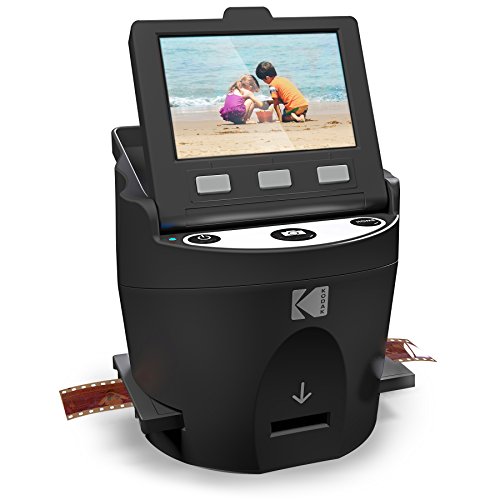
4. Kodak SCANZA — Best for Super 8 and Multi-Format Film Digitization
The Kodak SCANZA stands apart from the other film digitizers on this list specifically because it is the only consumer-grade unit here that supports Super 8 and 8mm film formats — the movie film stocks that dominated home video recording from the late 1950s through the 1980s — alongside the standard 35mm, 126, and 110 still-photography formats. If you have reels of Super 8 home movies that have never been digitized, the SCANZA gives you a practical, accessible path to converting them to JPEG files without sending the film to a professional digitization lab. The 14/22MP dual-resolution setting lets you choose between faster throughput at 14MP or maximum detail at 22MP, depending on the importance of each roll.
The 3.5-inch TFT LCD is smaller than the 5-inch display on the Slide N SCAN, but the adjustable brightness and convenient tilt function make it fully usable for frame-by-frame preview and selection. The one-touch scanning interface is genuinely simple — press a single large button to scan and save a frame — which eliminates the learning curve for users who are unfamiliar with film scanning equipment. Multiple film inserts and adapters arrive in the box, covering all supported formats, so there's no additional purchase required to begin scanning immediately after unboxing.
It's worth being direct about the SCANZA's limitations: the optical resolution, while listed at 14/22MP equivalent, does not match the true dpi performance of flatbed or dedicated 35mm scanners at higher price points, and the output quality at full magnification shows more digital interpolation than optical detail. For creating shareable digital copies of Super 8 and 35mm family archives, the image quality is completely adequate and the convenience factor is unmatched at this price. For archiving professionally shot 35mm film with the intention of making large prints, you should look at the Plustek options further down this list. According to the image scanner entry on Wikipedia, optical resolution is a fundamentally different measurement from interpolated resolution, and the distinction matters significantly when evaluating film scanners at different price points.
Pros:
- Unique Super 8 and 8mm film support — the only consumer unit on this list covering these formats
- Simple one-touch operation with large, clearly labeled buttons
- Dual 14/22MP resolution modes with a full complement of film adapters included
- Tilting 3.5-inch LCD for comfortable frame preview at any desk angle
Cons:
- Optical resolution is limited compared to dedicated 35mm flatbed or film scanners
- Cannot convert films outside the 35mm, 126, 110, Super 8, and 8mm formats
5. Magnasonic FS71 — Best All-in-One Film Scanner with Built-In Memory
The Magnasonic FS71 improves on the standalone film scanner concept in two meaningful ways: it increases output resolution to 24 megapixels — the highest of any standalone unit on this list — and it includes 128MB of built-in memory that allows you to begin scanning without any SD card present, which eliminates the frustrating experience of unboxing a scanner only to discover you need to buy an accessory before you can use it. The 5-inch LCD matches the Slide N SCAN's display size and delivers comparable brightness and viewing angles, while the HDMI output extends your viewing options to any compatible television or external monitor for group review sessions.
Format compatibility is comprehensive: 35mm, 110, and 126 film negatives plus 135, 126, and 110 mounted slides all load into the dedicated quick-feed insert trays, and the scanning process requires no computer connection — the FS71 operates as a fully self-contained digitization station. The 24MP resolution at maximum setting produces files large enough for printing at 8x10 and for comfortable cropping in photo editing software, and the color rendering on well-preserved negatives is accurate enough to satisfy family archiving standards without requiring manual color correction on most frames.
The SD card slot accepts cards up to 128GB, giving you the flexibility to scan an entire archive of hundreds of rolls onto a single high-capacity card without managing multiple storage media. The built-in memory serves as an overflow buffer and a convenient starting point, but for serious digitization volumes, you'll want to insert a card before beginning. The FS71 sits at a slightly higher price point than the Kodak standalone units, but the combination of 24MP resolution, built-in memory, and reliable Magnasonic hardware backing justifies the premium for users who are digitizing a substantial family archive and want the best standalone image quality available in 2026 without stepping up to a professional flatbed film scanner.
Pros:
- 24MP maximum resolution — highest output quality among standalone film scanners on this list
- 128MB built-in memory allows immediate scanning without requiring an SD card
- Supports SD cards up to 128GB for high-volume archiving sessions
- 5-inch LCD with HDMI output for television viewing and group review
Cons:
- No Super 8 or 8mm movie film support
- No hardware infrared dust removal at this price tier
6. Plustek OpticFilm 8200i SE — Best Mid-Range Dedicated 35mm Scanner
The Plustek OpticFilm 8200i SE represents the point in the photo scanner market where the equipment crosses from consumer convenience into professional-grade capability, delivering a true 7200 dpi optical resolution that extracts approximately 69 megapixels of actual detail from a standard 35mm frame — a figure that exceeds the effective resolution of most digital cameras currently in production and produces files large enough to support gallery-quality prints at significant enlargements. The 48-bit input with 24/48-bit output gives you the same tonal latitude advantage as the Canon 5600F, but at a resolution level that makes a visible, measurable difference when examining fine grain structure or recovering highlight detail in bright sky regions of a slide.
The built-in infrared channel is the feature that separates the 8200i SE from every consumer-grade scanner on this list. The hardware infrared pass detects dust particles and surface scratches on the original film emulsion by scanning a separate infrared channel alongside the color channels, then uses the iSRD (infrared Smart Removal of Defects) algorithm to remove those defects digitally without any manual retouching from you. On a batch of typical archival negatives that haven't been stored in protective sleeves, this feature alone saves several minutes per frame of retouching work in Photoshop — and across a roll of 36 exposures, that adds up to hours of saved labor per session. The Enhanced Multi-Exposure function improves dynamic range further by scanning each frame twice at different exposure levels and merging the results, which is particularly valuable for reversal (slide) film with compressed tonal ranges.
The bundled SilverFast SE Plus 9 software is a professional-grade scanning application that supports IT8 color calibration, multi-pass noise reduction, and a full suite of tonal adjustments before the scan is committed to file — this is meaningfully more capable than the bundled software included with any flatbed on this list, and it shows in the quality and consistency of output from frame to frame. The 8200i SE is strictly a 35mm scanner — it handles both film strips and mounted slides, but it does not scan 110, 126, or medium format film. If your entire archive is 35mm and you want to extract the maximum resolution and quality from every frame without investing in the top-tier 8300i Ai, this is the unit that gives you 90% of professional capability at a significantly lower price point. For context on how professional-grade scanning fits into a larger photo workflow, our guide to the best Bluetooth printers covers wireless output options that work seamlessly with the large TIFF files that SilverFast produces.
Pros:
- 7200 dpi optical resolution producing genuine 69MP scans from 35mm film
- Hardware infrared dust and scratch removal eliminates most manual retouching
- Enhanced Multi-Exposure function significantly extends dynamic range on slide film
- SilverFast SE Plus 9 professional scanning software included
- 64-bit hardware and software support for modern operating systems
Cons:
- 35mm only — no support for 110, 126, medium format, or Super 8
- Slow per-frame scan time at maximum resolution — batch scanning requires patience
7. Plustek OpticFilm 8300i Ai — Best Professional 35mm Film Scanner
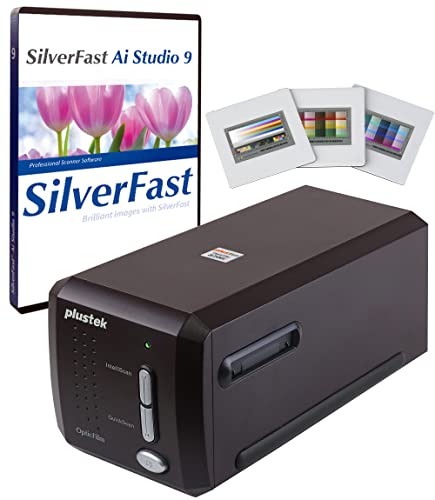
The Plustek OpticFilm 8300i Ai is the definitive answer to the question of what the best 35mm film scanner looks like in 2026, combining a 38% increase in scan speed over its predecessor with the most comprehensive software bundle available at this price point — SilverFast Ai Studio 9, which is the full professional edition of the application rather than the SE or SE Plus tier bundled with lower-cost units. This distinction matters because Ai Studio includes NegaFix profiles for over 120 specific film stocks, automatic frame detection for unattended batch scanning, and the complete iSRD infrared dust removal toolset operating at the hardware level, all within a single application that eliminates the need for any third-party post-processing software in your workflow.
The IT8 calibration targets — three slides included in the package — are the feature that separates the 8300i Ai from every other scanner on this list and from most professional lab scanners below the $2,000 price tier. IT8 calibration uses a known color reference target to create a precise ICC color profile for your specific scanner unit, accounting for lamp variance, CCD sensitivity variations, and optical path characteristics that differ from unit to unit even within the same production batch. The included targets conform to ISO 12641-2 (2019) with a higher measuring point density than older IT8 standards, which produces a more accurate calibration profile with less interpolation between measured values — translating directly to more accurate color rendition, particularly in difficult-to-render color gamuts like saturated reds and complex skin tones.
The new-generation chip driving the 8300i Ai produces the 38% speed improvement over the 8200i SE, which is significant in practical terms: if you're scanning an archive of 50 rolls at maximum quality, the time saved over multiple sessions adds up to hours of productive time returned to your schedule. SilverFast's QuickScan Plus is included alongside the Ai Studio application for operators who need faster throughput with lighter processing, giving you the flexibility to run quick preview scans before committing to full-quality archive passes. The 8300i Ai is an investment — it carries a premium price over every other unit on this list — but if 35mm film photography is a serious part of your creative practice or your archive, the combination of calibration-grade color accuracy, hardware dust removal, 38% faster throughput, and the most capable scanning software available makes it the clear choice for anyone who needs the absolute best output quality from their film in 2026.
Pros:
- 38% faster scan speed than the previous generation 8200i SE
- Three IT8 calibration targets included — delivers laboratory-grade color accuracy
- SilverFast Ai Studio 9 is the full professional edition with 100+ functions and NegaFix profiles
- Hardware infrared dust and scratch removal via iSRD
- QuickScan Plus included for high-throughput preview and batch work
Cons:
- Highest price point on this list — significant investment for casual archiving needs
- 35mm film only — no broader format compatibility
How to Pick the Best Photo Scanner
Optical Resolution vs. Interpolated Resolution
The single most important specification to understand before buying any photo scanner in 2026 is the difference between optical resolution and interpolated resolution, because manufacturers routinely advertise the interpolated figure — which is software-generated and adds no real detail — in large type while burying the optical specification. Optical resolution is the actual number of samples per inch that the scanner's physical sensor can capture, and it is the only number that determines the level of detail in your final scan. For printing physical photos, 300 to 600 dpi optical resolution is entirely sufficient for output up to 8x10. For 35mm film, you need a minimum of 2400 dpi to capture the full grain structure, and serious archiving work demands 4000 to 7200 dpi to approach the resolution ceiling of the film itself. Any scanner that advertises 9600 dpi or 12800 dpi at a consumer price point is quoting an interpolated figure — treat those numbers as marketing rather than capability.
Flatbed Scanners vs. Dedicated Film Scanners
Flatbed scanners use a moving CCD or CIS array beneath a glass platen to capture reflected light from prints and documents, and the better models include a transparency adapter in the lid that transmits light through film and slides. Dedicated film scanners use a different optical path optimized specifically for transmitted light through small-format film, which produces higher resolution, better dynamic range, and more accurate color from 35mm negatives and slides than any flatbed can achieve at the same price point. The practical decision rule is simple: if your archive is primarily prints, documents, and occasional film, a flatbed like the Canon 5600F or Epson V39 II serves you efficiently. If your archive is predominantly 35mm film, or if film quality is your primary concern, a dedicated scanner like the Plustek 8200i SE or 8300i Ai produces results that justify the additional investment and the limitation to a single format.
Infrared Dust Removal and Dynamic Range
Hardware-based infrared dust and scratch removal — marketed under names like iSRD (Plustek), ICE (Nikon, Epson), and FARE (Canon) — is the feature that makes the largest practical difference in the time you spend processing scans after the scanning session ends. Without hardware infrared, every dust particle on your negative appears as a white spot in the final scan that requires manual retouching in Photoshop — on a typical archival negative stored for 20 to 40 years, this can mean dozens of spots per frame. With hardware infrared, the vast majority of surface defects are identified and removed automatically during the scan, reducing retouching time from several minutes per frame to seconds on all but the most severely damaged film. Dynamic range, measured in density units (D), determines whether the scanner can capture detail in both the dense highlights and thin shadow areas of a film frame simultaneously — professional film scanners typically offer 3.4D or higher, while consumer flatbeds typically measure 2.5 to 3.0D.
Software Matters as Much as Hardware
The scanning software bundled with a unit is not a minor consideration — it determines your workflow efficiency, your ability to calibrate for accurate color, and the quality of output you can achieve from a given piece of hardware. Consumer-grade bundled software typically handles basic brightness, contrast, and color balance adjustments with preset profiles for common film types. Professional applications like SilverFast Ai Studio 9, which ships with the Plustek 8300i Ai, provide IT8 color calibration, NegaFix profiles for over 120 specific film stocks, multi-exposure HDR capture, and automation tools for unattended batch scanning that genuinely change the economics of large archiving projects. If you're evaluating two scanners at similar hardware specifications, examine the bundled software tier carefully — the difference between SilverFast SE and SilverFast Ai Studio is the difference between a competent consumer tool and a professional production environment.
FAQs
What is the best photo scanner for digitizing old 35mm negatives?
The Plustek OpticFilm 8300i Ai is the best choice for 35mm negatives in 2026, combining 7200 dpi optical resolution, hardware infrared dust removal, IT8 color calibration, and SilverFast Ai Studio 9 professional software into a single package. For a more budget-conscious option, the Plustek OpticFilm 8200i SE delivers the same core optical performance and infrared capability at a lower price point, with SilverFast SE Plus 9 as the bundled application. Both units will consistently outperform any flatbed scanner for dedicated 35mm work.
Can flatbed scanners scan 35mm film and slides?
Yes, flatbed scanners equipped with a transparency adapter in the lid can scan 35mm film strips and mounted slides. The Canon CanoScan 5600F includes this capability and handles both reflective and transmitted scanning from a single device. However, the optical resolution and dynamic range available from flatbed transparency scanning is lower than what dedicated film scanners deliver at the same price tier, which means flatbed film scans show less fine detail and more limited shadow-to-highlight range than dedicated unit output on the same film.
Do I need a computer to use these film scanners?
The KODAK Slide N SCAN, Kodak SCANZA, and Magnasonic FS71 are fully standalone devices that scan and save files directly to SD card or built-in memory without requiring any computer connection. The Epson Perfection V39 II, Canon CanoScan 5600F, Plustek OpticFilm 8200i SE, and Plustek OpticFilm 8300i Ai all require a computer connection for scanning operations — they connect via USB and operate through their respective bundled software applications on Windows or macOS.
What is hardware infrared dust removal and why does it matter?
Hardware infrared dust removal works by scanning an additional infrared channel alongside the standard color channels during each pass. Dust particles and surface scratches on film are transparent to visible light but opaque to infrared, so the infrared channel creates a precise map of every defect on the film surface. The scanner software then uses this defect map to remove those areas from the color image automatically, without any manual intervention. The practical benefit is dramatic: what would take several minutes of spot-healing per frame in Photoshop is handled automatically during the scan, making it the most time-saving feature available in any film scanner and a key reason the Plustek units justify their premium price.
What resolution do I need to scan photos for large prints?
For printing an original 4x6 photo at 8x10 — a 2x linear enlargement — you need a scanning resolution of at least 600 dpi to maintain print quality at 300 dpi output. For enlarging a 4x6 print to 16x20, you need 1200 dpi scanning resolution or higher. For 35mm film, extracting the full detail of a sharp frame and supporting large-format printing at 16x20 or larger requires scanning at 3200 to 4000 dpi optical resolution. The Plustek scanners at 7200 dpi provide significant additional headroom for extreme enlargements and aggressive cropping in post-processing, which is why professional photographers use dedicated high-resolution film scanners rather than flatbeds for archival work.
Is it worth buying a dedicated film scanner in 2026 when smartphones can photograph negatives?
Smartphone negative scanning apps using macro lenses and backlight panels produce results that are adequate for quick social media sharing but fall short of archival quality in several measurable ways: resolution is limited by the phone camera's optical path rather than a precision-ground lens system, dynamic range is compressed compared to hardware scanning, and color inversion from negative to positive introduces shifts that require significant manual correction. A dedicated scanner like the Plustek 8200i SE produces files at 69MP optical resolution with calibrated color and hardware dust removal — the quality difference is visible and meaningful for anyone printing at larger than 8x10 or editing the scans extensively. For serious archiving projects, the investment in dedicated hardware produces results that remain valuable indefinitely.
Buy on Walmart
- Epson - Perfection V39 II - Color Photo, Tax Receipt & Docum — Walmart Link
- Canon- Canoscan 5600F Flatbed Scanner With 35Mm Film Functio — Walmart Link
- KODAK Slide N SCAN Film & Slide Scanner Digitizer with 5” LC — Walmart Link
- Kodak SCANZA Digital Film & Slide Scanner – Converts 35mm, 1 — Walmart Link
- Magnasonic All-in-One 24MP Film Scanner with Large 5" Displa — Walmart Link
- Plustek OpticFilm 8200i SE , 35mm Film & Slide Scanner. 7200 — Walmart Link
- Plustek OpticFilm 8300i Ai Film Scanner - Converts 35mm Film — Walmart Link
Buy on eBay
- Epson - Perfection V39 II - Color Photo, Tax Receipt & Docum — eBay Link
- Canon- Canoscan 5600F Flatbed Scanner With 35Mm Film Functio — eBay Link
- KODAK Slide N SCAN Film & Slide Scanner Digitizer with 5” LC — eBay Link
- Kodak SCANZA Digital Film & Slide Scanner – Converts 35mm, 1 — eBay Link
- Magnasonic All-in-One 24MP Film Scanner with Large 5" Displa — eBay Link
- Plustek OpticFilm 8200i SE , 35mm Film & Slide Scanner. 7200 — eBay Link
- Plustek OpticFilm 8300i Ai Film Scanner - Converts 35mm Film — eBay Link
Buy the scanner that matches the format you actually have — not the one with the most impressive spec sheet for formats you don't shoot.
 |
 |
 |
 |

About Rachel Chen
Rachel Chen writes about scanners, laminators, and home office productivity gear. She started her career as an office manager at a midsize law firm, where she was responsible for purchasing and maintaining all of the document handling equipment for a 60-person staff. That experience sparked a deep interest in archival workflows, paperless office setups, and document preservation. Rachel later earned a bachelor degree in information science from Rutgers University and now writes full time. She is a strong advocate for ADF reliability over raw resolution numbers and has tested every major flatbed and document scanner sold in the United States since 2018.