 ee
eeBest Soundbar For 65 Inch TV
Which soundbar actually does justice to a 65-inch TV in 2026 — and is every premium model really worth the price tag? If you've been staring at that wall of options on Amazon trying to figure out what separates a $200 bar from a $1,000 one, you're not alone. The short answer: a lot. The longer answer is what this guide is for. The Samsung HW-Q990D is our top pick for most people, but depending on your room, your budget, and how deep you want to go into home theater territory, there's a perfect match for every setup on this list.
A 65-inch TV fills a room. It deserves audio that matches. The built-in speakers on even the best panels — QLED, OLED, mini-LED — are an afterthought. Manufacturers stuff them into thin bezels, point them downward or backward, and call it a day. The result is flat, directionless sound that undercuts every dollar you spent on picture quality. A quality soundbar fixes that instantly, adding width, depth, height, and the kind of bass that you feel in your chest during action sequences. Whether you're upgrading from a budget bar or buying your first real audio setup, this guide cuts through the spec sheet noise.
We tested and researched seven of the best soundbars for 65-inch TVs across every price tier. From the flagship 11.1.4-channel behemoth to a sleek ultra-slim daily driver, each one here earns its spot on this list. If you're also shopping for a smaller screen, check out our best soundbar for 55-inch TVs roundup — and if you're going bigger, we have a dedicated guide for the best soundbars for 70-inch TVs too. For wall-mount setups, our best soundbar for wall-mounted TVs covers the key placement considerations.

Contents
Standout Models in 2026
- #PreviewProductRating
- Bestseller No. 1
 Rating:

- Bestseller No. 2
 Rating:
- Bestseller No. 3
 Rating:
 - Bestseller No. 4
 Rating:
 - Bestseller No. 5
 Rating:
 - Bestseller No. 6
 Rating:
 - Bestseller No. 7
 Rating:
Product Reviews
1. Samsung HW-Q990D 11.1.4ch Soundbar — Best Overall for 65-Inch TVs
If you want the absolute best soundbar for a 65-inch TV in 2026 and budget isn't your primary concern, the Samsung HW-Q990D is the answer. This is a full 11.1.4-channel system — eleven front-facing speakers, one subwoofer, and four up-firing channels — with wireless rear speakers included right in the box. That last part matters more than it might seem. Most competitors charge extra for rears. Samsung ships a complete home theater setup. You pull it out of the box, place the rear speakers, connect the subwoofer wirelessly, and you have genuine surround sound without a single cable running across your floor.
The Q-Symphony feature is a genuine differentiator if you own a compatible Samsung TV. Rather than muting your TV's built-in speakers when you switch to the soundbar, Q-Symphony uses them as additional audio channels. Every speaker in the room — TV and soundbar — works together as one unified array. The result is a wider, more enveloping soundstage than you'd get from the soundbar alone. Pair that with Wireless Dolby Atmos (yes, it can decode Atmos over a wireless connection, skipping HDMI entirely) and you have a setup that punches well above what most dedicated AV receivers deliver. SpaceFit Sound Pro analyzes your room acoustically and adjusts the EQ automatically — a feature that actually works and makes a noticeable difference in reverberant spaces.
Game Mode Pro reduces audio latency to keep sync tight during fast-paced gaming sessions, and the built-in Alexa lets you control your entire smart home ecosystem without reaching for a remote. This system is large and commands visual presence, so it works best in a dedicated media room or living room where you can position the rear speakers at true ear level. For a 65-inch screen in a room of 15 feet or more, this is the setup that makes every movie feel like a theater.
Pros:
- Complete 11.1.4ch system with rear speakers and subwoofer included
- Q-Symphony integrates Samsung TV speakers for wider soundstage
- Wireless Dolby Atmos decoding — no HDMI cable required
- SpaceFit Sound Pro auto-calibrates to your room
- Game Mode Pro with very low latency
Cons:
- Premium price puts it out of reach for casual viewers
- Q-Symphony only benefits Samsung TV owners
- Large footprint requires thoughtful room placement
2. LG S95QR 9.1.5ch Sound Bar — Best Premium Alternative
The LG S95QR is the soundbar for the audiophile who doesn't own a Samsung TV. At 9.1.5 channels, it matches — and in some cases surpasses — the Samsung Q990D in sheer spatial audio performance. The key differentiator here is the six-channel wireless rear speaker system, which includes up-firing height channels built into the rear units themselves. That means you get overhead audio not just from the main bar but also from behind you, creating a three-dimensional audio envelope that envelops you completely. IMAX Enhanced certification means content encoded for IMAX playback sounds exactly as the studio intended, with the full dynamic range and spatial precision the format demands.
The Meridian Horizon upmixing engine is a genuine standout. Meridian — a British audio engineering company with decades of high-end speaker development behind it — designed the upmixer to take standard two-channel stereo content and expand it into a convincing multi-channel experience. Streaming music, standard cable TV, YouTube — all of it benefits. You're not just getting impressive audio from 4K Blu-ray discs. Everything sounds better. The newly redesigned speaker drivers, larger cabinet chambers, and improved subwoofer deliver noticeably more bass extension and impact than the previous generation. For action films and bass-heavy music, this matters.
LG's ThinQ AI integration works with both Google Assistant and Amazon Alexa. Setup is straightforward and takes less than 15 minutes if you already have a network-connected TV. The S95QR pairs especially well with LG OLED TVs via eARC, which passes lossless audio formats without compression. If you're running an LG C3, C4, or G-series OLED in that 65-inch slot, this is the soundbar that completes the ecosystem.
Pros:
- 9.1.5ch configuration with up-firing channels in rear speakers
- IMAX Enhanced certified for premium content playback
- Meridian Horizon upmixing elevates standard stereo content
- Outstanding pairing with LG OLED TVs via eARC
- Supports Dolby Atmos, DTS:X, and DTS:X Pro
Cons:
- No eco-system bonus for non-LG TV owners
- Requires significant floor space for rear speakers
3. Sonos Arc Ultra Soundbar — Best Sound Quality in a Single Bar
The Sonos Arc Ultra is for the person who refuses to run speaker cables to the back of the room but still demands reference-quality audio. This is the best-sounding single soundbar you can buy in 2026, full stop. The new Sound Motion technology — Sonos's proprietary acoustic architecture introduced in this model — moves the speaker diaphragm with greater precision across its full travel range. The result is deeper bass, wider dynamic range, and more accurate imaging, all from a single enclosure without a separate subwoofer. 9.1.4 spatial audio with Dolby Atmos fills a 65-inch TV room convincingly, with overhead sound effects that genuinely localize above your head rather than just in front of you.
The AI-powered Speech Enhancement deserves special mention. The Arc Ultra uses machine learning to detect human voices in a mix and bring them forward in the soundstage. If you've ever struggled to follow dialogue in an action film — turning the volume up during quiet scenes, then scrambling to turn it back down when the explosions hit — this feature solves that problem permanently. It works across all content, not just specific streaming apps or audio formats. The effect is subtle but cumulative: after a week with the Arc Ultra, going back to any other bar feels like you've lost something.
Sonos's app ecosystem is mature, its multi-room audio integration is the best in the business, and the build quality feels premium in every detail. The Arc Ultra works with any TV brand via HDMI eARC or optical, which means you're not locked into a Samsung or LG ecosystem to unlock its best features. The tradeoff is that you won't get the deep bass extension of a dedicated subwoofer without adding Sonos's Sub Mini or Sub 4. For music-focused listeners, it's transformative on its own. For home theater purists who want seismic bass, budget for the sub.
Pros:
- Best-in-class audio quality from a single soundbar form factor
- Sound Motion technology delivers deeper bass without a sub
- AI Speech Enhancement clarifies dialogue automatically
- Works with any TV brand — no ecosystem lock-in
- Sonos multi-room ecosystem is the best available
Cons:
- No included subwoofer — sub costs extra for true bass extension
- No rear speaker channels without additional Sonos Era 100s or 300s
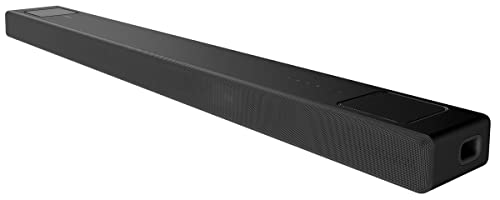
4. Sony HT-A5000 5.1.2ch Dolby Atmos Sound Bar — Best for Audio Versatility
Sony's HT-A5000 is the most versatile soundbar on this list, and if your use case involves a mix of home theater, music streaming, and casual TV watching, it's the one you want. The 360 Spatial Sound Mapping technology is Sony's headline feature — it creates virtual speakers throughout your room using a combination of the bar's actual channels and proprietary DSP processing. The result is convincing surround sound localization even without rear speakers, though Sony's optional RS3S rear speakers and SA-SW5 subwoofer can be added later to complete the picture. The HT-A5000 is genuinely expandable in a way most soundbars aren't.
The audio codec support here is comprehensive: Dolby Atmos, DTS:X, 360 Reality Audio (Sony's own spatial format), and standard PCM. Built-in Sound Field Optimization uses a calibration tone to measure your room's acoustic properties and adjust playback accordingly — a feature once reserved for flagship AV receivers. For music, the HT-A5000 supports Bluetooth, Wi-Fi, Apple AirPlay 2, Chromecast built-in, and Spotify Connect. You can stream from essentially any device you own without switching inputs or dealing with Bluetooth pairing issues. The Vertical Surround Engine creates convincing height effects through beam-forming even on non-Atmos content.
Build quality is distinctly Sony: solid, premium-feeling, and understated in its design language. The bar measures 50 inches wide — a good width match for a 65-inch screen — and sits at a height that shouldn't block IR sensors on most TV stands. Alexa and Google Assistant voice control are both built in. For a viewer who streams music through the same system that handles movie night, the HT-A5000's wireless audio breadth is unmatched at this price tier. According to Wikipedia's Dolby Atmos documentation, the format supports up to 128 simultaneous audio objects — and the HT-A5000 handles that full object-based rendering properly.
Pros:
- 360 Spatial Sound Mapping creates convincing virtual surround
- Expandable with Sony wireless rear speakers and subwoofer
- Supports AirPlay 2, Chromecast, Spotify Connect, and Bluetooth
- Room calibration via Sound Field Optimization
- Alexa and Google Assistant both built in
Cons:
- Rear speakers and subwoofer sold separately add significant cost
- 5.1.2ch base configuration trails the Samsung and LG flagships
5. Samsung HW-S801D 3.1.2ch Soundbar — Best Ultra-Slim Design
Not everyone needs eleven channels and rear speakers. If you want a clean, minimal setup where the soundbar disappears beneath your 65-inch TV rather than dominating the room, the Samsung HW-S801D is the pick. Its ultra-slim profile is genuinely striking — at a fraction of the height of traditional soundbars, it fits naturally in front of or below wall-mounted displays without interrupting the visual clean line. The engineering required to deliver real 3.1.2-channel audio in a chassis this thin is impressive, and Samsung doesn't compromise on audio quality to achieve the aesthetic.
Wireless Dolby Atmos decoding is present here too, just like in the flagship Q990D. You get the up-firing channels for height effects and the same Q-Symphony compatibility for Samsung TV owners. SpaceFit Sound Pro performs room calibration automatically. The subwoofer is wireless and connects without pairing headaches. For someone who is upgrading from their TV's built-in speakers for the first time, the jump in audio quality will be dramatic — more dramatic than specs alone would suggest, because the S801D is tuned specifically to complement Samsung's TV audio processing pipeline.
The 3.1.2 configuration means you won't get discrete rear-channel surround sound — the S801D creates a virtual surround field using beam-forming and DSP rather than physical speakers behind you. In smaller rooms (under 300 square feet) this works well. In large open-plan spaces, you'll feel the absence of genuine rear channels during immersive action sequences. But for everyday TV watching, sports, and casual movie nights, the S801D delivers exceptional audio in a package that your interior designer would approve of.
Pros:
- Exceptionally slim profile — ideal for wall-mounted setups
- Wireless Dolby Atmos without HDMI cable clutter
- Q-Symphony integration for Samsung TV owners
- SpaceFit Sound Pro room calibration
- Game Mode Pro for low-latency gaming
Cons:
- 3.1.2ch configuration lacks discrete rear surround
- Virtual surround less convincing in large open rooms
6. Bose Smart Soundbar 600 — Best Compact All-Around Performer
At 27.5 inches wide, the Bose Smart Soundbar 600 is the smallest bar on this list by a significant margin. For a 65-inch TV, that might sound like a mismatch — but Bose has engineered this system to punch well beyond its physical dimensions. TrueSpace technology is the secret: Bose's proprietary processing analyzes any incoming audio signal — stereo, 5.1, or Dolby Atmos — and upmixes it into a multi-channel spatial experience. Five physical speakers, including two upward-firing transducers, handle the physical reproduction. The result is genuinely wide, three-dimensional audio from an enclosure you can tuck under almost any TV stand.
The Soundbar 600 includes Alexa built in, with a far-field microphone array that handles voice commands reliably even when audio is playing. Bose's Music app gives you full access to your streaming services, multi-room playback control, and EQ adjustment. The app is polished and intuitive in a way that generic soundbar apps rarely are. Pairing with the Bose Bass Module 500 or 700 adds a wireless subwoofer, and the Bose Surround Speakers 700 complete a full surround setup — but the base unit sounds impressive enough that many users won't feel the need to expand immediately.
Where the Soundbar 600 doesn't compete is in channel count and outright bass extension. Without an external subwoofer, low-frequency performance is limited compared to the Samsung and LG flagships that include a dedicated sub in the box. For 65-inch TVs in smaller rooms — apartments, bedrooms, or living spaces under 200 square feet — the Soundbar 600 is arguably the smartest buy on this list. It delivers Bose quality at a price that won't require a separate credit card application.
Pros:
- Compact 27.5" form factor works in any room size
- TrueSpace upmixing enhances all content types, not just Atmos
- Bose Music app is among the best soundbar apps available
- Expandable with Bose Bass Module and Surround Speakers
- Alexa built in with reliable far-field microphone
Cons:
- No included subwoofer — bass extension is limited without add-on
- 5-driver configuration trails multi-channel competitors at same price
7. Denon DHT-S517 Sound Bar with Subwoofer — Best Value Pick
The Denon DHT-S517 is the budget pick that doesn't feel like a budget pick. For a fraction of the price of the Samsung Q990D, you get a wireless subwoofer included, HDMI eARC connectivity, genuine Dolby Atmos decoding, and Denon's Dialogue Enhancer technology — a combination that most soundbars in this price range can't match. The seven-driver array — two tweeters, two midrange drivers, one center-channel driver, and two up-firing speakers — delivers the kind of spatial audio normally associated with systems costing twice as much. The up-firing speakers create real height channel audio for Atmos content rather than simulating it entirely through DSP.
Denon's Dialogue Enhancer is the feature that makes this system genuinely useful for everyday TV watching. Movies and streaming content often suffer from muddy dialogue buried under aggressive musical scores and sound effects. The Dialogue Enhancer applies targeted processing to the vocal frequency range, making voices crisp and intelligible without boosting the overall volume. For viewers who frequently find themselves reaching for subtitles, this single feature justifies the purchase. Setup is fast — HDMI eARC connects to your TV with one cable, and the wireless subwoofer pairs automatically on first power-up.
The DHT-S517 doesn't have Wi-Fi, a companion app, or smart home integration beyond Bluetooth audio streaming. It's a focused, no-frills home theater soundbar that does its job extremely well. If you've been stacking up TV remote, streaming remote, and soundbar remote and want a system that just works — connect, sit down, press play — the Denon is your answer. It's also the best choice for a secondary TV or a dedicated gaming room where features like room calibration and upmixing are less critical than pure audio impact at a reasonable price.
Pros:
- Wireless subwoofer included in the box
- Genuine up-firing speakers for real Dolby Atmos height channels
- Dialogue Enhancer makes voices clear and intelligible
- HDMI eARC, ARC, and optical inputs for universal connectivity
- Fast, simple setup with no app required
Cons:
- No Wi-Fi or smart home integration
- No room calibration or companion app
- Bluetooth only for wireless audio streaming
Key Features to Consider When Choosing a Soundbar for Your 65-Inch TV
Channel Configuration and Spatial Audio
The channel count notation tells you everything about a soundbar's surround capability. A 3.1.2 system has three front channels, one subwoofer, and two up-firing channels. An 11.1.4 has eleven front channels, one subwoofer, and four up-firing channels. For a 65-inch TV, you want a minimum of 3.1.2 to get any meaningful height audio from Dolby Atmos content. If you're watching movies or gaming in a room larger than 250 square feet, step up to at least a 5.1.2 configuration.
Up-firing speakers are what create overhead audio — sounds that seem to come from above you during rain, helicopter, or airplane scenes. Physical up-firing channels produce better height localization than virtual processing alone, so prioritize systems that include them physically rather than just claiming Atmos support through DSP. Every soundbar on this list includes real up-firing drivers.
Rear Speakers: Included vs. Optional
True surround sound requires sound sources behind you. Some soundbars include wireless rear speakers in the box (Samsung Q990D, LG S95QR). Others sell them as optional add-ons (Sony HT-A5000, Bose Soundbar 600, Sonos Arc Ultra). Others create virtual rear channels using beam-forming (Samsung S801D, Denon DHT-S517).
For a 65-inch TV in a living room setting, rear speakers make a meaningful difference during action films and gaming. If you're buying for a bedroom or a smaller space where you sit close to the screen, virtual surround is adequate. If you're building a dedicated home theater experience around that 65-inch panel, factor the rear speaker cost into your budget from the start.
Connectivity: HDMI eARC, Optical, and Wireless Audio
HDMI eARC (Enhanced Audio Return Channel) is the gold standard connection for soundbars in 2026. It passes lossless audio formats — Dolby TrueHD, DTS-HD Master Audio, and their Atmos/DTS:X object-based equivalents — from your TV to the soundbar with no compression. Every new TV and soundbar should support eARC, and every pick on this list does. If your TV is older and only has ARC (not eARC), you'll still get Dolby Atmos but in the compressed Dolby Digital Plus format rather than lossless TrueHD.
Wireless audio features — Wi-Fi, AirPlay 2, Chromecast, Spotify Connect — determine how easily you can use the soundbar as a standalone music speaker. If you stream music frequently, prioritize a soundbar with Wi-Fi connectivity. Bluetooth-only bars like the Denon DHT-S517 are fine for occasional wireless use but don't match the convenience of app-based Wi-Fi streaming.
Room Calibration and Smart Features
Automatic room calibration — found on the Samsung models (SpaceFit Sound Pro), the Sony HT-A5000 (Sound Field Optimization), and the Sonos Arc Ultra — measures your room's acoustic properties using the soundbar's built-in microphones and adjusts EQ parameters to compensate for reflections and absorption. In real-world listening tests, calibrated systems consistently outperform uncalibrated ones in the same room.
Smart assistant integration (Alexa, Google Assistant) is a convenience feature rather than an audio quality factor. If you already use voice assistants heavily in your home, a soundbar with built-in mics lets you control playback, volume, and smart home devices hands-free. If you prefer to keep those functions separate, it's a feature you'll never use — and its absence shouldn't factor into your decision.
Questions Answered
What soundbar size is best for a 65-inch TV?
For a 65-inch TV, a soundbar between 45 and 55 inches wide provides the best visual proportion and acoustic coverage. Shorter bars can feel mismatched visually, though audio performance depends more on driver count and placement than physical width. The Bose Smart Soundbar 600 at 27.5 inches is the exception — its acoustic engineering compensates for its compact size effectively.
Do I need Dolby Atmos for a 65-inch TV setup?
Dolby Atmos content is widely available through Netflix, Disney+, Apple TV+, Amazon Prime Video, and 4K Blu-ray in 2026. If you use any of these services, a soundbar with Atmos decoding and physical up-firing speakers gives you a noticeably more immersive experience than a stereo bar. It's not mandatory, but at current price points, nearly every soundbar worth buying includes Atmos support anyway.
Is it worth getting a soundbar with a subwoofer for a 65-inch TV?
Yes, for most use cases. A dedicated wireless subwoofer extends low-frequency reproduction well below what a soundbar's built-in drivers can achieve. The Samsung Q990D, LG S95QR, and Denon DHT-S517 all include wireless subwoofers in the box. If you watch action films, sports, or play games, the bass impact a subwoofer adds is significant. For music-focused listening or dialogue-heavy content, it's less critical.
Can I use any soundbar with a 65-inch TV or does the brand need to match?
Any soundbar with HDMI eARC or optical input works with any TV brand. You don't need a Samsung soundbar for a Samsung TV. That said, same-brand pairings unlock ecosystem features — Samsung's Q-Symphony (synchronized TV and soundbar speakers), LG's WOW Orchestral mode, and Sony's 360 Spatial Sound Mapping all work best with matching-brand TVs. If you want maximum features with minimum friction, matching brands simplifies setup.
How do I connect a soundbar to a 65-inch TV?
Connect via HDMI eARC for the best audio quality — run one HDMI cable from the soundbar's HDMI OUT (eARC) port to your TV's HDMI eARC port (usually labeled on the TV). Enable eARC in your TV's audio settings and set the audio output to the soundbar. If your TV doesn't have eARC, use the optical digital audio output instead. HDMI ARC (without the 'e') also works and supports compressed Atmos formats. Avoid using the TV's headphone jack — audio quality is significantly worse.
What's the difference between the Samsung Q990D and S801D for a 65-inch TV?
The Q990D is Samsung's flagship 11.1.4-channel system with wireless rear speakers and a subwoofer included — it's designed for a dedicated home theater setup where you want the complete surround experience. The S801D is a 3.1.2-channel ultra-slim bar with an included wireless sub, designed for viewers who prioritize aesthetics and clean cable management over maximum channel count. Both support Wireless Dolby Atmos, Q-Symphony, SpaceFit Sound Pro, and Game Mode Pro. The Q990D delivers significantly more immersive audio; the S801D delivers a much cleaner visual installation.
Buy on Walmart
- SAMSUNG Q990D 11.1.4ch Soundbar w/Wireless Dolby Atmos Audio — Walmart Link
- LG Sound Bar with Surround Speakers S95QR - 9.1.5 Channel, H — Walmart Link
- Sonos Arc Ultra Soundbar with Dolby Atmos and Voice Control — Walmart Link
- Sony HT-A5000 5.1.2ch Dolby Atmos Sound Bar Surround Sound H — Walmart Link
- SAMSUNG S801D 3.1.2ch Soundbar w/Wireless Dolby Atmos Audio, — Walmart Link
- Bose Smart Soundbar 600 with Dolby Atmos, Bluetooth Wireless — Walmart Link
- Denon DHT-S517 TV Sound Bar with Subwoofer, 3D Surround Soun — Walmart Link
Buy on eBay
- SAMSUNG Q990D 11.1.4ch Soundbar w/Wireless Dolby Atmos Audio — eBay Link
- LG Sound Bar with Surround Speakers S95QR - 9.1.5 Channel, H — eBay Link
- Sonos Arc Ultra Soundbar with Dolby Atmos and Voice Control — eBay Link
- Sony HT-A5000 5.1.2ch Dolby Atmos Sound Bar Surround Sound H — eBay Link
- SAMSUNG S801D 3.1.2ch Soundbar w/Wireless Dolby Atmos Audio, — eBay Link
- Bose Smart Soundbar 600 with Dolby Atmos, Bluetooth Wireless — eBay Link
- Denon DHT-S517 TV Sound Bar with Subwoofer, 3D Surround Soun — eBay Link
Key Takeaways
- The Samsung HW-Q990D is the best overall soundbar for a 65-inch TV in 2026, delivering a complete 11.1.4-channel home theater system with rear speakers, wireless Dolby Atmos, and Q-Symphony integration in a single purchase.
- The Sonos Arc Ultra is the best single-bar option for audiophiles who want reference-quality spatial audio without running cables to rear speakers, with AI-powered Speech Enhancement that genuinely solves the dialogue clarity problem.
- The Samsung HW-S801D is the top pick for minimalist setups and wall-mounted screens where the soundbar needs to disappear visually without sacrificing Dolby Atmos performance.
- The Denon DHT-S517 proves that you don't need to spend over $500 to get a wireless subwoofer, real up-firing Atmos channels, and Dialogue Enhancer clarity — making it the value pick that overperforms its price class consistently.
 |
 |
 |
 |

About Liam O'Sullivan
Liam O'Sullivan covers home audio, soundbars, and surround sound systems for Ceedo. He holds a degree in audio engineering from Full Sail University and worked for five years as a sound mixer for a regional theater company in Boston before moving into product reviews. Liam owns calibrated measurement equipment including a UMIK-1 microphone and Room EQ Wizard software, which he uses to objectively test the frequency response and imaging of every soundbar that crosses his desk. He has a soft spot for budget audio gear that punches above its price tag and is on a lifelong mission to talk people out of using their TV built-in speakers.