 ee
eeScanners ›
Is It Illegal to Have a Police Scanner in Your Car
If you have ever wondered, is it illegal to have a police scanner in your car, you are not alone. Thousands of hobbyists, truckers, storm chasers, journalists, and curious drivers ask this question every year. The short answer is: in most of the United States, carrying a police scanner in your vehicle is perfectly legal — but there are meaningful exceptions at the state level that can get you into serious trouble if you are unaware of them. Before you invest in a quality unit from our scanner guide, it is worth understanding exactly where the law stands and how it applies to your situation.
Police scanners are radio receivers that monitor public safety radio frequencies — the same channels used by law enforcement, fire departments, and emergency medical services. For decades, listening to these broadcasts has been a legal and even encouraged activity for citizens who want to stay informed about local emergencies. However, the line between passive listening and criminal facilitation has shaped a patchwork of state laws that every scanner owner should know.
Contents
What Is a Police Scanner and How Does It Work?
A police scanner is a radio receiver designed to sweep through a range of radio frequencies automatically, stopping when it detects an active transmission. Unlike a standard AM/FM radio that locks onto a single channel, a scanner cycles through hundreds or thousands of programmed frequencies in seconds, allowing the listener to catch active conversations on emergency service channels. Modern digital scanners decode trunked radio systems — the same kind used by most large metropolitan police departments — giving hobbyists access to the same communications that were once only audible on analog radios.
Understanding the hardware category a scanner falls into is worth a quick detour. If you have ever asked yourself basic questions like whether a scanner is an input or output device, the answer shapes how you think about what the technology actually does. A police scanner is purely an input device in terms of the data it receives from the airwaves — it captures radio signals and converts them into audible sound. It does not transmit anything, which is one of the key reasons federal law treats passive listening very differently from unauthorized broadcasting.
Types of Police Scanners
There are three main categories of police scanners on the market today:
- Handheld portable scanners — battery-powered, compact units ideal for field use, storm chasing, or carrying in a vehicle
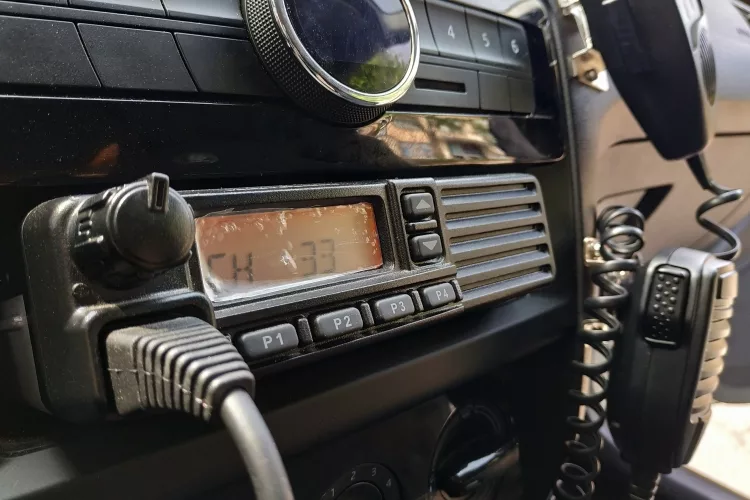
- Mobile/vehicle-mount scanners — designed to be permanently installed in a car or truck, often with a dedicated antenna mount
- Desktop base station scanners — stationary units with superior antenna capability for home or office monitoring
Each type receives the same radio frequencies; the primary differences are portability, antenna performance, and how they are powered. For vehicle use, both handheld and mobile-mount scanners are common.
Scanner vs. Other Receiving Devices
It is also worth noting that smartphone apps such as Broadcastify stream police audio over the internet rather than receiving RF signals directly. These apps occupy a legal gray area distinct from traditional scanner hardware, as they are technically internet radio streams rather than radio receivers. Physical scanners receive over-the-air transmissions, and that distinction matters for how laws apply to them.
Is It Illegal to Have a Police Scanner in Your Car? Federal Law Explained
At the federal level, it is not illegal to have a police scanner in your car. The United States has a long tradition of protecting the public's right to access radio transmissions broadcast over public airwaves, and that tradition is codified in law. However, federal law does draw a clear line at certain types of communications.
The Electronic Communications Privacy Act
The Electronic Communications Privacy Act of 1986 (ECPA) is the primary federal statute governing the interception of electronic communications. Under the ECPA, it is legal to listen to radio communications that are:
- Transmitted on frequencies allocated to public safety services
- Intended for general public reception
- Not scrambled or encrypted in a manner that makes interception unlawful
Police radio frequencies in most jurisdictions are unencrypted public safety communications, which means passive listening is permitted under federal law. The ECPA does prohibit intercepting encrypted communications or using intercepted content for criminal gain, but simply monitoring an open police channel while driving is not a federal offense.
The Communications Act of 1934, as amended, also protects the right to receive radio transmissions. Historically, Congress has been reluctant to restrict public access to over-the-air broadcasts on public safety channels, viewing transparency as a democratic value.
State Laws on Police Scanners in Vehicles
While federal law permits scanner ownership, individual states have the authority to impose their own restrictions — and several have done exactly that. The critical distinction most state laws make is between possessing a scanner generally and possessing one in a vehicle, particularly while committing or planning to commit a crime. A handful of states go further and restrict in-vehicle scanner possession outright, regardless of intent.
States Where Scanners Are Restricted or Illegal in Vehicles
The states with the most notable scanner restrictions for vehicle owners include:
- New York — Possessing a radio capable of receiving police frequencies in a vehicle while committing a crime is a misdemeanor under New York Penal Law. Context and intent play a major role.
- Florida — Florida Statute § 934.215 makes it illegal to possess a scanner in a vehicle, vessel, or aircraft if the person is also in possession of a firearm or controlled substance, or if the scanner is being used to facilitate a crime.
- Minnesota — Minnesota law restricts the use of mobile scanners in ways that could assist criminal activity. Law enforcement has broader authority to question scanner possession during stops involving suspected criminal activity.
- Indiana — Indiana Code § 35-44.1-2-9 restricts the possession of a police scanner in a vehicle under certain criminal circumstances.
- Kentucky — Kentucky Revised Statutes include provisions that can make in-vehicle scanner possession evidence of criminal intent under specific circumstances.
- New Jersey — New Jersey has historically had more restrictive scanner laws, though amateur radio licensees and certain professionals are exempt.
Quick-Reference State Law Table
| State | In-Vehicle Possession | Key Restriction | Professional Exemption |
|---|---|---|---|
| Alabama | Legal | None specific | N/A |
| California | Legal | Cannot use to facilitate a crime | Yes — licensed professionals |
| Florida | Restricted | Illegal when combined with firearm or controlled substance | Yes — law enforcement, licensed dealers |
| Indiana | Restricted | Illegal in vehicle when committing a crime | Yes — licensed professionals |
| Kentucky | Restricted | Can constitute evidence of criminal intent | Yes — emergency personnel |
| Michigan | Legal | Cannot use to intercept encrypted communications | N/A |
| Minnesota | Restricted | Cannot use to facilitate criminal activity | Yes — licensed professionals |
| New Jersey | Restricted | Stricter ownership rules; exemptions available | Yes — amateur radio licensees |
| New York | Restricted | Illegal in vehicle during commission of a crime | Yes — licensed security, media |
| Texas | Legal | None specific | N/A |
| Ohio | Legal | Cannot use to facilitate crime | N/A |
| Washington | Legal | None specific | N/A |
Note: Laws change. Always verify current statutes in your state before purchasing or traveling with a scanner. The table above reflects general provisions and is not legal advice.
When Does Carrying a Scanner Cross the Line?
Even in states where scanner possession is broadly legal, there are clear circumstances in which having one in your car can lead to criminal charges. Understanding these scenarios is essential for any responsible scanner owner.
Intent and Criminal Activity
The most common legal trigger across nearly every state is intent to facilitate a crime. If law enforcement can demonstrate that you were using a police scanner to monitor police activity in order to evade detection while committing a crime — drug trafficking, burglary, or any other offense — the scanner itself becomes evidence of criminal conspiracy. Prosecutors have used scanner possession as an aggravating factor in cases involving:
- Drug distribution operations where suspects monitored patrol activity
- Residential burglary rings that used scanners to avoid police response
- Vehicle theft operations coordinated around police dispatch patterns
In these contexts, the scanner does not need to be the primary offense — it amplifies the charges associated with the underlying crime. This is why even in scanner-friendly states, knowingly carrying one while engaged in illegal activity is an extremely poor decision.
Professional Exceptions
Most states with scanner restrictions carve out explicit exemptions for:
- Licensed amateur (ham) radio operators — frequently exempt due to their regulatory framework under the FCC
- Credentialed journalists and news media — many states recognize press freedom interests in scanner access
- Security professionals and private investigators — often require a state-issued license to qualify for exemption
- Emergency management volunteers — CERT members and disaster response volunteers in many jurisdictions
If you fall into one of these categories, keep your credentials accessible when traveling with a scanner, especially across state lines.
How to Choose a Legal Police Scanner
For most buyers in scanner-permissive states, the question quickly shifts from legality to capability. Modern scanners are sophisticated digital devices, and choosing the right one involves understanding the radio systems used by your local emergency services.
Features to Look For
When evaluating a police scanner for vehicle use, the following specifications matter most:
- Digital decoding (P25, DMR, NXDN) — Most major metropolitan police departments have migrated to digital trunked systems. A scanner that only receives analog signals will miss the majority of modern law enforcement transmissions. P25 Phase I and Phase II decoding covers the vast majority of U.S. public safety systems.
- Trunking support — Trunked radio systems dynamically assign channels from a shared pool. Without trunking capability, a scanner will catch only fragments of transmissions. Look for scanners that support Motorola, EDACS, and LTR trunked systems at minimum.
- Frequency coverage — Public safety communications span VHF (136–174 MHz), UHF (380–512 MHz), and 700/800 MHz bands. A scanner covering all these ranges future-proofs your purchase as agencies migrate between spectrum allocations.
- GPS integration — Some advanced scanners incorporate GPS to automatically load local talkgroups as you travel, eliminating the need to manually reprogram the unit when crossing county lines.
- Database connectivity — Services like RadioReference.com maintain up-to-date trunked system databases that can be uploaded directly to compatible scanners, saving hours of manual programming.
Just as you would compare specifications when researching the best tablets with HDMI output for connectivity and display flexibility, evaluating a scanner's feature set against your specific monitoring goals will save you from buyer's remorse on a device you will use for years.
Tips for Responsible Police Scanner Use
Owning a police scanner is a responsibility as much as a hobby. The radio communications you receive represent real emergencies involving real people. Responsible scanner culture has existed for decades alongside professional public safety communities, and maintaining that positive relationship requires some basic discipline.
- Know your state law before you drive. If you are planning a road trip across multiple states, check the scanner laws for each state on your route. What is legal in Ohio may be restricted in New Jersey. Ignorance of state law is not a defense.
- Never share sensitive operational information. If you monitor a police operation in progress, do not post the details to social media in real time. Doing so can endanger officers and compromise ongoing investigations, and in some jurisdictions it can constitute obstruction.
- Do not use a scanner while committing a crime. This seems obvious, but it bears repeating: scanner possession combined with criminal activity transforms a legal hobby into additional criminal exposure in virtually every U.S. jurisdiction.
- Respect encrypted channels. If your local police have moved to encrypted communications, do not attempt to decrypt them. Decryption of lawfully encrypted transmissions is prohibited under the ECPA regardless of state law.
- Keep software and databases current. Trunked radio systems update their configurations regularly. An outdated database means you may miss active channels or unknowingly scan decommissioned frequencies. Regular updates are part of responsible scanner ownership.
- Consider your context. Monitoring a scanner at home during a severe weather event is very different from driving with one conspicuously mounted on your dash in a high-crime area. Context affects how law enforcement perceives scanner possession during routine stops, even where it is technically legal.
Just as maintaining a properly managed scanner application in software requires diligence to avoid resource leaks and system issues, maintaining a police scanner properly — both legally and technically — requires ongoing attention to ensure it continues to serve you well without creating problems.
Police scanners remain one of the most compelling and genuinely useful pieces of radio technology available to civilians. Whether you are a weather spotter, a news hobbyist, a trucker monitoring road conditions, or simply someone who wants to stay aware of local emergencies, understanding the legal landscape ensures that your interest in public safety radio stays a hobby — not a liability.
Frequently Asked Questions
Is it illegal to have a police scanner in your car in the United States?
At the federal level, it is not illegal to have a police scanner in your car. Federal law permits passive listening to public safety radio frequencies. However, several states — including Florida, New York, Minnesota, Indiana, Kentucky, and New Jersey — have their own restrictions, particularly when a scanner is possessed in a vehicle in connection with criminal activity. Always check the specific laws of your state before traveling with a scanner.
Which states make it illegal to have a police scanner in your car?
No state makes scanner possession completely illegal for all residents, but several states — most notably Florida, New York, New Jersey, Minnesota, Indiana, and Kentucky — have laws restricting scanner possession in vehicles under specific circumstances, such as when the owner is also in possession of a weapon, controlled substance, or is engaged in criminal activity. Exemptions often exist for licensed professionals, amateur radio operators, and credentialed journalists.
Can police confiscate my scanner during a traffic stop?
Police can confiscate a scanner if they have probable cause to believe it is being used in furtherance of a crime or if you are in a state where in-vehicle possession is restricted under the circumstances of your stop. In states where scanner possession is fully legal and no criminal activity is suspected, officers generally do not have grounds to seize the device. Keeping your scanner legally registered and understanding your state's laws reduces this risk significantly.
Do I need a license to own or operate a police scanner?
No FCC license is required to own or operate a police scanner in the United States, as scanners are receive-only devices and do not transmit. Amateur radio licenses are irrelevant to scanner ownership, though holding one can provide a legal exemption in states that restrict scanner possession in vehicles. No special permit is needed at the federal level for passive listening to unencrypted public safety frequencies.
Is it legal to listen to encrypted police radio channels with a scanner?
No. The Electronic Communications Privacy Act (ECPA) of 1986 prohibits the intentional interception of encrypted radio communications. If your local law enforcement has migrated to an encrypted digital system, attempting to decrypt those transmissions is a federal violation regardless of which state you live in. Modern scanners can receive and display encrypted channels but cannot decode their audio content, which keeps passive scanner users on the right side of the law.
Can I use a police scanner app on my phone instead of a hardware scanner?
Yes, apps like Broadcastify stream police audio feeds over the internet and are legal to use in all U.S. states. However, they are technically internet radio streams rather than direct radio receivers, so they have slightly different legal treatment than hardware scanners. The audio quality, latency, and channel availability depend on volunteer-operated feed providers and internet connectivity, making dedicated hardware scanners more reliable in the field. Hardware scanners also work in areas with no cell coverage, which is critical for storm chasing or rural emergency monitoring.
 |
 |
 |
 |

About Rachel Chen
Rachel Chen writes about scanners, laminators, and home office productivity gear. She started her career as an office manager at a midsize law firm, where she was responsible for purchasing and maintaining all of the document handling equipment for a 60-person staff. That experience sparked a deep interest in archival workflows, paperless office setups, and document preservation. Rachel later earned a bachelor degree in information science from Rutgers University and now writes full time. She is a strong advocate for ADF reliability over raw resolution numbers and has tested every major flatbed and document scanner sold in the United States since 2018.