 ee
eeBest Projector Screen 2026
The Elite Screens Yard Master 2 earns the top spot in 2026 — its snap-together aluminum frame, CineWhite UHD-B material, and tool-free assembly make it the most versatile outdoor screen you can buy for under $300. Choosing the right projector screen matters as much as choosing the right projector, because even the best beam of light will look muddy on a surface that wasn't designed to handle it. Screen material, gain rating, ambient light rejection, and mounting style all interact with your room's lighting conditions and your projector's throw distance to produce the final image you actually watch.
In 2026, the projector screen market has matured into distinct segments that serve genuinely different use cases: portable outdoor screens for backyard movie nights, fixed-frame ALR screens for dedicated home theaters with UST laser projectors, and motorized electric screens for living rooms and conference spaces where you need clean retractable solutions. If you're also researching the projector itself, our guides on Best Laser Projectors 2026 and Best DLP Projectors 2026 pair directly with the screens reviewed here. Understanding gain, aspect ratio, and ambient light rejection before you buy will save you from an expensive mismatch between your screen and projector.
According to Wikipedia's overview of projection screen technology, screen gain is defined as the ratio of screen brightness relative to a standard Lambertian surface — and this single number explains why a 0.6-gain ALR screen can still produce a punchier image in a bright room than a 1.3-gain matte white screen. The seven screens reviewed below cover every major use case and price tier, from a $40 foldable fabric sheet to a $1,200+ motorized tension floor-riser built specifically for ultra-short-throw laser projectors.

Contents
- Best Choices for 2026
- Detailed Product Reviews
- Elite Screens Yard Master 2 100" — Best Overall Outdoor
- Elite Screens Aeon CLR3 123" — Best UST ALR Fixed Frame
- Elite Screens Saker Tab-Tension AcousticPro 150" — Best for Large Home Theater
- VIVIDSTORM S PRO 100" — Best Floor-Rising UST Screen
- Elite Screens Yard Master Plus 120" — Best Adjustable Outdoor
- Mdbebbron 120" Foldable — Best Budget Portable
- Akia Screens 125" Motorized — Best Electric Drop-Down
- Buying Guide
- Frequently Asked Questions
Best Choices for 2026
- #PreviewProductRating
- Bestseller No. 1
 Rating:

- Bestseller No. 2
 Rating:
- Bestseller No. 3
 Rating:
 - Bestseller No. 4
 Rating:
 - Bestseller No. 5
 Rating:
 - Bestseller No. 6
 Rating:
 - Bestseller No. 7
 Rating:
Detailed Product Reviews
1. Elite Screens Yard Master 2, 100-Inch — Best Overall Outdoor Portable Screen
The Elite Screens Yard Master 2 remains the definitive outdoor projector screen in 2026, and it's easy to understand why: the snap-on aluminum frame goes up in minutes without a single tool, and the CineWhite UHD-B tensioned matte white material holds a perfectly flat surface once assembled. At 100 inches diagonal with a 16:9 aspect ratio, you get a 48.8" × 87.0" viewing area that fills the backyard or living room with detail that's sharp from corner to corner. The 1.3 gain pushes reflected brightness noticeably above neutral, which is useful in environments with ambient light sneaking in from porch fixtures or street lamps.
The fully black-backed fabric blocks light bleed from behind the screen, so colors stay saturated rather than washing out into grays. ISF certification means the color accuracy meets professional calibration standards, which matters if you're pairing this with a quality 4K projector. The padded carrying bag and lightweight square-tube aluminum construction make transport genuinely practical — you can move this to a neighbor's yard, a rooftop, or a camping site without needing a pickup truck or a second person to manage the load.
Compatibility with short-throw and ultra-short-throw projectors extends the screen's usefulness beyond standard long-throw setups, giving you flexibility if you decide to upgrade your projector later. Cleaning is as simple as mild soap and water applied with a soft cloth, and the sealed edge design with snap-button material attachment prevents the fabric from developing sag or wrinkle over time. At this price point and capability level, no other outdoor screen gets close.
Pros:
- Tool-free snap-on assembly completes in minutes
- 1.3 gain CineWhite UHD-B material delivers bright, calibration-accurate color
- 180° viewing angle keeps the image consistent across wide seating arrangements
- Padded carry bag makes transport between venues easy
- Compatible with short-throw and ultra-short-throw projectors
Cons:
- Freestanding design requires level ground for stable placement
- 100 inches may feel small for larger outdoor spaces with 20+ viewers
2. Elite Screens Aeon CLR3 123" UST ALR — Best Fixed-Frame Screen for UST Projectors
If you own or plan to buy an ultra-short-throw laser projector, the Elite Screens Aeon CLR3 is the screen you pair it with — full stop. The CLR3 (Ceiling Light Rejecting, third generation) optical stack uses an advanced layered filter structure that rejects up to 90% of overhead ambient light while reflecting the projected beam directly toward the viewer. The result is up to 75 times better contrast than a standard matte white surface in a bright room, which means you can watch movies with the lights on without the image washing out to an unwatchable gray mess.
At 123 inches diagonal, the 60.2" × 107" viewing area commands a dedicated wall with authority. The edge-free fixed frame eliminates the black border surround that most framed screens use, creating a virtually borderless cinematic rectangle on your wall. The 0.8 gain rating keeps the image from appearing overly hot in the center — a common issue with high-gain ALR screens that create visible hotspots — while the 170° wide viewing angle ensures consistent brightness for seats positioned well off-axis. The grey screen material enhances native contrast and produces deep blacks that stand out sharply against bright highlights, which is the visual signature that separates a great home theater from a merely adequate one.
The Aeon CLR3 is strictly designed for UST projectors mounted on a table or low stand directly in front of and below the screen — it will not work correctly with ceiling-mounted or standard long-throw projectors, and Elite Screens is explicit about this limitation. Within that constraint, this is the most capable ambient-light-rejecting fixed-frame screen available at this screen size without crossing into custom-install territory. Pair it with one of the top picks from our Best Motorized Projector Screens guide if you need a retractable version of similar ALR performance.
Pros:
- Rejects up to 90% of ceiling ambient light — genuinely usable with overhead lights on
- 75× contrast improvement versus standard matte white in bright rooms
- Edge-free frame creates a cinematic borderless look on the wall
- Supports 4K/8K Ultra HD and Active 3D content
- 0.8 gain eliminates hotspotting that plagues higher-gain ALR screens
Cons:
- Exclusively compatible with UST tabletop or bottom-mounted projectors — not ceiling mounts
- Fixed-frame format means no retraction — screen is always visible on the wall
3. Elite Screens Saker Tab-Tension AcousticPro UHD 150" — Best for Dedicated Large Home Theaters
The Elite Screens Saker Tab-Tension AcousticPro UHD answers the question that dedicated home theater builders eventually ask: where do the speakers go? With this 150-inch electric drop-down screen, the answer is directly behind the screen surface itself. The AcousticPro UHD material is a dense synthetic weave designed to be acoustically transparent — sound passes through the screen to reach your ears from center-channel and left/right speakers mounted behind it, just as commercial cinema theaters are configured. The mean attenuation is only -2.36dB, which means your speakers lose virtually nothing acoustically while the screen maintains a moire-free 1.0 gain image surface for 4K and 8K content.
Tab-tension technology pulls the fabric taut from both side channels simultaneously as the screen extends downward, keeping the surface perfectly flat without any waviness or edge curl that plagues non-tensioned electric screens. The black aluminum housing measures 150.4" wide and just 4.0" deep, so it sits flush against the ceiling without dominating the room when retracted. The 12-inch drop extension brings the visible screen area to 73.5" × 130.7" — more than enough surface for a reference-quality 4K image at proper theater viewing distances.
Control flexibility is comprehensive: an infrared remote, a radio frequency remote that works through walls, a three-way wall switch, and a wireless 5–12 volt trigger for automation system integration all come in the box. The built-in RJ45 port enables IP control through a Crestron, Control4, or Savant system, and the wall and ceiling mounting brackets allow sliding adjustment so you can align the case exactly between studs. At 150 inches, this is the largest screen in this roundup, and it justifies every inch with build quality and feature depth that rivals screens costing significantly more.
Pros:
- Acoustically transparent AcousticPro UHD material lets speakers mount directly behind the screen
- Tab-tension mechanism keeps 150-inch fabric surface perfectly flat during and after deployment
- Comprehensive control: IR remote, RF remote, wall switch, 5–12V trigger, and RJ45 IP control
- Black aluminum housing sits flush with the ceiling at just 4.0" deep
- 1.0 gain with 180° viewing angle — accurate brightness across all seating positions
Cons:
- Professional installation strongly recommended due to size and wiring complexity
- Premium price point places this firmly in dedicated home theater budgets
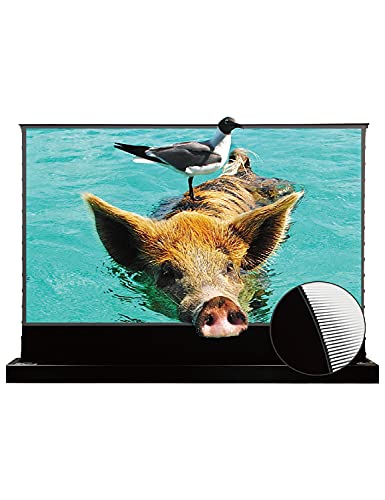
4. VIVIDSTORM S PRO Motorized Tension Floor Rising 100" — Best Floor-Rising Screen for UST Laser Projectors
The VIVIDSTORM S PRO solves a specific problem with uncommon elegance: you have an ultra-short-throw laser projector sitting on a low console or TV stand, and you want a screen that rises from the floor directly in front of it rather than dropping from the ceiling. The motorized tension floor-rising mechanism stores the ALR screen material in a black housing at the base, and the screen rises vertically in a tensioned, perfectly flat panel when activated — no ceiling attachment, no wall mounting, no separate installation whatsoever. This makes it the cleanest integration for the increasingly popular living-room UST setup where a projector replaces a television entirely.
The screen material uses a sawtooth optical structure with a light-rejecting filter layered into the surface. This engineering specifically targets ceiling ambient light — the angular cuts in the material reflect the projector's upward beam toward the viewer while the filter blocks downward ambient light from washing out the image. The result is 97% ALR resistance with a 0.6 gain specification that prevents the hotspotting you'd see with higher-gain materials, all within a 170° viewing angle that covers wide living-room seating. 8K/4K Ultra HD and Active 3D support are standard, and the 110V power system means you plug it into any standard wall outlet.
The trade-off is weight — at 61.73 lbs, the VIVIDSTORM S PRO is not a screen you reposition casually, and the floor-rise format means it must stay permanently placed in front of your projector position. It is also strictly incompatible with any projector that is ceiling-mounted or suspended — the optical geometry of the ALR material works only when the light source comes from below the screen's horizontal midpoint. Within those constraints, the visual performance in a bright living room is genuinely impressive, delivering contrast and color saturation that no standard matte white screen at any price can match in ambient light.
Pros:
- Floor-rising mechanism requires no ceiling or wall mounting — clean self-contained installation
- 97% ALR resistance with sawtooth optical structure designed specifically for UST projectors
- 0.6 gain prevents center hotspotting while maintaining vibrant color saturation
- Supports 8K/4K and Active 3D — future-proof for next-generation UST projectors
- Tensioned surface remains flat throughout the full image area
Cons:
- 61.73 lbs — repositioning this screen after initial placement is a two-person job
- Strictly incompatible with ceiling-mounted or suspended projectors
5. Elite Screens Yard Master Plus, 120-Inch — Best Adjustable-Height Outdoor Screen
The Elite Screens Yard Master Plus steps up from the Yard Master 2 in one critical way: adjustable height. The collapsible frame with detachable T-legs allows you to set the bottom of the screen anywhere from 74 inches above ground to 127.2 inches, which means you can precisely dial in the vertical position to clear a crowd of standing viewers or match the projector's throw angle when setup conditions vary. At 120 inches diagonal, the 59.0" × 104.7" viewing area is noticeably larger than the 100-inch version, making it the right choice for larger outdoor gatherings where rows of seating stretch further back.
The screen material is the same CineWhite UHD-B used in the Yard Master 2 — 1.3 gain, 180° viewing angle, fully black-backed, and rated for 4K Ultra HD and Active 3D projection with both standard and short-throw projectors. The sealed edge and snap-button material attachment system keeps the fabric taut across the frame without any tools, and the lightweight aluminum construction means one person can manage setup without assistance. Elite Screens backs this specific model with a two-year US-based warranty, which provides meaningful peace of mind for a screen that lives outdoors through variable weather conditions.
The optional Drape Kit (sold separately, model ZOMS2PL-DK) covers the space beneath the screen to the ground, giving outdoor screenings a more finished theatrical appearance and blocking light bleed from projectors positioned close to the screen. If you host regular outdoor movie nights and need a screen that adapts to changing venue configurations from event to event, the Yard Master Plus delivers the Yard Master 2's proven performance at a slightly larger scale with the added practical benefit of height adjustability that the base model simply doesn't offer.
Pros:
- Adjustable height from 74" to 127.2" accommodates standing crowds and varying throw angles
- Same CineWhite UHD-B material as the Yard Master 2 — no image quality compromise
- 120-inch size adds meaningful screen real estate for larger gatherings
- Two-year US-based warranty covers outdoor use conditions
- Optional Drape Kit available for a finished theatrical look
Cons:
- Slightly heavier and bulkier than the 100-inch Yard Master 2 for transport
- Drape Kit is a separate purchase — not included at retail
6. Mdbebbron 120-Inch Foldable Portable Screen — Best Budget Option
If your budget is tight and your requirements are basic — an occasional backyard movie or a portable screen for classroom presentations — the Mdbebbron 120-inch foldable screen delivers a functional large-format surface at a fraction of the cost of framed alternatives. The polyester fabric is thicker than typical budget screens, reducing wrinkle visibility after unfolding, and the anti-crease treatment in the material helps the surface recover its flatness faster than plain fabric alternatives when you take it out of a bag. The 16:9 aspect ratio and 120-inch diagonal match the most common content and projector configurations you'll encounter in everyday use.
The real selling point is portability taken to its logical extreme: this screen folds down small enough to fit in a backpack alongside your projector, making it genuinely practical for locations where you can't predict what mounting surfaces or floor space will be available. It supports front projection from one side and back projection from the opposite side, which doubles the mounting configuration options in unusual venues — you can hang it from a rope, clip it to a stand, or tape it to a wall and project through it from behind a translucent partition. The Mdbebbron won't match the tensioned flatness or gain performance of a framed screen, but for casual use where convenience outweighs critical image accuracy, it's difficult to argue with the value proposition.
You will notice wrinkles from folding creases on the first few uses, and the center tension won't match what a snap-frame or tab-tensioned electric screen delivers. Accept those limitations upfront and you'll find the Mdbebbron handles its role as a grab-and-go portable screen with surprising competence for the price. Ideal for users who want a screen they can lend to friends, bring to a rental property, or pack in a suitcase for travel presentations without fear of damaging something expensive.
Pros:
- Folds small enough for a backpack — the most portable screen in this roundup
- Supports both front and rear projection configurations
- Anti-crease polyester fabric reduces post-fold wrinkle visibility
- Extremely affordable — the clear budget choice at 120 inches
- Suitable for classroom, office, and outdoor casual use
Cons:
- No frame means no tension — surface flatness is noticeably inferior to framed screens
- Creases from folding remain visible for first several uses
7. Akia Screens 125-Inch Motorized Projector Screen — Best Electric Drop-Down for Home and Office
The Akia Screens 125-inch motorized screen occupies the sweet spot between the entry-level pull-down manual screens and the premium tab-tensioned electric options: it delivers clean motorized drop-down operation at a price point accessible to home theater enthusiasts who want electric convenience without committing to a professional installation budget. The 125-inch diagonal provides a 61.3" × 109" viewing area that comfortably fills a dedicated media room or large living-room wall, and the durable black metal housing measures 73.5" × 118" overall — clean dimensions that don't overpower the ceiling when retracted.
The MaxWhite 2 multi-layer front projection material is ISF certified for accurate color reproduction, which means it meets the same calibration benchmark that professional AV installers reference when aligning high-end projection systems. The 1.1 gain sits just above neutral, providing a modest brightness boost without narrowing the viewing cone — the 180° specification keeps image quality consistent for viewers seated at steep off-axis angles. The black-backed design prevents any light from the room behind the screen from washing through the material and degrading the image, which is particularly important in rooms where the screen backs up to a lighted hallway or poorly blacked-out window.
The tubular motor operates smoothly and quickly, and the programmable vertical drop setting on the detachable wall controller lets you stop the screen at a precise height above the floor rather than running to full extension every time. The infrared remote is included for standard use, and the programmable drop position means you can align the bottom edge of the screen with your projector's native throw angle without shimming the projector mount. For anyone looking for a reliable, well-specified motorized screen at a mainstream price, the Akia Screens 125-inch competes directly with options at significantly higher price points. See our dedicated guide on Best Motorized Projector Screens for a deeper field comparison if motorized operation is your primary requirement.
Pros:
- ISF-certified MaxWhite 2 material delivers accurate color reproduction for calibrated setups
- Programmable vertical drop position stops the screen at any custom height
- 1.1 gain with 180° viewing angle — bright image without compromising off-axis quality
- Tubular motor provides fast, quiet, and reliable operation
- Black metal housing maintains a clean aesthetic when the screen is retracted
Cons:
- Non-tensioned fabric may show minor waves in the lower third at full extension
- Recommended for standard long-throw projectors — not optimized for UST setups
Buying Guide: How to Choose the Best Projector Screen in 2026
Screen Material and Gain: The Foundation of Image Quality
Screen gain is the single most misunderstood specification in projector screens, and getting it wrong causes more buyer's remorse than any other factor. Gain measures how much light the screen reflects relative to a reference white surface — a 1.0-gain screen reflects light uniformly in all directions, while a 1.3-gain screen concentrates more light toward center seating at the expense of off-axis brightness. Higher gain is not automatically better: in rooms with wide seating arrangements, a 1.3-gain screen will produce noticeably different brightness levels for viewers sitting at the sides versus the center, while a 1.0-gain surface maintains consistent output across all positions.
- 0.6–0.8 gain (ALR screens): Best for bright rooms with a UST projector — maximum ambient light rejection
- 1.0–1.1 gain (neutral white): Best for dark or controlled rooms with any standard projector throw type
- 1.3 gain (CineWhite): Best for outdoor use or larger rooms where center-seat brightness is the priority
Ambient light rejecting (ALR) materials are specifically engineered optical surfaces — not simply grey fabric — that use either a micro-lenticular or sawtooth structure to filter incoming light by angle, rejecting overhead ambient sources while reflecting the projected beam from below. Standard matte white materials cannot replicate this performance in a lit room regardless of gain specification, so if your viewing environment has unavoidable ceiling light, ALR is a necessary investment rather than a luxury upgrade.
Throw Type Compatibility: Match Your Projector First
Before you choose a screen, confirm your projector's throw ratio — this determines which screens are physically compatible with your setup. Throw ratio is the distance between the projector lens and the screen divided by the screen width, and it falls into three main categories that drive very different screen requirements.
- Standard (long) throw (1.4:1 to 2.0:1): Works with any screen type — matte white, grey, or ALR framed and motorized screens
- Short throw (0.4:1 to 1.4:1): Works with most screen types including the Elite Screens Yard Master 2 and Yard Master Plus
- Ultra-short throw (UST, below 0.4:1): Requires a screen specifically engineered for UST projection — the Aeon CLR3 and VIVIDSTORM S PRO are the right choices here, and using a standard matte white surface with a UST projector produces significant hotspotting and washout
This compatibility issue is responsible for a large fraction of negative projector screen reviews online — users pair a UST projector with a standard matte white screen and blame the screen for image quality problems that are actually an engineering mismatch. Confirm your projector's throw type before purchase and use that as your primary filter.
Mounting Format: Portable, Fixed Frame, or Motorized
The three main mounting formats serve fundamentally different lifestyle needs, and each has trade-offs that are independent of price level.
- Portable freestanding or foldable: Maximum flexibility for multi-location use — backyard, classroom, travel. Trade-off is setup time and surface flatness. The Elite Screens Yard Master 2 and Yard Master Plus represent the premium tier here; the Mdbebbron covers the budget tier.
- Fixed frame: Permanently mounted to the wall, permanently tensioned flat. Best image quality for its material type since tension never changes and the frame is rigid. The Aeon CLR3 is the standout fixed-frame option in this roundup.
- Motorized electric: Retracts when not in use, preserving the room's visual cleanliness for daylight living. The Saker Tab-Tension AcousticPro and Akia Screens 125-inch represent opposite ends of the motorized price spectrum with genuinely different performance characteristics.
Screen Size and Viewing Distance
The relationship between screen size and viewing distance is where many buyers make preventable mistakes by purchasing a larger screen than their room geometry supports comfortably. The general rule for 4K content is that the ideal viewing distance is 1 to 1.5 times the screen's diagonal measurement, which means a 100-inch screen works best at 8–12 feet of viewing distance, and a 150-inch screen requires 12–18 feet for a comfortable experience without visible pixel structure.
- Under 10 feet viewing distance: 80–100-inch screens
- 10–15 feet viewing distance: 100–120-inch screens
- 15–20 feet viewing distance: 120–150-inch screens
- 20+ feet viewing distance: 150 inches and above
Outdoor spaces regularly break this rule in the other direction — viewers spread across larger distances benefit from a larger screen, and ambient light concerns typically outweigh pixel density at those distances. In dedicated indoor home theaters, erring toward the lower end of the size range for your viewing distance produces a sharper, more immersive experience than an oversized screen that dominates peripheral vision uncomfortably.
Frequently Asked Questions
What is the difference between ALR and standard matte white projector screens?
Ambient light rejecting (ALR) screens use a structured optical surface — either micro-lenticular layers or a sawtooth filter — that selectively reflects projected light toward the viewer while blocking overhead and ambient room light. Standard matte white screens reflect light uniformly in all directions regardless of its source, so any room light hitting the surface washes directly into your eyes as visible brightness on the image. In a dark room, both materials produce excellent images; in a lit room, ALR produces dramatically better contrast — up to 75 times better by Elite Screens' own testing with the Aeon CLR3 versus a matte white surface under identical lighting.
Can I use a UST projector with a regular matte white screen?
Technically yes, but the results are poor enough that you should treat UST projectors as requiring a UST-compatible ALR screen. The geometry of ultra-short-throw optics sends light at a steep upward angle from a position very close to the screen — a standard matte white surface reflects this angled beam unevenly, creating a severe brightness hotspot at the bottom of the image and dim output at the top. UST-specific screens like the Elite Screens Aeon CLR3 and VIVIDSTORM S PRO are engineered to receive light from that steep low angle and redirect it uniformly toward the viewer, which is why they are exclusively compatible with UST projectors and incompatible with ceiling-mounted standard-throw units.
How important is screen gain, and what gain should I choose in 2026?
Gain determines both how bright your image appears and how evenly that brightness distributes across different seating positions. For dark or controlled rooms with a standard long-throw projector, a 1.0 to 1.1 gain neutral white surface is the most versatile choice — it maintains consistent brightness across wide seating areas without any off-axis fall-off. For outdoor use where maximizing visible brightness matters, a 1.3-gain CineWhite material like that used in the Elite Screens Yard Master series boosts center-seat luminance meaningfully. For bright rooms with a UST projector, gain is secondary to the ALR specification — a 0.6 to 0.8 gain ALR screen will outperform a 1.3-gain matte white screen in contrast and color accuracy under ambient light conditions by a significant margin.
What screen size do I need for a 4K projector?
The ideal screen size for 4K content depends on your viewing distance more than anything else. At 4K resolution, the recommended viewing distance is 1 to 1.5 times the screen's diagonal, which means a 100-inch screen works best at 8–12 feet, a 120-inch screen at 10–15 feet, and a 150-inch screen at 12–18 feet. Within those distances, 4K content from a quality projector will appear sharp and detailed without visible pixel structure. Going significantly larger than your distance supports causes the image to look softer than it should — not because the projector lacks resolution, but because your eyes' angular resolving capability can detect individual pixels at close distances on an oversized panel.
Are motorized projector screens worth the extra cost over fixed-frame screens?
Motorized screens are worth the premium specifically when you use your projection space for non-movie purposes during the day — if your home theater is also your living room, a motorized screen retracts out of sight and restores the room to its standard function, while a fixed-frame screen permanently dominates the wall. In a dedicated light-controlled home theater that you use exclusively for watching content, a fixed-frame screen delivers better image quality for the money because the material remains permanently tensioned flat and the frame itself prevents edge curl and fabric movement that even good motorized systems occasionally exhibit. For a mixed-use space, motorized is the practical choice; for a dedicated theater room, fixed-frame is the performance choice.
What is tab-tension in electric projector screens and why does it matter?
Tab-tension refers to a tensioning system built into motorized screens where thin cords run along both side edges of the fabric and pull the material taut laterally as the screen descends. Without tab-tension, the fabric in a large motorized screen tends to develop subtle waves, ripples, or a slight bow in the center after extended use — these distortions are visible as image distortion and uneven focus across the screen surface. Tab-tension eliminates these deformities by maintaining constant lateral pull across the full height of the extended screen, keeping the projection surface as flat as a fixed-frame screen. At 150 inches, tab-tension is not optional — it's what separates reference-quality motorized screens like the Elite Screens Saker from budget electric screens that develop visible wave patterns within months of installation.
Buy on Walmart
- Elite Screens Yard Master 2, 100-INCH Outdoor Indoor Project — Walmart Link
- Elite Screens Aeon CLR3 123" UST ALR Projector Screen, 16:9 — Walmart Link
- Elite Screens Saker Tab-Tension AcousticPro UHD Series, 150- — Walmart Link
- VIVIDSTORM S PRO Motorized Tension Floor Rising Projector Sc — Walmart Link
- Elite Screens Yard Master Plus, 120-INCH 16:9 Height Setting — Walmart Link
- Mdbebbron 120 inch Projector Screen 16:9 Foldable Anti-Creas — Walmart Link
- Akia Screens 125-Inch Motorized Projector Screen, 16:9, Elec — Walmart Link
Buy on eBay
- Elite Screens Yard Master 2, 100-INCH Outdoor Indoor Project — eBay Link
- Elite Screens Aeon CLR3 123" UST ALR Projector Screen, 16:9 — eBay Link
- Elite Screens Saker Tab-Tension AcousticPro UHD Series, 150- — eBay Link
- VIVIDSTORM S PRO Motorized Tension Floor Rising Projector Sc — eBay Link
- Elite Screens Yard Master Plus, 120-INCH 16:9 Height Setting — eBay Link
- Mdbebbron 120 inch Projector Screen 16:9 Foldable Anti-Creas — eBay Link
- Akia Screens 125-Inch Motorized Projector Screen, 16:9, Elec — eBay Link
The best projector screen is the one matched precisely to your projector's throw type and your room's lighting conditions — everything else is secondary to getting those two variables right.
 |
 |
 |
 |

About Sarah Whitford
Sarah Whitford is Ceedo's resident projector and home theater expert. She got her start as a custom AV installer for a regional integrator in the Pacific Northwest, where she designed and installed media rooms and conference spaces for residential and small business clients for over six years. Sarah earned her CTS certification from AVIXA and has personally calibrated more than 150 projectors using Datacolor and SpyderX colorimeters. She is opinionated about throw distance math, contrast ratios, and the realities of ambient light, and she will happily explain why most people should not buy a 4K projector. Sarah lives in Portland with her partner and an aging Akita.