 ee
eePrinters ›
Best Cloud-Connected Printers for Google Workspace 2026
Google Workspace now serves over 10 million paying business customers worldwide, yet printer connectivity consistently ranks among the top five IT frustrations for teams of every size, with research suggesting the average knowledge worker burns nearly an hour each week fighting with printers that drop off the network, reject mobile print jobs, or simply refuse to talk to Google Drive without a fresh round of driver updates.
A genuinely cloud-connected printer does more than broadcast a Wi-Fi signal and call it a day. It integrates with Google Drive, Gmail, and Android or iOS devices at the application level, letting you send a job directly from a Docs tab or a mobile screen without installing proprietary desktop software every time your IT environment changes. The best models in 2026 add intelligent dual-band Wi-Fi with automatic connection recovery, so your team never stares at a blinking amber light during the ten minutes before a client call. When choosing a printer for a Google Workspace environment, you also want to think about print speed under load, duplex scanning for uploading documents back into Drive, and a monthly duty cycle that honestly matches the volume your office actually produces, rather than the theoretical maximum the spec sheet advertises.
The seven printers reviewed below represent the strongest options across inkjet, laser, and ink-tank categories for 2026, spanning compact desktop models for small teams all the way to departmental workhorses that can sustain multi-user print queues without complaint. If you're evaluating options beyond the cloud-connectivity angle, our guide to the best printers covers a wider set of use cases to help you narrow your search before you commit. For teams running a mix of Mac and PC hardware, our best all-in-one printers for Mac 2026 guide is also worth a look alongside this one.

Contents
Best Choices for 2026
- #PreviewProductRating
- Bestseller No. 1
 Rating:

- Bestseller No. 2
 Rating:
- Bestseller No. 3
 Rating:
 - Bestseller No. 4
 Rating:
 - Bestseller No. 5
 Rating:
 - Bestseller No. 6
 Rating:
 - Bestseller No. 7
 Rating:
Our Hands-On Reviews
1. HP OfficeJet Pro 9135e — Best for Office Color Documents
The HP OfficeJet Pro 9135e is the printer you reach for when your team's output includes a steady stream of client-facing color documents — think brochures, proposals, and presentation handouts where deep blacks and vivid accent colors genuinely matter for the impression you're making. HP rates it at 25 pages per minute in black and 20 ppm in color, which are competitive figures for a consumer-to-prosumer inkjet, and in daily use those speeds hold up well across mixed print queues that blend text-heavy pages with the occasional graphics-rich chart. The dual 250-sheet input trays give you genuine paper flexibility, so you can load letterhead in one tray and plain stock in the other without constantly swapping out media between jobs.
Wireless reliability is where the 9135e earns its spot on this list for Google Workspace teams specifically. HP's dual-band Wi-Fi implementation includes an automatic self-healing feature that detects a dropped connection and resolves it without requiring you to re-enter credentials or restart the printer from the control panel. The HP Smart app connects directly to Google Drive, Gmail, and Google Photos, letting you pull a file from Drive and send it to the printer in a handful of taps from a phone or tablet. The AI-enabled features built into the 9135e's firmware — part of HP's broader push into smarter device management — also handle minor print quality adjustments automatically, which reduces the frequency of manual calibration runs in high-humidity office environments.
The three-month Instant Ink trial included with purchase is a genuine sweetener if your team's print volume is consistent enough to benefit from a subscription model, and HP's cartridge monitoring works through the same Smart app you'll already use for Google integration. If you later decide Instant Ink isn't the right fit for your workflow, switching back to standard cartridges is straightforward and doesn't lock you out of any printer features. This is a well-rounded machine for offices printing 500 to 1,500 pages per month across a team of up to eight people.
Pros:
- Dual-band Wi-Fi with automatic connection self-healing stays reliably online in busy office networks
- Two 250-sheet trays allow mixed media loading without constant intervention
- HP Smart app integrates directly with Google Drive, Gmail, and Google Photos
- AI-enabled print quality adjustments reduce manual calibration needs over time
Cons:
- Inkjet running costs are higher per page than laser alternatives at similar price points
- Color print speed of 20 ppm lags behind laser models at comparable price brackets
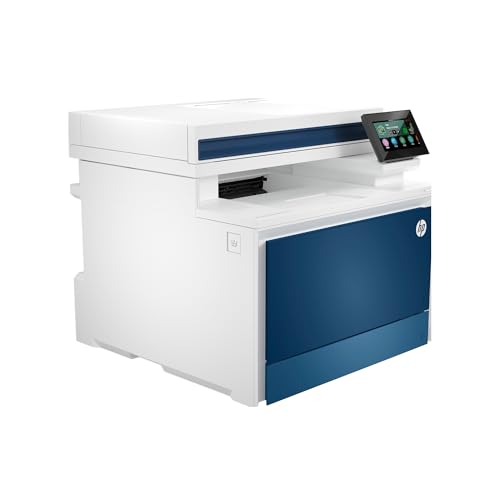
2. HP Color LaserJet Pro MFP 4301fdw — Best for Teams Up to 10 People
When you need a single machine to anchor the printing needs of a small but active team, the HP Color LaserJet Pro MFP 4301fdw delivers the kind of consistent throughput that prevents the printer from becoming a daily bottleneck. HP rates it at 35 color pages per minute, and unlike inkjet ratings that reflect optimal conditions with a specific media type, the LaserJet Pro maintains that speed across plain paper, light cardstock, and mixed document types without a meaningful drop-off. The auto document feeder combined with auto two-sided printing and scanning means your team can push through multi-page contracts, invoices, and scan-to-Drive workflows without babysitting the machine between jobs.
The 4301fdw's intelligent Wi-Fi system continuously monitors signal quality and switches between bands to maintain the strongest available connection, which matters in offices where 2.4 GHz congestion from other devices causes intermittent print failures. HP's integration with Google Workspace goes beyond basic Mopria support — the HP Smart app allows direct printing from Drive and Gmail, and the printer supports HP ePrint for email-based job submission, which is particularly useful when team members are working remotely and need to prepare materials before coming into the office. The full-function MFP configuration adds a flatbed scanner and fax capability, covering the complete range of document workflows that a small office encounters without requiring additional hardware.
The laser engine produces genuinely sharp color output with accurate skin tones and clean text at any point size you're likely to use in business documents, and the toner cartridges offer strong page yields that keep the cost-per-page competitive for a color laser in this class. For teams that print reports, presentations, or color-coded spreadsheets regularly, the 4301fdw offers a meaningful step up in output quality and reliability compared to consumer-grade inkjet alternatives at a similar investment level.
Pros:
- 35 ppm color speed sustains output for teams of up to 10 concurrent users without queuing delays
- Intelligent Wi-Fi automatically finds the strongest available band to stay connected
- Auto two-sided printing and scanning with ADF cover the full range of small office workflows
- Sharp laser color output with consistent quality across mixed document types
Cons:
- Initial purchase price is higher than comparable inkjet all-in-ones
- Color toner replacement cost is a real ongoing expense for teams with heavy color volume
3. Canon Color imageCLASS MF753Cdw II — Best for Speed and Long-Term Reliability
Canon's Color imageCLASS MF753Cdw II brings the same core engine architecture that built Canon's reputation in the enterprise laser market and packages it in a form factor that fits a medium-sized office desk without dominating the workspace. The headline specification is a 35 ppm rate in both color and monochrome, which matches the fastest competing models in this category, but Canon pairs that speed with a first-print time of approximately seven seconds — meaning the printer doesn't leave you watching a warm-up animation after a long idle period. That responsiveness matters more than raw throughput speed in offices where print jobs arrive in short bursts rather than long continuous runs.
The wireless setup process on the MF753Cdw II is notably streamlined, with Canon's setup wizard walking you through connection to your network in just a few steps using either WPS push-button pairing or manual SSID entry. Once connected, the printer supports Canon's PRINT Business app as well as Mopria, Apple AirPrint, and Wi-Fi Direct, giving every device type in a mixed-OS Google Workspace environment a reliable path to submit jobs without additional configuration. The 4-in-1 functionality — print, scan, copy, fax — combined with duplex support on both copy and scan operations makes this a comprehensive document management hub rather than a simple output device.
The three-year limited warranty that Canon includes with the MF753Cdw II is one of the most competitive coverage periods in this product tier and reflects genuine confidence in the machine's build durability. For offices that have been burned by printer failures in the middle of critical deadlines, that warranty is not a trivial differentiator. Canon's imageCLASS line consistently scores well in long-term reliability assessments, and the second-generation designation on this model reflects meaningful component refinements over the original MF753Cdw rather than a purely cosmetic update.
Pros:
- 35 ppm color and monochrome with a 7-second first-print time eliminates frustrating warm-up delays
- Three-year limited warranty provides significantly longer coverage than most competing models
- Broad wireless compatibility covers AirPrint, Mopria, Wi-Fi Direct, and Canon's own PRINT Business app
- Duplex copy and scan operations streamline high-volume document workflows
Cons:
- Canon's color toner cartridges carry a premium price compared to Brother equivalents
- The control panel interface takes longer to learn than HP's touchscreen alternatives
4. Brother MFC-L3780CDW — Best Laser Quality for Budget-Conscious Teams
Brother's MFC-L3780CDW uses LED-based laser technology rather than a conventional laser engine, and the distinction is worth understanding before you buy. LED printing eliminates the rotating laser mirror assembly that can fail in traditional laser printers, replacing it with a fixed array of LEDs that exposes the drum in a single pass with no moving optical components. The practical result is an output that achieves genuine laser sharpness — crisp text edges, clean halftones, and consistent color reproduction across the full run — combined with an internal mechanism that has fewer wear-prone components to worry about over a multi-year ownership period.
Print speed reaches 31 pages per minute, and the single-pass duplex copy and scan capability is a genuine workflow advantage over printers that flip the page and make a second pass to handle the reverse side. That single-pass architecture not only cuts the time required for duplex copy jobs roughly in half, but it also reduces mechanical wear on the paper path by eliminating the additional transport cycle. The scan speeds of 29 images per minute in black and 22 ipm in color are strong enough to support regular scan-to-Google-Drive workflows without creating a queue behind the machine during busy morning periods.
The two-month Brother Refresh subscription trial included at purchase mirrors HP's Instant Ink approach and gives you a direct comparison between subscription and pay-as-you-go toner replacement before committing to either model. Brother's Alexa compatibility adds voice-triggered print commands for teams that have integrated smart speakers into their office workflow, which is a minor convenience that nonetheless signals the kind of broad ecosystem integration that makes cloud-connected printing genuinely practical in 2026. If you're comparing this against other connectivity-focused options, our roundup of the best Bluetooth printers 2026 covers additional wireless connectivity options that might complement your office setup.
Pros:
- LED laser technology reduces mechanical complexity and long-term failure risk
- Single-pass duplex copy and scan significantly cuts multi-page job completion time
- 31 ppm print speed with strong scan throughput supports busy multi-user environments
- Works with Alexa for voice-triggered print commands in smart office setups
Cons:
- Color output saturation can appear slightly muted compared to conventional laser competitors
- Paper capacity is modest at the entry configuration, requiring frequent refills at higher volumes
5. Epson EcoTank Pro ET-5850 — Best for Low Running Costs
The fundamental value proposition of the EcoTank Pro ET-5850 is straightforward: you pay a higher upfront price in exchange for dramatically lower per-page costs over the machine's operational lifetime, because the ink tank system replaces expensive cartridges with large refillable reservoirs that you top off with bottled ink sold at a fraction of the cartridge equivalent cost. Epson's all-pigment ink formulation in the ET-5850 delivers up to 4,800 x 2,400 dpi resolution with print speeds of 25 ppm for both color and black output, and the monthly duty cycle of 66,000 pages positions this as a genuinely high-capacity machine rather than a consumer device stretched to prosumer use.
The connectivity package on the ET-5850 covers every standard office requirement: USB 2.0, Ethernet LAN, USB host, and Wi-Fi, with a 50-sheet auto document feeder to support sustained scan-to-Drive and copy workflows. The Ethernet port is a meaningful advantage over Wi-Fi-only competitors if your office runs a structured wired network, because a wired connection eliminates the variable latency and dropout risk that even the best dual-band Wi-Fi implementations occasionally exhibit under heavy network load. The fax memory accommodates up to 550 pages, which is a genuinely useful buffer for environments that still receive inbound fax transmissions that need to be queued for retrieval.
The media versatility of the ET-5850 extends to cardstock, matte paper, glossy photo paper, plain paper, and envelopes, which gives you genuine flexibility for producing varied office output — from plain-text invoices to glossy product sheets — without switching machines. The automatic two-sided duplexer handles both copying and printing hands-free, and the 50-sheet ADF capacity supports multi-page document scanning in a single run without manual page feeding. If your office's print economics favor low per-page cost over laser speed, this machine offers a compelling total cost of ownership advantage over both cartridge inkjets and color laser alternatives when you run the numbers across a 24-month period.
Pros:
- Ink tank system eliminates expensive cartridge replacements and dramatically lowers per-page running costs
- Ethernet port provides a stable wired connection option for structured office networks
- 66,000-page monthly duty cycle handles demanding multi-user print environments
- All-pigment ink delivers sharp text and accurate color across a wide range of media types
Cons:
- Higher upfront purchase price creates a longer break-even horizon for lower-volume users
- Physical footprint is larger than competing models, requiring dedicated desk or credenza space
6. HP Color LaserJet Pro 4201dw — Best for Print-Only Laser Speed
Not every Google Workspace office actually needs scanning and fax functionality built into its printer — teams that handle document digitization through a dedicated receipt scanner or photo scanner can often skip the MFP premium and invest in a faster, more focused print-only laser instead. The HP Color LaserJet Pro 4201dw makes exactly that trade-off: it strips out the flatbed scanner, ADF, and fax modem to deliver a leaner, slightly smaller machine that still produces 35 color pages per minute with HP's full intelligent Wi-Fi stack on board.
The same auto two-sided printing technology from HP's MFP line carries over to the 4201dw, so you get the full duplex workflow benefit on output jobs without sacrificing print speed for the flip cycle. HP's intelligent Wi-Fi system, which actively monitors connection quality and switches connection parameters to maintain stability, is particularly important for print-only devices because there is no user-facing control panel scan session to indicate when a Wi-Fi issue has developed — the printer just needs to stay silently ready to receive jobs at all times. The HP Smart app provides the same Google Drive, Gmail, and HP ePrint integration available on HP's MFP models, so your cloud printing workflow is functionally identical.
The 4201dw is HP's answer to the question of what happens when you want laser quality and laser speed in a form factor that doesn't take over the corner of the room, and for offices where scanning infrastructure already exists through other means, the answer is a well-targeted solution. The build quality is consistent with HP's broader Color LaserJet Pro family, rated for up to 10 concurrent users and positioned firmly in the same durability tier as the 4301fdw MFP despite the reduced feature count. You're essentially paying for speed and print quality here, and both deliver reliably in regular use.
Pros:
- 35 ppm color speed in a more compact, focused form factor than full MFP alternatives
- Auto two-sided printing maintains duplex capability without the MFP scanner overhead
- Identical HP Smart app Google Workspace integration to the full MFP lineup
Cons:
- No scanning, copying, or fax — requires separate hardware for document digitization workflows
- Single paper tray limits media flexibility compared to dual-tray MFP configurations
7. Epson WorkForce Pro WF-4830 — Best High-Volume Inkjet for Mixed Media
The Epson WorkForce Pro WF-4830 is the machine you choose when you need high-volume inkjet output with a paper capacity that can survive a full workday without constant refilling, and when the variety of media your team prints on makes a versatile inkjet more practical than a single-media laser alternative. The 500-sheet total paper capacity across input trays is a genuine operational advantage in offices where print volume spikes unpredictably during project deadlines or client delivery periods, reducing the interruptions that kill momentum in the middle of a busy afternoon.
Epson's DURABrite Ultra ink dries almost instantly on the page, which eliminates the smudging that has historically been the most significant practical drawback of inkjet output in office environments. Print speed reaches 25 pages per minute in black, and the combination of built-in wireless, Wi-Fi Direct, Bluetooth Low Energy, and Ethernet gives you more connection pathway options than any single competing model in this review. The 50-page ADF handles sustained copy and scan sessions, and the 4.3-inch color touchscreen makes navigating between scan-to-email, scan-to-Drive, and copy functions genuinely intuitive without requiring visits to a web interface for routine operations.
App-based and email-based wireless printing let you submit jobs from a smartphone, tablet, or laptop without installing drivers, which is the connectivity model that Google Workspace environments increasingly require as team hardware becomes more varied and device management becomes more distributed. The WF-4830's combination of 500-sheet capacity, fast-drying pigment ink, and broad wireless connectivity makes it one of the more versatile all-rounders in this price tier, and it handles a wider range of media types — including envelopes and heavier cardstock — than most laser competitors without special configuration or separate trays. For teams that need a reliable daily driver rather than the absolute fastest laser throughput, this Epson delivers consistent performance across a long list of real-world print scenarios. Teams comparing multiple paper-handling configurations should also review our guide to the best dual-tray laser printers 2026 for a direct look at how laser alternatives handle high-capacity paper management.
Pros:
- 500-sheet paper capacity reduces refill interruptions during high-volume print periods
- DURABrite Ultra pigment ink dries fast, eliminating smudging on fresh inkjet output
- Bluetooth Low Energy, Wi-Fi Direct, Ethernet, and wireless all supported simultaneously
- 4.3-inch color touchscreen simplifies navigation for scan-to-Drive and copy workflows
Cons:
- Inkjet per-page cost exceeds laser alternatives at high monthly print volumes
- Bluetooth Low Energy connectivity is a convenience feature, not suitable for primary connection
Choosing the Right Cloud-Connected Printer: A Buying Guide
Wi-Fi Performance and Connection Reliability
The single most important factor for a Google Workspace printer in 2026 is not print speed or resolution — it is whether the machine stays connected reliably enough that your team never has to troubleshoot a dropped printer session during a productive period. Dual-band Wi-Fi support, where the printer can operate on both 2.4 GHz and 5 GHz bands, is a baseline requirement in any office where the 2.4 GHz band carries significant congestion from IoT devices, older laptops, and wireless peripherals. HP's intelligent Wi-Fi self-healing and Canon's streamlined setup process both address this reliability requirement from different architectural angles, and either approach outperforms basic single-band implementations in real office conditions. Look specifically for printers that advertise automatic connection recovery, not just dual-band support, because the former is an active feature that prevents failures while the latter is simply a hardware specification.
Print Speed and Volume Requirements
The rated ppm figure on a printer's specification sheet represents the maximum throughput under optimal conditions, and actual sustained throughput in a multi-user environment typically runs 15 to 25 percent below that figure once warm-up cycles, duplex operations, and mixed-document processing are factored in. A team of five to eight people producing 800 to 1,500 pages per month is well-served by any of the 25 to 31 ppm models in this guide, while teams of eight to fifteen people with monthly volumes above 2,000 pages should focus on the 35 ppm laser models — the HP 4301fdw, Canon MF753Cdw II, or HP 4201dw — to maintain acceptable queue times during peak periods. When evaluating volume requirements, count your actual monthly output honestly rather than estimating conservatively, because an undersized printer creates more cumulative productivity loss than the cost difference between tiers.
Inkjet vs. Laser: Understanding Running Costs
The laser printing cost advantage over inkjet becomes meaningful once your monthly output consistently exceeds 500 color pages, because toner cartridges carry higher page yields per dollar than ink cartridges at comparable price points. Below that threshold, the higher upfront cost of a color laser often exceeds the savings from lower per-page costs within a reasonable ownership horizon, making a well-specified inkjet like the HP OfficeJet Pro 9135e or the Epson WorkForce Pro WF-4830 the economically rational choice for lighter-use teams. The Epson EcoTank Pro ET-5850 represents a third path — high upfront cost with dramatically lower per-page running costs than either cartridge inkjet or toner laser — that pays off clearly for teams printing above 1,000 color pages per month over a two- to three-year ownership period. Running the numbers for your specific volume and color mix before purchase is not optional; the total cost of ownership across 24 months can differ by several hundred dollars depending on which model you choose.
Google Workspace Integration Depth
Basic Mopria compatibility allows Android devices to discover and print to any Mopria-certified printer without app installation, which covers the bare minimum for Google Workspace printing from mobile. The models in this guide go further — HP's Smart app provides direct Drive and Gmail printing, Epson's iPrint app supports Drive access on both iOS and Android, and Canon's PRINT Business app provides similar Drive connectivity. The practical differentiator between manufacturers at this level is less about technical capability and more about app reliability and the frequency of updates that keep integrations working as Google updates Workspace APIs. HP and Epson both have strong track records of maintaining their app integrations through Workspace API changes, which makes them the lower-risk choices for organizations that cannot tolerate a printing workflow interruption when Google rolls out a platform update.
Questions Answered
Do these printers work directly with Google Drive?
Yes, all seven printers in this guide support printing from Google Drive through either a manufacturer app or Mopria-standard Android printing. HP's Smart app, Epson's iPrint app, and Canon's PRINT Business app all provide direct access to Drive files from a mobile device, letting you browse your Drive, select a document, and send it to the printer without transferring the file locally first. For desktop Chrome users, the Chrome print dialog connects to any printer on your network that is visible to your OS, which includes all models listed here.
What is cloud printing and how does it work with Google Workspace?
Cloud printing refers to the ability to send print jobs to a network-connected printer from any device — laptop, phone, tablet — without requiring the device and printer to share the same local network segment or have matching drivers installed. In a Google Workspace context, cloud printing most commonly works through manufacturer mobile apps that bridge your Drive or Gmail content to the printer, through Mopria for Android, through Apple AirPrint for iOS and macOS, or through direct IP printing for devices on the same Wi-Fi network. Google's own Cloud Print service was discontinued in 2021, but the combination of manufacturer apps and open standards like Mopria provides equivalent functionality across all the printers reviewed here.
Which printer is best for a small team of 5 to 10 people?
The HP Color LaserJet Pro MFP 4301fdw is the strongest all-around recommendation for a team of five to ten people in a Google Workspace environment. It delivers 35 ppm color output, includes a full scanner and ADF for document workflows, maintains reliable Wi-Fi connectivity through HP's intelligent connection management, and produces laser-quality color output that holds up for professional client-facing documents. If your team's budget is tighter and color volume is moderate, the Brother MFC-L3780CDW offers strong laser-quality output with single-pass duplex scanning at a lower price point that still performs well under multi-user load.
Do I need special software to print from Gmail on these printers?
On a desktop computer, you can print from Gmail using Chrome's standard print dialog without any additional software, provided the printer is visible on your network. From a mobile device, you have two primary options: use the manufacturer's app (HP Smart, Epson iPrint, or Canon PRINT Business) which typically includes Gmail integration, or use your device's native print function through Mopria on Android or AirPrint on iOS. All seven printers in this guide support at least one of these pathways for Gmail printing from mobile, and most support all three, so you're not locked into a single workflow depending on which device type your team uses most frequently.
Are inkjet or laser printers better for Google Workspace environments?
For most Google Workspace offices in 2026, a color laser printer delivers the better daily experience because it offers faster warm-up times, more consistent output quality across a full workday, and lower per-page costs at the moderate to high volumes typical of active business teams. That said, inkjet models like the Epson WorkForce Pro WF-4830 and the HP OfficeJet Pro 9135e are legitimate alternatives for teams with lower monthly volumes, needs for photo-quality output, or budgets that make the higher upfront cost of a laser machine impractical. The EcoTank Pro ET-5850 is the exception that challenges the laser cost argument directly, offering inkjet versatility at running costs that compete with laser toner on a per-page basis once the ink tank reservoirs are filled.
How important is dual-band Wi-Fi for office printing in 2026?
Dual-band Wi-Fi support is a significant practical advantage in any office that has accumulated a variety of connected devices over the past several years, because 2.4 GHz band congestion is a real and growing problem in dense device environments. A printer that can connect and maintain a stable session on the 5 GHz band avoids the interference and packet loss that causes phantom print job failures and connection-dropped errors on 2.4 GHz-only devices. Beyond the hardware specification, look for models that actively monitor connection quality and switch parameters to maintain stability — that active management feature, present in HP's intelligent Wi-Fi implementation and similar systems from Canon and Epson, is what converts dual-band hardware support into a genuinely reliable daily printing experience.
Buy on Walmart
- HP OfficeJet Pro 9135e Wireless All-in-One Color Inkjet Prin — Walmart Link
- HP Color LaserJet Pro MFP 4301fdw Wireless All-in-One Color — Walmart Link
- Canon Color imageCLASS MF753Cdw II - Wireless Duplex Laser P — Walmart Link
- Brother MFC-L3780CDW Wireless Digital Color All-in-One Print — Walmart Link
- Epson EcoTank Pro ET-5850 Wireless Color All-in-One Supertan — Walmart Link
- HP Color LaserJet Pro 4201dw Wireless Color Laser Printer, B — Walmart Link
- Epson Workforce Pro WF-4830 Wireless All-in-One Printer, Aut — Walmart Link
Buy on eBay
- HP OfficeJet Pro 9135e Wireless All-in-One Color Inkjet Prin — eBay Link
- HP Color LaserJet Pro MFP 4301fdw Wireless All-in-One Color — eBay Link
- Canon Color imageCLASS MF753Cdw II - Wireless Duplex Laser P — eBay Link
- Brother MFC-L3780CDW Wireless Digital Color All-in-One Print — eBay Link
- Epson EcoTank Pro ET-5850 Wireless Color All-in-One Supertan — eBay Link
- HP Color LaserJet Pro 4201dw Wireless Color Laser Printer, B — eBay Link
- Epson Workforce Pro WF-4830 Wireless All-in-One Printer, Aut — eBay Link
Next Steps
- Identify your team's actual monthly print volume by checking your current printer's page counter or estimating from your ink or toner replacement frequency, then use that number to narrow your shortlist to the models with an appropriate duty cycle and running cost profile.
- Check the current price on Amazon for your top two or three choices — prices on these models shift regularly, and the gap between a laser and inkjet option may be smaller at the time you're reading this than it was when this guide was last updated.
- Download the manufacturer's app — HP Smart, Epson iPrint, or Canon PRINT Business — on your phone and test the Google Drive integration using any nearby compatible printer before purchasing, so you know exactly how the workflow will function in your daily routine.
- Review your existing network infrastructure to confirm you have a 5 GHz band available on your router, since dual-band Wi-Fi only delivers its full benefit if your network broadcast supports it on both frequencies.
- Read the full customer reviews on Amazon for your final choice, filtering specifically for reviews from verified purchasers who mention Google Workspace, Drive, or Chromebook compatibility, since those use-case-specific experiences are the most directly relevant to your situation.
 |
 |
 |
 |

About Dror Wettenstein
Dror Wettenstein is the founder and editor-in-chief of Ceedo. He launched the site in 2012 to help everyday consumers cut through marketing fluff and pick the right tech for their actual needs. Dror has spent more than 15 years in the technology industry, with a background that spans software engineering, e-commerce, and consumer electronics retail. He earned his bachelor degree from UC Irvine and went on to work at several Silicon Valley startups before turning his attention to product reviews full time. Today he leads a small editorial team of category specialists, edits and approves every published article, and still personally writes guides on the topics he is most passionate about. When he is not testing gear, Dror enjoys playing guitar, hiking the trails near his home in San Diego, and spending time with his wife and two kids.