 ee
eePrinters ›
Best Postcard Printer 2026
You've just returned from a weekend trip with a memory card full of moments worth keeping, and you want to send a few of those photos as real, tangible postcards to people who actually matter. The problem is that most home printers treat 4×6 prints as an afterthought, and sorting through dozens of options that span wildly different price points, technologies, and print sizes takes longer than the trip itself. That's the exact frustration this guide is designed to cut through.
The best postcard printer in 2026 depends entirely on what you're printing, how often you print, and whether you want something portable enough to throw in a bag or a desktop workhorse capable of handling professional-grade output. Dye-sublimation printers dominate the compact end of the market because they produce water-resistant, fingerprint-proof prints that rival commercial photo labs. Inkjet systems from Epson and Canon take over when you need larger formats, finer detail, or the flexibility to print on cardstock and specialty media. Understanding which technology fits your workflow saves you from buying the wrong machine and regretting it three months later.
To put this guide together, we evaluated seven printers across print quality, connectivity options, running costs, and real-world usability for postcard-sized output. Whether you're browsing from a phone or sitting at a desk comparing specs, you'll find a clear recommendation for every use case below. If you're also shopping for other printing hardware, our roundup of the best all-in-one printers for Mac 2026 and the best Bluetooth printers 2026 cover complementary territory worth reading alongside this guide.
Contents
- Editor's Recommendation: Top Picks of 2026
- In-Depth Reviews
- Canon Selphy CP1500 Bundle — Best Overall
- Epson PictureMate PM-400 — Best for Simplicity
- HP Sprocket Studio Plus — Best for Social Printers
- Canon PIXMA PRO-200S — Best for Professionals
- Epson SureColor P700 — Best for Fine Art Output
- Epson EcoTank ET-8550 — Best for High Volume
- Epson EcoTank ET-8500 — Best Budget EcoTank
- Choosing the Right Postcard Printer
- What People Ask
- Next Steps
Editor's Recommendation: Top Picks of 2026
- #PreviewProductRating
- Bestseller No. 1
 Rating:

- Bestseller No. 2
 Rating:
 - Bestseller No. 3
 Rating:
- Bestseller No. 4
 Rating:
 - Bestseller No. 5
 Rating:
 - Bestseller No. 6
 Rating:
 - Bestseller No. 7
 Rating:
In-Depth Reviews

1. Canon Selphy CP1500 Bundle — Best Overall Postcard Printer
The Canon Selphy CP1500 has earned its position as the top recommendation for postcard printing because it delivers on every promise without requiring you to become a technical specialist. This bundle packages the printer alongside 108 sheets of KP-108 photo paper, three full-size dye-sublimation color ink cartridges, and a microfiber cleaning cloth, so you're ready to print the moment the box opens. That's a meaningful advantage over bare-unit purchases where you inevitably discover the included paper runs out after twenty prints and replacement costs catch you off guard.
Dye-sublimation technology is the core reason the output looks as good as it does, with heat-transferred dyes that fuse directly into the paper surface rather than sitting on top like traditional inkjet dots. The result is water-resistant, fingerprint-resistant prints with smooth tonal gradations that photograph particularly well when you're creating cards to send. Wireless connectivity via Wi-Fi means you're printing from a smartphone in under two minutes after initial setup, and the compact footprint fits on a corner of any desk or slides into a travel bag for events and parties.
Running costs are predictable because the dye-sub cartridge and paper are sold as matched sets — you always know exactly how many prints remain. Canon's companion app handles basic editing, borders, and index prints without requiring a laptop. For anyone who wants professional postcard quality at home without managing ink levels or driver conflicts, the CP1500 bundle is the clearest answer on the market in 2026.
Pros:
- Complete out-of-box bundle with 108 sheets and three ink cartridges included
- Dye-sublimation prints are water-resistant and fingerprint-proof
- Wi-Fi wireless printing from smartphone, tablet, or PC
- Compact and genuinely portable for events or travel
Cons:
- Locked into Canon's proprietary paper-and-ink sets — no third-party media
- Output limited to 4×6 format; no larger postcard sizes available
2. Epson PictureMate PM-400 — Best for Simplicity and Reliability
The Epson PictureMate PM-400 occupies a distinct position in the compact photo printer market because it uses Epson's six-color Claria HD inkjet system rather than dye-sublimation, delivering borderless 4×6 and 5×7 prints with a level of color accuracy that dedicated photo enthusiasts consistently prefer. The wider format support gives you genuine flexibility for postcard printing — a standard 4×6 card is the obvious use case, but the 5×7 option opens up oversized postcards that stand out in a mailbox. Wireless connectivity is handled cleanly, with both Wi-Fi and direct printing from devices via Epson's iPrint app.
Build quality feels solid and purposeful rather than toy-like, which matters when you're running batches of cards for a holiday mailing. Epson's use-and-replace ink cartridges mean you can swap individual color channels without discarding a full ink set, though the PM-400 does require genuine Epson cartridges — third-party or refilled options create reliability issues the manufacturer explicitly warns against. Print speed is competitive for a compact unit, and the output dries quickly enough for handling without smearing under normal conditions.
If your priority is color accuracy and flexible print sizes rather than maximum portability, the PM-400 consistently outperforms dye-sub competitors in side-by-side comparisons for subjects with complex color gradients. It's the right choice for anyone who already understands inkjet workflows and wants a dedicated photo companion printer that stays on a desk rather than traveling in a bag. The best Epson EcoTank printer guide is worth reading if you're curious how the PM-400 compares to Epson's tank-based systems at different volume levels.
Pros:
- Six-color Claria HD ink delivers exceptional color accuracy for photos
- Supports both 4×6 and 5×7 borderless prints — more format flexibility than most competitors
- Wireless printing via Wi-Fi and Epson iPrint app
- Individual ink replacement reduces waste compared to all-in-one cartridges
Cons:
- Requires genuine Epson cartridges — third-party options cause print failures
- Ink cost per print is higher than dye-sub systems at volume
3. HP Sprocket Studio Plus — Best for Social Media Printers and Creative Customization
HP's Sprocket Studio Plus is engineered for a specific kind of user: someone who lives in their photo roll, shares constantly on Instagram or TikTok, and wants to turn digital moments into physical keepsakes that feel personalized rather than clinical. The bundle includes 118 sheets of tear-resistant, smudge-proof, waterproof paper alongside three dye-sublimation cartridges, and the HP Sprocket app unlocks a creative editing suite with stickers, frames, filters, and collage layouts before you send anything to print. That pre-print customization workflow is meaningfully different from competing systems where the app is a thin wrapper around basic wireless printing.
Print quality is excellent for casual and social use cases, with the dye-sub process ensuring the output survives handling, humidity, and being stuck on a fridge for months without fading. The 4×6 format covers standard postcard dimensions precisely, and the dry-to-the-touch output means you can stack cards immediately after printing without worrying about ink transfer. Wi-Fi connectivity is fast and stable, pairing reliably with both iOS and Android devices, and the compact form factor means you can set this up at a party or family gathering without it dominating the table.
Where the Sprocket Studio Plus loses ground to competitors is in the depth of professional color management — this is not the printer you buy if you're calibrating output against Pantone references or preparing press-ready postcard artwork. For everything else, it delivers exceptional value in 2026, particularly given the generous paper-and-cartridge bundle included at purchase. If print durability matters as much as customization to your workflow, dye-sublimation printing technology is worth understanding in detail before committing to any system.
Pros:
- Creative editing app with stickers, frames, and filters before printing
- Tear-resistant, waterproof, smudge-proof output paper included
- Generous bundle: 118 sheets and 3 cartridges included
- Dry-to-the-touch prints — immediate stacking and handling
Cons:
- No professional color management tools — not suited for press-ready artwork
- Locked to HP's proprietary media ecosystem
4. Canon PIXMA PRO-200S — Best for Professional Postcard and Wide-Format Output
The Canon PIXMA PRO-200S is a professional-grade 13-inch inkjet printer built for photographers, designers, and print professionals who need postcard printing as one output format within a much broader workflow. The eight-color dye-based ink system produces prints with a color gamut wide enough to render the kind of vibrant, saturated hues that make postcard artwork pop off the page, and the 3.0-inch color LCD monitor on the printer itself gives you direct control without needing a laptop tethered to the device at all times. Borderless printing from 3.5×3.5 inches up to 13×19 inches means you're not restricted to standard postcard dimensions if your creative work demands something larger.
Speed is a legitimate competitive advantage here — a bordered A3+ print completes in 90 seconds, and an 8×10 finishes in 53 seconds, which matters significantly when you're running production batches of custom postcards for events, mailings, or client deliveries. Wireless connectivity and USB are both supported, and driver stability across Windows and macOS has been consistently reliable in professional environments. The 3.0-inch LCD streamlines status monitoring and job management without forcing you to pull up a desktop interface every time you need to check ink levels or queue status.
This is not the right printer if your sole use case is printing casual 4×6 postcards at low volume — the footprint is substantial, the price reflects professional-grade specifications, and the value proposition only materializes when you're exploiting the full format range and color capability. But if you're a designer or photographer who needs a single machine capable of handling everything from standard postcards to exhibition-quality prints, the PRO-200S delivers without compromise. See our complete printers guide for a broader comparison of professional and consumer printing options available this year.
Pros:
- Eight-color dye-based ink system for vibrant, wide-gamut color output
- Borderless printing from 3.5×3.5 inches up to 13×19 inches
- Fast production speeds — A3+ in 90 seconds, 8×10 in 53 seconds
- 3.0-inch color LCD for on-device management without a PC
Cons:
- Large footprint — requires dedicated desk or studio space
- High upfront cost relative to compact postcard printers
5. Epson SureColor P700 — Best for Fine Art and Archival Postcard Printing
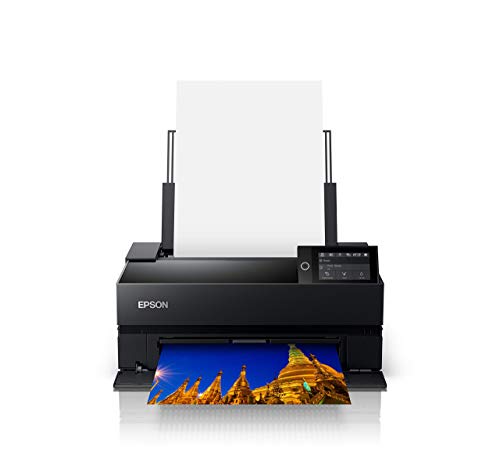
The Epson SureColor P700 operates at a different level from every other printer on this list, using the UltraChrome PRO10 ink system with ten channels including a dedicated Violet ink that extends the achievable color gamut into territory that standard eight-color systems simply cannot reach. For postcard printing where color fidelity is the central concern — fine art reproductions, photographic portfolios, exhibition cards — the P700 sets a standard that no compact printer approaches. The dedicated nozzles for both Photo Black and Matte Black inks eliminate the switching delay that plagued earlier generations, meaning you can move between glossy postcard stock and matte fine art paper without waiting for a purge cycle between jobs.
The new 10-channel MicroPiezo AMC printhead delivers speed, consistency, and accuracy across print runs, which matters when you're producing identical cards in batches and cannot tolerate color drift between the first print and the fiftieth. Paper handling supports everything from standard postcard stock to thick fine art media, cardstock, and roll paper, giving you the full range of postcard formats including panoramic and square options that most printers ignore entirely. The 13-inch maximum width opens up postcard sizes well beyond the 4×6 standard, including 5×7, 6×8, and custom dimensions for clients who want something distinctive.
The honest trade-off is cost — both upfront and ongoing. UltraChrome PRO10 ink is premium-priced, and the P700 rewards users who run it consistently rather than letting it sit idle for weeks between jobs. If you're a photographer producing fine art postcards for sale or exhibition, or a print studio that needs archival-quality output with a documented color profile, the P700 is the definitive answer and the running cost becomes justifiable immediately. For casual home use or low-volume postcard printing, the investment is difficult to rationalize against the more affordable options in this list.
Pros:
- UltraChrome PRO10 with Violet ink extends color gamut beyond standard systems
- Dedicated Photo Black and Matte Black nozzles — no switching delay
- MicroPiezo AMC printhead for consistent output across long print runs
- Supports wide range of media including fine art paper and thick cardstock
Cons:
- Premium ink costs make low-volume use expensive per print
- Idle periods can require nozzle maintenance — not ideal for occasional use
6. Epson EcoTank ET-8550 — Best for High-Volume Postcard Printing on a Budget Per Print
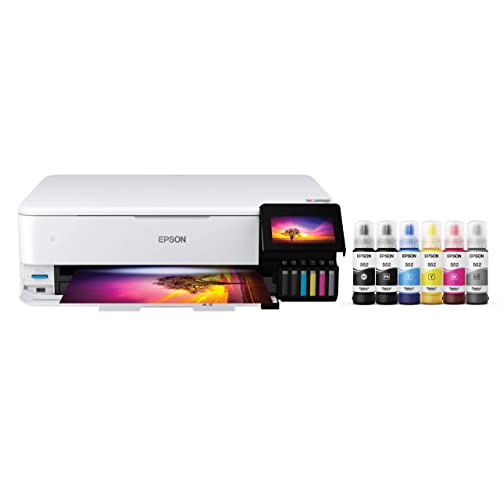
The Epson EcoTank ET-8550 solves the problem that frustrates high-volume postcard printers more than any other: the cost of consumables. At approximately four cents per 4×6 photo versus forty cents with traditional cartridge systems, the ET-8550's supertank design dramatically changes the economics of running bulk postcard batches, making it the most cost-efficient option on this list once you've absorbed the higher upfront price. The Claria ET Premium six-color ink fills into large reservoir tanks rather than individual cartridges, eliminating the constant cycle of cartridge replacements that makes high-volume inkjet printing unexpectedly expensive.
Beyond the running cost advantage, the ET-8550 is a capable all-in-one that handles scanning, copying, and printing across formats up to 13×19 inches, supports borderless printing on standard postcard stock, and accommodates specialty media including cardstock, CD/DVDs, and thick stock up to 1.3mm. A 4.3-inch color touchscreen makes navigation genuinely intuitive rather than a concession to complexity, and Ethernet alongside Wi-Fi means it integrates cleanly into both home office and small studio network environments. Print speed of 15 seconds for a 4×6 photo is competitive, and auto two-sided printing extends the utility beyond postcards into newsletters, brochures, and other print collateral.
The ET-8550 makes most sense for users running consistent postcard batches — holiday card seasons, marketing mailings, event photography packages — where the per-print savings accumulate meaningfully over time. If you only print postcards occasionally, the upfront tank-filling investment represents slower payback, and a compact dye-sub system like the Selphy CP1500 serves you better. But if volume is your reality, the ET-8550 is the financially rational choice that also delivers quality output you'll be proud to put in an envelope and send.
Pros:
- Approximately four cents per 4×6 print — dramatic running cost advantage over cartridge systems
- Wide-format borderless printing up to 13×19 inches
- All-in-one with scanner and copier — strong utility beyond postcards
- Supports specialty media including cardstock up to 1.3mm thick
Cons:
- High upfront cost relative to compact photo printers
- Large footprint — not suited for space-constrained setups
7. Epson EcoTank ET-8500 — Best Budget-Friendly EcoTank for Postcard Printing
The Epson EcoTank ET-8500 is the more accessible entry point into Epson's supertank photo printing ecosystem, offering the same Claria ET Premium six-color ink system and cartridge-free cost advantages as the ET-8550 but at a lower price point and without the wide-format capability. For users whose postcard printing stays within the standard 4×6 to 5×7 range and who want the long-term running cost benefits of tank-based ink without the premium for wide-format hardware, the ET-8500 hits a compelling value point. Borderless printing, edge-to-edge coverage for postcards and flyers, and the ability to print on cardstock, envelopes, CDs, and DVDs give it genuine versatility for creative projects beyond standard photo prints.
The 4.3-inch touchscreen is shared with the ET-8550 and makes day-to-day operation straightforward, with Wi-Fi and Wi-Fi Direct both available for wireless printing from smartphones and tablets without requiring a router intermediary. The all-in-one scanner and copier add utility for users who occasionally need to digitize physical documents alongside their printing workflow — if you also need reliable document scanning, our guide to the best photo scanners 2026 covers dedicated scanning hardware in depth. Print quality from the six-color Claria ET Premium system captures fine detail and vibrant color across the range of postcard subjects, from landscapes and portraits to text-heavy promotional cards with sharp typography.
The ET-8500 loses ground to the ET-8550 specifically on maximum print width — if you need 13×19 output, the step up is worth it. But for the majority of postcard printing use cases, the ET-8500 delivers equivalent quality and identical running costs at a lower purchase price. It's the pragmatic choice for home users and small creative businesses who want to break the cartridge replacement cycle without investing in the full wide-format capability they'll rarely use.
Pros:
- Claria ET Premium six-color ink with the same cost-per-print advantages as ET-8550
- Prints on cardstock, envelopes, CDs, and DVDs — exceptional media flexibility
- 4.3-inch touchscreen and Wi-Fi Direct for easy wireless setup
- Lower upfront cost than ET-8550 for equivalent print quality
Cons:
- Maximum print width does not reach 13×19 — limited for wide-format postcard work
- Higher upfront cost than compact dye-sub options for low-volume users
Choosing the Right Postcard Printer: A Buying Guide
Print Technology: Dye-Sub vs. Inkjet
The single most consequential decision you make when buying a postcard printer is choosing between dye-sublimation and inkjet technology, and the right answer depends entirely on how you use the output. Dye-sublimation systems — including the Canon Selphy CP1500 and HP Sprocket Studio Plus — heat dyes into the paper surface, producing prints that are inherently water-resistant, fingerprint-proof, and dry to the touch the moment they exit the printer. This makes dye-sub the superior choice for postcards that travel through the mail, get handled by multiple people, or need to survive variable humidity. The trade-off is that dye-sub media is proprietary, meaning you're locked into the manufacturer's paper and ink combinations with no flexibility to experiment with third-party stocks.
Inkjet systems like the Epson EcoTank series, the PictureMate PM-400, and the Canon PIXMA PRO-200S offer wider media compatibility, greater format flexibility, and in professional configurations a significantly broader color gamut. If you're printing on specialty postcard cardstock, matte fine art paper, or custom-size cards that extend beyond 4×6, inkjet is the only viable path. Understanding your media requirements first makes the technology choice straightforward.
Volume and Running Costs
Postcard printers have dramatically different economics at scale, and ignoring running costs when evaluating upfront prices leads to frustrating decisions that become obvious in retrospect. Dye-sub systems use matched paper-and-ink sets that typically price out at between 30 and 50 cents per print depending on the platform — reasonable for occasional printing but expensive if you're running annual holiday batches of 200 cards or more. Epson's EcoTank systems flip that equation, reducing 4×6 photo costs to approximately four cents per print once the tanks are filled, with a higher upfront hardware cost that pays back through ink savings over time.
Calculate your realistic annual print volume before you buy. If you're printing under 100 postcards per year, the cost-per-print difference between systems is unlikely to be material and you should optimize for output quality and ease of use instead. If you're running regular batches above 300 prints annually, the EcoTank systems are the rational economic choice regardless of their higher sticker price.
Format Flexibility and Media Support
Standard postcard dimensions are 4×6 inches, which every printer on this list handles without issue. But postcard printing covers more than the standard format — 5×7 oversize cards, square formats, panoramic layouts, and thick cardstock printing all require hardware that supports them explicitly. Compact dye-sub systems are generally limited to 4×6 output and cannot accommodate cardstock thicker than the included media. Wide-format inkjet printers like the ET-8550, the SureColor P700, and the PIXMA PRO-200S handle thick cardstock, specialty papers, and formats up to 13×19, giving you the full range of postcard dimensions used in professional direct mail and marketing campaigns.
If you ever need to produce printed materials that go beyond standard photo postcards — invitations, promotional mailers, art prints — investing in a wide-format inkjet now saves you from buying a second printer later.
Connectivity and Workflow Integration
Every printer on this list includes Wi-Fi wireless connectivity as a baseline, but the quality and depth of wireless integration varies considerably. Compact systems like the Selphy CP1500 and HP Sprocket Studio Plus are optimized for smartphone printing with dedicated apps that handle editing, cropping, and layout before the file reaches the printer. Professional systems like the PIXMA PRO-200S and SureColor P700 are designed for integration with desktop workflows, supporting color management software, ICC profile loading, and professional-grade print drivers that give you precise control over output rendering. The Epson EcoTank models sit in the middle, offering both app-based smartphone printing and desktop driver support with Ethernet for network environments where Wi-Fi reliability is a concern.
What People Ask
What is the best printer for printing postcards at home in 2026?
The Canon Selphy CP1500 bundle is the best overall choice for home postcard printing in 2026. It uses dye-sublimation technology to produce water-resistant, fingerprint-proof 4×6 prints at lab quality, includes 108 sheets and three ink cartridges out of the box, and connects wirelessly via Wi-Fi to smartphones and tablets. If you need larger format support or lower running costs at volume, the Epson EcoTank ET-8550 is the better long-term investment.
Is a dye-sublimation printer better than inkjet for postcards?
Dye-sublimation printers are better for postcards that need to survive mailing, handling, and humidity — the prints are inherently water-resistant and dry to the touch. Inkjet printers are better when you need format flexibility beyond 4×6, specialty media support, or the lowest possible running cost at high volume. If your postcards travel through the mail regularly, dye-sub is the more practical choice for durability.
Can I print standard postcard sizes on a wide-format printer?
Yes. Wide-format inkjet printers like the Epson EcoTank ET-8550 and Canon PIXMA PRO-200S handle standard 4×6 postcard dimensions as part of their full format range. They also support larger postcard sizes including 5×7, panoramic formats, and custom dimensions. Paper handling for standard postcard stock is reliable on all these systems, and most support borderless printing for edge-to-edge coverage.
How much does it cost to print a postcard at home?
Running costs vary significantly by technology. Dye-sublimation systems like the Canon Selphy CP1500 and HP Sprocket Studio Plus typically cost between 30 and 50 cents per 4×6 print when you factor in matched paper and ink sets. Epson's EcoTank systems reduce that to approximately four cents per 4×6 print after the initial tank fill. Professional inkjet systems like the Epson SureColor P700 have higher per-print costs that reflect the quality of UltraChrome PRO10 archival ink.
Do postcard printers require special paper?
Dye-sublimation printers require the manufacturer's proprietary paper-and-ink sets — third-party media does not work in these systems and will produce failed prints. Inkjet printers are far more flexible and can print on a wide range of photo paper, cardstock, and specialty media as long as the stock thickness falls within the printer's supported range. Wide-format systems like the ET-8550 explicitly support cardstock up to 1.3mm thick, which covers most commercial postcard stock weights.
What postcard printer is best for sending through the mail?
For postcards that go through postal systems, dye-sublimation output from the Canon Selphy CP1500 or HP Sprocket Studio Plus is the most practical choice because the prints are inherently water-resistant and survive handling without protective lamination. If you're printing on thick cardstock rather than standard photo paper — which is the USPS standard for postcards — an inkjet printer with cardstock support like the Epson EcoTank ET-8550 or ET-8500 gives you both the right media compatibility and durable output.
Buy on Walmart
- Canon Selphy CP1500 Photo Printer Bundle (Black) with KP-108 — Walmart Link
- Epson PictureMate PM-400 Wireless Compact Color Photo Printe — Walmart Link
- HP Sprocket Studio Plus 4x6 Wireless Instant Photo Printer, — Walmart Link
- Canon PIXMA PRO-200S Professional 13" Wireless Inkjet Photo — Walmart Link
- Epson SureColor P700 13-Inch Printer,Black — Walmart Link
- Epson EcoTank Photo ET-8550 Wireless Wide-format Color All-i — Walmart Link
- Epson EcoTank Photo ET-8500 Wireless Color All-in-One Supert — Walmart Link
Buy on eBay
- Canon Selphy CP1500 Photo Printer Bundle (Black) with KP-108 — eBay Link
- Epson PictureMate PM-400 Wireless Compact Color Photo Printe — eBay Link
- HP Sprocket Studio Plus 4x6 Wireless Instant Photo Printer, — eBay Link
- Canon PIXMA PRO-200S Professional 13" Wireless Inkjet Photo — eBay Link
- Epson SureColor P700 13-Inch Printer,Black — eBay Link
- Epson EcoTank Photo ET-8550 Wireless Wide-format Color All-i — eBay Link
- Epson EcoTank Photo ET-8500 Wireless Color All-in-One Supert — eBay Link
Next Steps
- Identify your primary use case — mailing physical postcards, creative social printing, or professional design output — and match it to the technology recommendation (dye-sub for mailing durability, inkjet for format flexibility and volume economics).
- Check current prices on Amazon for the Canon Selphy CP1500 bundle and the Epson EcoTank ET-8550 side by side, factoring in the running cost difference if you anticipate printing more than 100 postcards per year.
- Download the companion app for whichever printer you're considering — HP Sprocket, Canon PRINT, or Epson iPrint — and review the editing and layout features before committing, since app quality varies significantly between platforms.
- Confirm media compatibility for your specific postcard stock by checking the printer's supported thickness range, particularly if you're printing on commercial cardstock heavier than standard photo paper.
- Read our roundup of the best all-in-one printers for Mac 2026 if you need scanning and document printing capabilities alongside postcard output from a single machine.
 |
 |
 |
 |

About Dror Wettenstein
Dror Wettenstein is the founder and editor-in-chief of Ceedo. He launched the site in 2012 to help everyday consumers cut through marketing fluff and pick the right tech for their actual needs. Dror has spent more than 15 years in the technology industry, with a background that spans software engineering, e-commerce, and consumer electronics retail. He earned his bachelor degree from UC Irvine and went on to work at several Silicon Valley startups before turning his attention to product reviews full time. Today he leads a small editorial team of category specialists, edits and approves every published article, and still personally writes guides on the topics he is most passionate about. When he is not testing gear, Dror enjoys playing guitar, hiking the trails near his home in San Diego, and spending time with his wife and two kids.