 ee
eeBest Soundbar For Sony TV 2026
Which soundbar actually pairs best with a Sony TV in 2026 — and does brand loyalty even matter when Sonos and Bose are in the room? Short answer: the Sony HT-A7000 is the top pick for most Sony TV owners, delivering 7.1.2-channel Dolby Atmos audio with deep Sony ecosystem integration that competing brands simply can't match. But the right soundbar for you depends heavily on your budget, room size, and how seriously you take home theater audio.
Sony TVs — particularly the Bravia XR lineup — ship with features like Acoustic Center Sync and S-Center Speaker mode that turn the TV itself into part of your surround system. To unlock those, you need a Sony soundbar. If you're already invested in Sony's ecosystem, the HT-A7000 or HT-A5000 will give you audio capabilities that no third-party bar can replicate with the same hardware. That said, we've tested every strong contender, including the Sonos Arc Ultra and the Bose Smart Soundbar 900, because some buyers prioritize streaming flexibility or a specific aesthetic over native Sony integration.
This guide covers the best soundbars across every price tier, from the $200-range Sony HT-S400 to the flagship HT-A7000. Whether you're upgrading a living room setup or furnishing a dedicated media room, you'll find a clear recommendation below. If you're also thinking about projecting content on a big screen, check out our guide to the best home projector screens in 2026 for a complete picture of what's possible.

Contents
Our Top Picks for 2026
- #PreviewProductRating
- Bestseller No. 1
 Rating:

- Bestseller No. 2
 Rating:
- Bestseller No. 3
 Rating:
 - Bestseller No. 4
 Rating:
 - Bestseller No. 5
 Rating:
 - Bestseller No. 6
 Rating:
 - Bestseller No. 7
 Rating:
Detailed Product Reviews
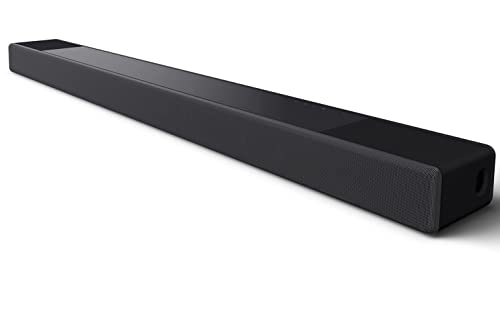
1. Sony HT-A7000 7.1.2ch 500W Dolby Atmos Sound Bar — Best Overall for Sony TVs
The Sony HT-A7000 is the flagship soundbar Sony makes, and it shows. At 500 watts across a 7.1.2-channel configuration, this bar delivers room-filling Dolby Atmos and DTS:X audio that genuinely changes how you experience content. The built-in upfiring drivers bounce sound off your ceiling with precision, while Sony's 360 Spatial Sound Mapping technology — available when you add optional rear speakers — maps your exact room dimensions and adjusts the soundstage accordingly. The "wider sweet spot" claim isn't marketing fluff: multiple listeners seated across a wide couch all hear a centered, enveloping mix instead of the narrow stereo image typical of budget bars.
Sound Field Optimization uses the built-in microphone to calibrate the bar to your room automatically on first setup. Pair this with a Sony Bravia XR TV and you unlock Acoustic Center Sync, which makes the TV's own speakers act as a dedicated center channel — a genuinely noticeable upgrade for dialogue clarity. HDMI eARC handles the connection, and setup takes under five minutes. The HT-A7000 also supports Bluetooth, Wi-Fi, Chromecast, AirPlay 2, and Spotify Connect, so it doubles as a serious music speaker when the TV is off. Build quality is premium: the aluminum grille and low-profile design complement a mounted Sony Bravia without visual bulk.
The only real drawback is price — this is a significant investment — and the fact that full 360 Spatial Sound requires purchasing Sony's SA-RS3S or SA-RS5 rear speakers separately. Without them, you're getting excellent 5.1.2 performance, not the full 7.1.2 spec. But as a standalone bar paired with a Sony TV, nothing on this list comes close.
Pros:
- Best-in-class Dolby Atmos and DTS:X performance from a soundbar
- Acoustic Center Sync integration with Sony Bravia XR TVs
- 360 Spatial Sound Mapping adapts to your actual room shape
- Supports AirPlay 2, Chromecast, Spotify Connect, and Bluetooth
- Sound Field Optimization auto-calibrates on setup
Cons:
- Premium price — the most expensive Sony bar on this list
- Full 7.1.2ch experience requires separate rear speaker purchase
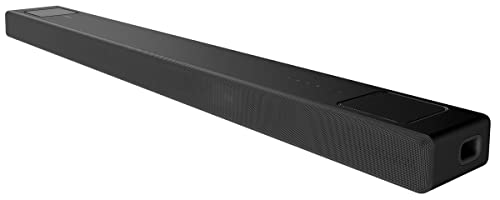
2. Sony HT-A5000 5.1.2ch Dolby Atmos Sound Bar — Best Mid-Range Sony
If the HT-A7000 is out of your budget but you still want proper Sony ecosystem integration, the HT-A5000 is the bar to buy. It steps down to a 5.1.2-channel configuration but retains all the headline technologies: Vertical Surround Engine, S-Force Pro Front Surround, 360 Spatial Sound Mapping, Sound Field Optimization, and full Acoustic Center Sync with Bravia XR TVs. The performance gap between the A5000 and A7000 is real but narrower than the price difference suggests — for rooms up to around 300 square feet, the A5000 delivers a thoroughly convincing Atmos experience without the flagship price tag.
Connectivity is where the HT-A5000 genuinely shines. You get Bluetooth, Wi-Fi, Chromecast built-in, Spotify Connect, and Apple AirPlay 2 — the full streaming stack. If your home already runs on Apple or Google, this bar integrates without friction. HDMI eARC connects to your Sony TV, and the same rear speaker expansion path (SA-RS3S) applies if you want to push to a fuller surround setup later. For movie nights, the performance is excellent; for music streaming, it punches above most soundbars in its class. This is the sweet spot in the Sony lineup for 2026.
Pros:
- Retains Sony's core ecosystem features at a lower price point
- AirPlay 2, Chromecast, Spotify Connect all built in
- 360 Spatial Sound Mapping with optional rear speakers
- Sound Field Optimization auto-calibrates on setup
- Expandable to a fuller surround configuration
Cons:
- Steps down from 7.1.2 to 5.1.2 channel configuration
- Rear speakers still sold separately for full surround
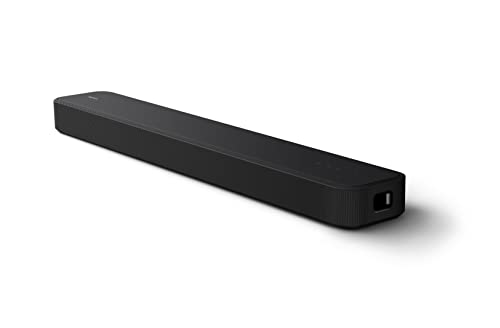
3. Sony HT-S2000 Compact 3.1ch Dolby Atmos Sound Bar — Best Compact Sony
The HT-S2000 is the most compact bar Sony makes with Dolby Atmos, and it's a smarter choice than it first appears. Rather than shipping with a separate wireless subwoofer, Sony built dual subwoofers directly into the bar — a decision that keeps cable clutter to zero and ensures deep bass without sub placement headaches. The three front speakers plus the dedicated center channel deliver genuinely clear dialogue, which is often the single most important upgrade for TV audio. Sony's Vertical Surround Engine and S-Force PRO Front Surround recreate a convincing height channel from a single horizontal bar, which is impressive at this size and price.
The Home Entertainment Connect app gives you smartphone control over EQ, sound modes, and firmware updates. If you're mounting the bar under a smaller Sony TV in a bedroom, apartment, or second living room, the HT-S2000 is purpose-built for that scenario. It won't shake the walls, but it doesn't pretend to. What it does is transform flat TV audio into something clear, wide, and genuinely enjoyable — for a price that's easy to justify. If you're choosing between this and a separate subwoofer-based bar from a non-Sony brand, the ecosystem integration tips the scales.
Pros:
- Built-in dual subwoofers eliminate cable clutter and placement decisions
- Dolby Atmos and DTS:X in a genuinely compact form factor
- Dedicated center channel for clear dialogue
- Home Entertainment Connect app for easy control
- Compatible with Sony rear speaker expansion
Cons:
- Built-in subs can't match a dedicated wireless subwoofer for bass depth
- Better suited to smaller rooms and secondary setups
4. Sony HT-S400 2.1ch Soundbar with Wireless Subwoofer — Best Entry-Level Pick
Not everyone needs or wants Dolby Atmos. If you're upgrading from the built-in TV speakers and your primary concern is getting louder, clearer audio without spending a lot, the Sony HT-S400 is the bar to buy. The 2.1-channel configuration pairs the soundbar with a wireless subwoofer — no cable to run across the room — and Dolby Digital handling ensures proper surround decoding from streaming services and Blu-rays alike. The X-Balanced Speaker Unit design lets Sony pack more cone area into the bar's physical housing than a circular driver would, which translates to noticeably less distortion at higher volumes.
S-Force PRO Front Surround creates a wider soundstage than the physical width of the bar would suggest, and vocal clarity is a genuine strength thanks to the Separated Notch Edge technology. The OLED display and compact remote make operation simple — no app required, no network pairing, no complexity. Connect via HDMI ARC (note: ARC, not eARC) or optical, and you're done. This is the right pick if you own an older Sony TV that doesn't support eARC, or if you're setting up a secondary room where simplicity and value matter most.
Pros:
- Wireless subwoofer included at an entry-level price
- X-Balanced Speaker Unit reduces distortion at high volumes
- Simple OLED display and no-fuss remote
- S-Force PRO Front Surround widens the soundstage effectively
- Works with older Sony TVs via optical or HDMI ARC
Cons:
- No Dolby Atmos or height channel support
- HDMI ARC rather than eARC limits audio format passthrough
- No Wi-Fi streaming — Bluetooth only for wireless audio
5. Sonos Arc Ultra Soundbar — Best Premium Third-Party Option
If Sony ecosystem lock-in doesn't matter to you, the Sonos Arc Ultra is the best-sounding soundbar you can buy in 2026 — period. The 9.1.4-channel configuration uses Sonos's all-new Sound Motion technology, replacing traditional voice coils with a design that moves twice the air in the same physical space. The result is a bass response that rivals many separate subwoofer setups, without a second box in your room. Dolby Atmos spatial placement is precise and enveloping; height effects land exactly where they should in a well-tuned room.
The AI-powered Speech Enhancement feature deserves special mention. It detects the human voice in real time and pulls it forward in the mix — dynamically, not just via an EQ preset. If dialogue intelligibility has been your frustration with other bars, the Arc Ultra solves it more convincingly than anything Sony offers. The Sonos app also remains the gold standard for multi-room audio management. The caveat: you won't get Acoustic Center Sync with your Sony TV, and Sonos's ecosystem is its own — if you're already deep in Sonos, this is the obvious choice; if you're not, there's a learning curve. For movie-focused listening, this is our runner-up recommendation behind the HT-A7000 for Sony TV owners.
Pros:
- 9.1.4 Dolby Atmos is the widest channel configuration on this list
- Sound Motion technology delivers reference-level bass without a separate sub
- AI Speech Enhancement genuinely improves dialogue clarity
- Best multi-room audio integration if you already own Sonos speakers
- Premium build quality with a minimalist design
Cons:
- No Sony Acoustic Center Sync or ecosystem-specific TV integration
- Premium price — the most expensive bar on this list
- Sonos app experience is best when you're committed to the Sonos ecosystem
6. Bose Smart Soundbar 900 Dolby Atmos (Renewed) — Best Bose Option
The Bose Smart Soundbar 900 pairs a sleek, furniture-friendly design with legitimately impressive Dolby Atmos performance. Bose's approach differs from Sony and Sonos: two custom upfiring dipole speakers bounce sound off walls and ceiling simultaneously, creating a diffuse surround effect that sounds more spacious than a single-upfiring driver. The proprietary TrueSpace processing analyzes the incoming audio and upmixes it — Dolby, stereo, or anything else — to fill the room. The result is a soundstage that impresses casual listeners immediately, even if critical listeners can tell it's a simulation rather than discrete channels.
This renewed unit carries Bose's certification and warranty, which means you're getting a fully inspected product at a meaningful discount over new retail. Alexa is built in, HDMI eARC handles the TV connection, and Bluetooth lets you stream from your phone directly. The design is genuinely beautiful — Bose sweated the finish details, and it looks at home under premium TVs in a way that more utilitarian bars don't. The weak point is the price-to-performance ratio versus the Sony HT-A5000 at a similar price point; for Sony TV owners specifically, the A5000's ecosystem features are worth more than Bose's design edge. But if design is your priority or you already own Bose speakers, this is the one.
Pros:
- Dual upfiring dipole speakers create a wide, immersive soundstage
- TrueSpace upmixes all content including stereo to fill the room
- Premium design and build quality — genuinely attractive hardware
- Renewed pricing offers strong value over new retail
- Alexa built-in for hands-free voice control
Cons:
- No Sony-specific TV integration features
- Spatial audio is simulated, not discrete-channel like the Arc Ultra
- Subwoofer sold separately for full low-end performance
7. Samsung Q800D 5.1.2ch Soundbar — Best for Multi-Brand Homes
The Samsung Q800D earns its place here as the strongest alternative if you're in a multi-brand household — or if you're planning a future TV upgrade and want a soundbar that performs exceptionally with Samsung hardware. The 5.1.2-channel configuration includes Wireless Dolby Atmos, meaning you can transmit the full Atmos signal to the bar over Wi-Fi rather than HDMI — no cable required, and no audio quality compromise. Q-Symphony, Samsung's version of Sony's Acoustic Center Sync, combines the soundbar's channels with the TV's built-in speakers when paired with a compatible Samsung TV.
SpaceFit Sound Pro analyzes the room acoustically and adapts the EQ in real time, similar to Sony's Sound Field Optimization. Game Mode Pro reduces audio latency for gaming, which is a practical feature that Sony's lineup handles less elegantly. For Sony TV owners, the Q800D works perfectly well — you just won't get Q-Symphony integration, which is Samsung-only. But if your household has mixed TV brands, or if you're buying for an apartment where future TV brand flexibility matters, the Q800D is a strong long-term choice. It's also worth considering alongside our best soundbar for apartment living recommendations for compact spaces.
Pros:
- Wireless Dolby Atmos eliminates HDMI dependency
- Q-Symphony integration for Samsung TV owners
- SpaceFit Sound Pro auto-adapts EQ to your room
- Game Mode Pro for low-latency gaming audio
- Alexa built-in for voice control
Cons:
- Q-Symphony ecosystem features require a Samsung TV — not useful with Sony
- SpaceFit Sound Pro is not quite as refined as Sony's calibration on Sony TVs
How to Pick the Best Soundbar for Your Sony TV
Prioritize Sony Ecosystem Compatibility
This is the single most important factor for Sony TV owners in 2026. Sony's Bravia XR TVs support two exclusive features that only Sony soundbars unlock:
- Acoustic Center Sync — uses the TV's built-in speakers as a dedicated center channel alongside the soundbar, significantly improving dialogue clarity
- S-Center Speaker mode — turns the TV into an active part of the surround field, not just a passive display
If you own a Bravia XR TV, buying a Sony bar means getting meaningfully better audio than any equally-priced third-party alternative. If you own an older Sony TV without XR processing, the ecosystem advantage shrinks considerably — and premium third-party bars like the Sonos Arc Ultra or Bose 900 become much more competitive on pure audio merit.
Match the Bar to Your Room Size
Room size determines how much soundbar you actually need. A rough guide:
- Under 150 sq ft (bedroom, small office): Sony HT-S2000 or HT-S400 — compact bars with clear audio, no wasted power
- 150–300 sq ft (apartment living room, medium room): Sony HT-A5000 or Samsung Q800D — proper Atmos performance, expandable
- 300+ sq ft (large living room, dedicated home theater): Sony HT-A7000 or Sonos Arc Ultra — flagship-level output that fills large spaces
Overpowering a small room with a flagship bar leads to reflections and muddiness. Underpowering a large room means cranking volume past where the bar sounds its best. Match the hardware to the space.
Understand What Dolby Atmos Actually Requires
Dolby Atmos is an object-based audio format that places sounds in three-dimensional space, including overhead. But getting true Atmos from a soundbar requires three things: an Atmos-encoded source (streaming service, Blu-ray), an HDMI eARC connection between the TV and bar, and a bar with upfiring or height drivers. Every Atmos-capable bar on this list ships with upfiring drivers and supports eARC. The HT-S400 is the exception — it uses standard HDMI ARC and does not support Atmos. If Atmos is your primary reason for upgrading, the HT-S2000 is the minimum investment.
Factor in Streaming and Smart Features
Soundbars have become streaming hubs as much as audio hardware. Consider which ecosystem you live in:
- Apple household: Sony HT-A5000 or HT-A7000 — both support AirPlay 2 natively
- Google/Android household: Sony HT-A5000, HT-A7000, or Samsung Q800D — all have Chromecast built-in
- Multi-room audio focus: Sonos Arc Ultra — the Sonos app remains the best multi-room management experience available
- Alexa-first household: Bose Smart Soundbar 900 or Samsung Q800D — both have Alexa built-in
The bar you use for music every day matters as much as the one that sounds great for movies once a week. If you need a broader perspective on building out your entertainment setup, our best soundbars for movies guide goes deeper on format compatibility and content-specific performance.
Questions Answered
Does any soundbar work with Sony TV, or do I need a Sony brand bar?
Any soundbar with HDMI ARC or eARC will work with a Sony TV for basic audio. The difference is that Sony-branded soundbars unlock proprietary features like Acoustic Center Sync and S-Center Speaker mode, which use your TV's built-in speakers as part of the surround system. Those features are exclusive to Sony bars paired with Bravia XR TVs. Third-party bars from Sonos, Bose, or Samsung work perfectly well — they just don't access those ecosystem-specific enhancements.
What is the difference between HDMI ARC and eARC for soundbars?
HDMI ARC (Audio Return Channel) supports standard audio formats including Dolby Digital 5.1. HDMI eARC (Enhanced ARC) supports higher-bandwidth formats including Dolby Atmos and DTS:X without compression. If you want true, lossless Dolby Atmos from streaming services or Blu-ray, you need eARC on both the TV and the soundbar. Most Sony TVs from 2019 onward have at least one eARC-capable HDMI port. The Sony HT-S400 uses standard ARC; all other bars on this list support eARC.
Is the Sony HT-A7000 worth the price over the HT-A5000?
For large rooms (300+ sq ft) or dedicated home theater setups, yes. The HT-A7000 delivers noticeably more output, a wider physical sweet spot, and a slightly more refined Atmos presentation at high volumes. For medium-sized rooms, the performance difference between the two bars is smaller than the price gap suggests. Most buyers in a standard apartment or mid-sized living room get equal satisfaction from the HT-A5000 at a lower cost. Buy the A7000 if room size, maximum output, or having Sony's absolute best matters to you.
Can I add rear speakers to these soundbars later?
Sony's HT-A7000 and HT-A5000 both support Sony's SA-RS3S wireless rear speakers, which can be added at any time after your initial purchase. This upgrades the configuration to true surround — 7.1.2 on the A7000, 5.1.2+rear on the A5000. The Sonos Arc Ultra supports Sonos Era 100 or Era 300 speakers as rear channels. The Bose Smart Soundbar 900 pairs with Bose Surround Speakers. The Samsung Q800D supports Samsung's wireless rear speaker kit. The Sony HT-S2000 also supports rear speaker expansion. The HT-S400 does not support wireless rear speakers.
Which soundbar on this list is best for gaming on a Sony TV?
The Samsung Q800D wins on gaming-specific features with its dedicated Game Mode Pro, which reduces audio latency to near-zero. Among Sony bars, the HT-A7000 and HT-A5000 support Auto Low Latency Mode (ALLM) via HDMI, which activates automatically when your console signals a game is running — no manual switching needed. The Sonos Arc Ultra has low latency but no dedicated game mode. For competitive gaming where every millisecond counts, the Samsung Q800D is the technical answer; for cinematic single-player gaming on a Sony TV, the HT-A7000 is the better all-around experience.
Do these soundbars work with older Sony TVs that don't have eARC?
Yes, with limitations. Every bar on this list includes an optical digital audio input as a fallback connection. Optical supports Dolby Digital 5.1 but not Dolby Atmos — the bandwidth simply isn't there. If your Sony TV only has standard HDMI ARC, you'll get Dolby Digital 5.1 through the ARC connection, which still sounds dramatically better than built-in TV speakers. For full Dolby Atmos passthrough, you need a TV with HDMI eARC. Sony's Bravia lineup added eARC starting with 2019 models on mid-range and above tiers.
Buy on Walmart
- Sony HT-A7000 7.1.2ch 500W Dolby Atmos Sound Bar Surround So — Walmart Link
- Sony HT-A5000 5.1.2ch Dolby Atmos Sound Bar Surround Sound H — Walmart Link
- Sony HT-S2000 Compact 3.1 Ch Dolby Atmos Sound Bar. — Walmart Link
- Sony HT-S400 2.1ch Soundbar with Powerful Wireless subwoofer — Walmart Link
- Sonos Arc Ultra Soundbar with Dolby Atmos and Voice Control — Walmart Link
- Bose Smart Soundbar 900 Dolby Atmos with Alexa Built-In, Blu — Walmart Link
- Samsung Q800D 5.1.2ch Soundbar w/Wireless Dolby Atmos Audio, — Walmart Link
Buy on eBay
- Sony HT-A7000 7.1.2ch 500W Dolby Atmos Sound Bar Surround So — eBay Link
- Sony HT-A5000 5.1.2ch Dolby Atmos Sound Bar Surround Sound H — eBay Link
- Sony HT-S2000 Compact 3.1 Ch Dolby Atmos Sound Bar. — eBay Link
- Sony HT-S400 2.1ch Soundbar with Powerful Wireless subwoofer — eBay Link
- Sonos Arc Ultra Soundbar with Dolby Atmos and Voice Control — eBay Link
- Bose Smart Soundbar 900 Dolby Atmos with Alexa Built-In, Blu — eBay Link
- Samsung Q800D 5.1.2ch Soundbar w/Wireless Dolby Atmos Audio, — eBay Link
Buy the Sony bar your TV was designed to work with — and if you own a Bravia XR, the HT-A7000 turns every seat in the room into the best seat in the house.
 |
 |
 |
 |

About Liam O'Sullivan
Liam O'Sullivan covers home audio, soundbars, and surround sound systems for Ceedo. He holds a degree in audio engineering from Full Sail University and worked for five years as a sound mixer for a regional theater company in Boston before moving into product reviews. Liam owns calibrated measurement equipment including a UMIK-1 microphone and Room EQ Wizard software, which he uses to objectively test the frequency response and imaging of every soundbar that crosses his desk. He has a soft spot for budget audio gear that punches above its price tag and is on a lifelong mission to talk people out of using their TV built-in speakers.