 ee
eeWebcams ›
Best Webcam For Video Conferencing 2026
You've got a client call in twenty minutes, you flip open your laptop, and the built-in camera makes you look like a pixelated ghost under fluorescent lighting — sound familiar? If you rely on video conferencing for work in 2026, a dedicated webcam is no longer a luxury; it's the difference between projecting competence and broadcasting apology. The market has moved fast, and the best options today pack 4K sensors, AI-powered framing, and noise-canceling microphones into compact, desk-friendly packages.
Choosing the right webcam for video conferencing comes down to more than resolution. You need to weigh field of view, autofocus speed, microphone quality, and platform certification — because a camera that looks great on paper but stutters on Microsoft Teams is useless in a real workday. Whether you're a remote executive, a hybrid worker sharing a open-plan office, or a student logging into virtual lectures, there's a specific webcam built for your situation, and we've tested and compared the top contenders for 2026.
Browse our full webcam buying guide for broader coverage across categories, but if video conferencing is your primary use case, this roundup focuses on the seven cameras that stood out for image quality, audio performance, software integration, and real-world reliability. We've also cross-referenced user feedback and spec sheets to make sure every recommendation holds up in daily use, not just controlled benchmarks.
Contents
- Editor's Recommendation: Top Picks of 2026
- Full Product Breakdowns
- Logitech Brio 505 — Best Overall
- Logitech MX Brio 705 for Business — Best 4K for Business
- Logitech C920x HD Pro — Best Budget Pick
- Anker AnkerWork C310 — Best AI Feature Set
- Dell UltraSharp WB7022 — Best for Dell Ecosystems
- Jabra PanaCast 20 — Best for Presentations
- Insta360 Link 2 — Best PTZ Webcam
- How to Pick the Best Webcam for Video Conferencing
- Common Questions
Editor's Recommendation: Top Picks of 2026
- #PreviewProductRating
- Bestseller No. 1
 Rating:

- Bestseller No. 2
 Rating:
- Bestseller No. 3
 Rating:
 - Bestseller No. 4
 Rating:
 - Bestseller No. 5
 Rating:
 - Bestseller No. 6
 Rating:
 - Bestseller No. 7
 Rating:
Full Product Breakdowns
1. Logitech Brio 505 Full HD 1080p Webcam — Best Overall
The Logitech Brio 505 earns its place at the top of this list by doing everything you need for daily video conferencing without requiring you to spend a premium on 4K resolution you'll rarely use on a call. It delivers sharp, well-exposed 1080p footage with Logitech's auto light correction working quietly in the background, so you look natural whether you're sitting in front of a bright window or under dim desk lighting. The dual noise reduction microphones pick up your voice cleanly and filter ambient sounds — keyboard clicks, HVAC hum, background chatter — without making your voice sound processed or distant.
Certification matters more than most buyers realize, and the Brio 505 is certified for Microsoft Teams, Zoom, and Google Meet, which means it integrates with those platforms' hardware management dashboards and delivers tested, reliable performance. It's also TAA compliant, making it a strong choice for government and enterprise procurement. Setup is plug-and-play on Windows, macOS, ChromeOS, and Chromebook, with no driver installation required, and the privacy shutter gives you a physical guarantee that the lens is covered when you're not on camera.
For most remote and hybrid workers in 2026, the Brio 505 represents the sweet spot of performance and value. You're not overpaying for 4K streaming when your calls compress to 1080p anyway, and you get Logitech's proven optical engineering in a compact, monitor-clip form factor that works on practically any display. If you're upgrading from a laptop webcam, the improvement will feel immediate and significant on your very first call.
Pros:
- Certified for Teams, Zoom, and Google Meet with TAA compliance for enterprise deployments
- Auto light correction handles challenging lighting without manual adjustments
- Dual noise reduction mics deliver clean, natural audio out of the box
- True plug-and-play across Windows, macOS, and ChromeOS — no software required
Cons:
- 1080p resolution may feel limiting if you move to 4K monitors and want matched sharpness
- Auto framing feature is basic compared to AI-powered competitors at higher price points
2. Logitech MX Brio 705 for Business 4K Webcam — Best 4K for Business
Step up to the MX Brio 705 and you immediately notice the difference in image fidelity — the 4K Ultra HD sensor, powered by Logitech's most advanced image processing engine and a custom-designed lens, renders fine detail with a level of clarity that makes standard HD cameras look soft by comparison. For executives, sales teams, or anyone whose professional image directly affects business outcomes, this is the camera that ensures you look sharp, composed, and fully present on every call. The auto light correction is more aggressive and more effective than the Brio 505's implementation, handling backlit scenarios with noticeably less blown-out background detail.
The business-grade differentiation goes beyond optics. Logitech Sync enables remote device management and firmware updates across a fleet of MX Brio 705 cameras, which is a genuine operational advantage for IT departments managing hybrid workforces. The secure boot design prevents unauthorized configuration changes at the device level — a security consideration that enterprise procurement teams specifically evaluate. Show Mode lets you tilt the camera downward to display physical documents or objects on a desk, which is genuinely useful for client presentations or technical reviews without a secondary document camera.
USB-C connectivity makes this camera compatible with modern laptops and docking stations without adapters, and the connection delivers enough bandwidth for smooth 4K output. For teams that invest in premium collaboration hardware, the MX Brio 705 is the reference-level business webcam in 2026. It's also worth noting that if you're building out a full home office setup, pairing this camera with a quality audio solution can further elevate your meeting presence beyond just the visual.
Pros:
- 4K Ultra HD with a custom lens delivers exceptional sharpness and color accuracy
- Remote management via Logitech Sync plus secure boot for enterprise IT control
- Show Mode enables document and object display during presentations
- USB-C connection with broad platform compatibility including Chromebook
Cons:
- Premium pricing puts it outside the budget of individual buyers upgrading a home setup
- 4K output requires adequate USB bandwidth — older USB hubs may bottleneck performance
3. Logitech C920x HD Pro PC Webcam — Best Budget Pick
The Logitech C920x has been the go-to recommendation for budget-conscious video conferencing for years, and the 2026 version adds compatibility with Nintendo Switch 2's new GameChat mode — broadening its appeal beyond the office without compromising its core conferencing performance. Full HD 1080p at 30fps is still more than adequate for every major video calling platform, and the automatic HD light correction and autofocus system produces bright, sharp images even in dim rooms where a basic webcam would produce muddy, underexposed footage. For students connecting to virtual classes or remote workers on a tight equipment budget, this camera delivers a professional result at an accessible price.
The dual built-in microphones record stereo audio with background noise suppression, and the capture is clean enough that many users choose to skip a separate USB microphone entirely on casual calls. The universal clip mount fits flat monitors, laptop displays, and tripods, giving you flexibility in how and where you position the camera. Works seamlessly with Microsoft Teams, Google Meet, Zoom, and Nintendo Switch 2's GameChat, covering every platform you're likely to encounter in a remote or hybrid work environment.
You're making real compromises with the C920x relative to 4K competitors — no AI framing, no enterprise management, no USB-C, and no significant low-light advantage beyond basic correction. But if your calls are conducted in a reasonably lit room and you're not presenting to boardroom audiences who scrutinize every pixel, the C920x gives you 90% of what matters at a fraction of the price. College students and first-time remote workers who are also researching the best Mac webcams in 2026 will find the C920x appears consistently across comparison lists for good reason.
Pros:
- 1080p/30fps delivers solid quality for everyday conferencing at a budget price point
- Autofocus and HD light correction work reliably without manual intervention
- Compatible with Nintendo Switch 2 GameChat plus all major conferencing platforms
- Universal mounting clip works on monitors, laptops, and tripods
Cons:
- No 4K, no AI framing, and no enterprise software integration
- Microphone quality is noticeably behind dedicated USB microphones or premium webcam mics
- USB-A only — requires an adapter on modern USB-C-only laptops
4. Anker AnkerWork C310 Webcam — Best AI Feature Set
Anker's AnkerWork C310 makes a strong case that you don't need a Logitech badge to get best-in-class AI features in a conferencing webcam. The 12-megapixel sensor captures 4K resolution with genuine detail preservation, and the combination of AI autofocus, AI framing, and dual-microphone AI noise canceling creates a conferencing experience that adjusts automatically to your environment without requiring you to configure anything. The AI framing tracks your position and reframes the shot smoothly, which matters significantly during long calls where you naturally shift in your seat, lean forward, or step away momentarily to grab notes.
The USB 3.0 connection with YUV encoding supports lossless 1080p at 60fps — a spec that makes this camera genuinely useful for livestreaming as well as conferencing, because smoother motion rendering at 60fps reduces the micro-stutter that plagues 30fps cameras when presenters gesture or move on screen. The adjustable field of view lets you dial in the exact framing you want for your specific desk setup, which is a flexibility advantage over cameras with fixed lens angles. The built-in privacy cover is a mechanical shutter rather than a software toggle, giving you the same physical security guarantee as higher-priced competitors.
According to research on videotelephony, perceived video quality directly affects how participants rate the professionalism and competence of the presenter — and the C310's AI feature stack is specifically engineered to address the variables that degrade that perception in real meetings. Anker has built a strong enough reputation in the audio and accessories space that the AnkerWork line carries genuine credibility, and the C310 represents the maturation of that product line into a serious conferencing tool for 2026.
Pros:
- AI autofocus, AI framing, and AI noise canceling work together as a unified system
- USB 3.0 with YUV encoding enables lossless 1080p at 60fps for smooth motion
- 12MP 4K sensor with adjustable field of view for flexible desk configurations
- Built-in mechanical privacy cover for physical lens blocking
Cons:
- No enterprise management software or IT fleet deployment support
- AI framing occasionally makes abrupt adjustments during fast movement rather than smooth tracking
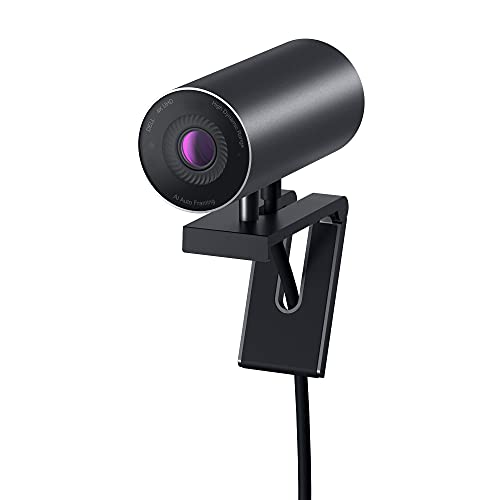
5. Dell UltraSharp Webcam WB7022 — Best for Dell Ecosystems
The Dell UltraSharp WB7022 is built around a large Sony STARVIS CMOS sensor, the same sensor family used in professional security and surveillance cameras chosen specifically for their exceptional low-light sensitivity and dynamic range. In practice, this means the WB7022 captures bright, vibrant, and properly exposed 4K HDR footage in lighting conditions that cause lesser cameras to either underexpose the subject or blow out the background — a persistent problem in home offices where windows create harsh backlighting behind the user. Dell's Image Signal Processor handles the raw sensor data to further optimize for extreme lighting scenarios, so the output looks polished without manual camera settings.
AI Auto Framing keeps you centered in the frame as you move, and the three selectable field-of-view options — 65°, 78°, and 90° — give you meaningful control over how much of your environment appears in frame. The 65° option is ideal for tight, solo-presenter shots; the 90° opens the frame for wider desk views when showing physical materials. Dell's companion software gives you a full suite of manual adjustments including brightness, sharpness, contrast, saturation, and digital zoom, all accessible through a clean interface that matches Dell's broader monitor and display management ecosystem.
If you're running a Dell display setup with a dual-screen configuration or a fully integrated Dell workspace, the WB7022's aesthetic and software integration with Dell Display Manager creates a cohesive experience that third-party cameras simply can't replicate. The mounting system is engineered specifically for Dell monitors with a precise clip fit, though it also works on standard monitor tops. For Dell-centric business environments in 2026, this is the natural, best-matched choice that eliminates driver conflicts and ensures seamless compatibility.
Pros:
- Sony STARVIS CMOS sensor delivers exceptional low-light sensitivity and HDR 4K output
- Three selectable field-of-view angles (65°, 78°, 90°) for flexible framing control
- Full manual adjustment suite through Dell's companion software interface
- AI Auto Framing keeps you centered reliably during natural movement
Cons:
- Premium pricing that sits above comparable 4K AI cameras from Logitech and Anker
- Software integration benefits are strongest within Dell ecosystems and less relevant on non-Dell hardware
6. Jabra PanaCast 20 Conferencing Camera — Best for Presentations
Jabra built its reputation in professional audio and conferencing hardware, and the PanaCast 20 brings that same enterprise-grade philosophy to a personal webcam. The 13-megapixel camera sensor driving the 4K Ultra HD output is paired with Jabra's onboard AI processing, which handles intelligent zoom, lighting optimization, and real-time framing adjustments without introducing any perceptible latency — a genuine technical achievement that many AI-camera competitors still struggle with. When you're presenting to a group, the intelligent zoom tracks your movements and adjusts the crop smoothly, so you stay in frame whether you're leaning toward the camera or stepping back to reference a monitor beside you.
The lighting optimization system is notably sophisticated — it analyzes your environment in real time and adjusts the image processing to compensate for whatever light source is dominant in the frame, whether that's overhead fluorescents, natural window light, or mixed sources. This produces a consistently natural-looking image across different times of day and office configurations without requiring you to adjust physical lighting before each call. The plug-and-play USB-C connection ensures compatibility with modern laptops and docking stations, and Jabra's software layer provides additional controls for users who want to fine-tune the camera behavior beyond the AI defaults.
For professionals who present frequently to clients, boards, or large teams, the PanaCast 20 produces results that make you look deliberate and polished on screen — which is the specific use case where a premium camera pays for itself most clearly. It's a camera built around the assumption that you value your on-screen presence enough to invest in hardware that manages it intelligently, and Jabra delivers on that promise with consistent, well-engineered performance in 2026.
Pros:
- 13MP sensor with real-time 4K AI processing and zero-latency intelligent zoom
- Intelligent lighting optimization adapts automatically to mixed and challenging light sources
- USB-C plug-and-play with enterprise-grade build quality and Jabra's proven reliability
- Excellent for professional presentations where consistent framing and exposure matter most
Cons:
- High price point reflects enterprise positioning and may be difficult to justify for casual users
- Lacks the physical privacy shutter that competitors at similar price levels offer
7. Insta360 Link 2 PTZ 4K Webcam — Best PTZ Webcam
The Insta360 Link 2 is the most technically ambitious webcam on this list — a full pan-tilt-zoom (PTZ) camera with a 1/2-inch sensor, which is substantially larger than the sensors found in every other camera here. That sensor size directly translates to better light collection, which means cleaner footage in low-light environments, more natural depth and color, and significantly better dynamic range when the background is brighter than your face. The Phase Detection Auto Focus system locks on to your face and tracks it with the kind of responsiveness you expect from a dedicated camera rather than a webcam, eliminating the hunting and re-locking delays that interrupt footage quality during movement.
The PTZ mechanism is where the Link 2 truly separates itself from the competition. The camera physically rotates to follow you as you move — not through a digital crop or AI framing simulation, but through actual motor-driven pan and tilt. This means you get full-resolution tracking across a wide physical range without the image quality penalty that digital zoom and crop impose. Gesture control lets you trigger specific camera behaviors without touching the device, which is genuinely useful during live presentations or streaming sessions where interrupting your flow to adjust camera settings breaks the momentum of your content.
Advanced AI noise-canceling microphones handle background sound with the same level of care applied to the video system, filtering ambient noise in real time to deliver clear, present audio even in acoustically challenging environments. For creators who use this camera across streaming, video conferencing, and content production — and who are also considering investments like a multifunction printer for their home office workflow — the Link 2 is a platform-grade tool that grows with your production needs rather than a single-purpose conferencing device. It works with Zoom, Teams, Twitch, and every other major platform you're likely to use in 2026.
Pros:
- 1/2-inch sensor delivers exceptional low-light performance and natural depth-of-field
- True PTZ motor-driven tracking provides full-resolution subject following without digital crop
- Phase Detection Auto Focus locks instantly and tracks without hunting or delay
- Gesture control enables hands-free camera adjustments during presentations and streams
- HDR plus best-in-class AI noise canceling for professional audio in any environment
Cons:
- Highest price point on this list — most of the premium is justified but not for everyone
- PTZ mechanism adds physical footprint and a slight learning curve for optimal setup positioning
- Overkill for users who primarily need a clean, stationary conferencing camera
How to Pick the Best Webcam for Video Conferencing
Resolution: 1080p vs. 4K — What Actually Matters on a Call
The resolution debate in webcam shopping often generates more confusion than clarity. Most major video conferencing platforms — including Zoom, Microsoft Teams, and Google Meet — stream at 1080p under standard bandwidth conditions, which means a 4K webcam will internally downscale its output to 1080p for transmission. The practical benefit of a 4K sensor in a conferencing context is sharper source footage before compression artifacts are applied, and a higher-quality starting point that the platform's encoding algorithm can work with more effectively. For users attending calls from home on a stable broadband connection, 4K is a meaningful upgrade over 1080p. For users on congested networks or mobile connections, the platform will throttle resolution regardless of what your camera captures, making 1080p a more efficient and equally effective choice. Evaluate your network conditions honestly before assuming 4K provides a visible advantage for your specific setup.
Platform Certification and Enterprise Integration
Buying a webcam certified for Microsoft Teams, Zoom, or Google Meet isn't just a marketing distinction — certified devices undergo compatibility testing that ensures they integrate properly with each platform's hardware management tools, deliver stable drivers, and meet the video and audio quality thresholds the platform's engineering teams have defined as acceptable for professional use. In enterprise environments, IT departments often restrict hardware to certified-only lists precisely because uncertified devices introduce unpredictable behavior during updates and platform version changes. If your organization manages hardware centrally, prioritize TAA compliance and platform certification as non-negotiable requirements before evaluating any other specs. For individual users, certification provides a practical assurance that the camera will work reliably across platform updates without requiring you to troubleshoot driver conflicts.
Microphone Quality and Noise Cancellation
The microphone in your webcam matters more than most buyers expect when they're focused on image quality comparisons. Poor-quality audio — characterized by room reverb, background noise bleed, or thin, distant-sounding voice reproduction — degrades meeting quality far more noticeably than a step down in video resolution. AI noise cancellation has improved substantially in 2026, with the best implementations in the Jabra PanaCast 20, Anker C310, and Insta360 Link 2 filtering ambient sound in real time while preserving natural voice characteristics. When evaluating webcam microphones, consider your specific environment: open-plan offices, rooms with hard surfaces, and home offices near traffic or family noise all place higher demands on noise cancellation systems than a quiet, acoustically treated private office. If you spend more than three hours daily on calls, the microphone quality difference between budget and premium cameras translates directly into listener fatigue reduction and perceived professionalism.
AI Features: Framing, Autofocus, and Lighting Correction
AI-powered camera features have moved from novelty to practical necessity in the best conferencing webcams of 2026, and understanding what each feature actually does helps you evaluate which ones matter for your use case. AI auto framing tracks your position in the frame and adjusts the crop to keep you centered — useful if you move around during calls, but unnecessary if you sit in a fixed position relative to the camera. AI lighting correction analyzes the ambient light in your environment and adjusts the exposure parameters dynamically — a significant advantage in home offices with variable natural light throughout the day. AI autofocus, particularly Phase Detection Auto Focus as found in the Insta360 Link 2, eliminates the hunting delay that contrast-detection autofocus systems exhibit when you move or when something crosses between you and the lens. Evaluate which of these features address real problems you experience on your current setup, and weight them accordingly rather than assuming all AI features contribute equally to your meeting quality.
Common Questions
What resolution webcam do I need for professional video conferencing in 2026?
For most professional conferencing scenarios, a 1080p webcam delivers fully adequate quality because major platforms like Zoom and Microsoft Teams stream at 1080p under normal bandwidth conditions. A 4K webcam improves the source footage quality and provides a better starting point for compression, which can produce visibly sharper output on stable high-bandwidth connections. If you're regularly presenting to large groups or recording sessions for later viewing, 4K is worth the additional investment. For daily internal meetings and one-on-one calls, a high-quality 1080p camera like the Logitech Brio 505 is the practical and cost-effective choice.
Does it matter if a webcam is certified for Microsoft Teams or Zoom?
Yes, certification matters more than most buyers realize, particularly in enterprise environments. Certified webcams have been tested specifically for compatibility with the platform's hardware management tools, driver stability across updates, and audio/video quality thresholds the platform enforces. For individual users, certification provides assurance of reliable operation across platform updates. For IT departments managing company-wide hardware, certification and TAA compliance are typically mandatory procurement requirements that narrow your choices significantly — which is why the Logitech Brio 505 and MX Brio 705 both lead with their certification credentials.
Is a separate microphone necessary if I buy a premium webcam?
For most conferencing use cases, the built-in microphones in premium webcams like the Jabra PanaCast 20, Anker AnkerWork C310, and Insta360 Link 2 deliver audio quality that's fully professional and eliminates the need for a separate USB microphone. These cameras use dual or multi-microphone arrays with AI noise cancellation that handles background noise effectively. Where a separate microphone remains the better choice is in podcast-style recording, content creation requiring broadcast-quality audio, or acoustically challenging environments like open offices where a directional cardioid microphone placed close to the speaker outperforms any array system mounted on a monitor.
Can I use a 4K webcam on an older computer or a slow internet connection?
A 4K webcam works on older hardware, but its benefits are reduced in two specific ways. First, older CPUs may struggle to process 4K video streams efficiently, causing higher CPU utilization during calls, which can affect system performance for other applications running simultaneously. Second, on slow or congested internet connections, video conferencing platforms automatically throttle output resolution to maintain connection stability — so the platform may downscale your 4K output to 720p or lower regardless of what your camera captures. On a modern laptop with a stable broadband connection, 4K provides a genuine improvement. On older hardware or constrained networks, a high-quality 1080p camera is the more efficient and equally effective option.
What does TAA compliance mean and do I need it?
TAA stands for Trade Agreements Act, a U.S. federal procurement regulation that requires certain government and government-contractor purchases to source from TAA-compliant countries. If you're purchasing webcams for a federal agency, a government contractor, or a public institution subject to federal procurement rules, TAA compliance is a mandatory requirement, not an optional preference. For private sector businesses, TAA compliance is optional but some enterprise IT procurement policies require it as a standard across all hardware purchases to simplify compliance management. Individual consumers and small businesses have no obligation to purchase TAA-compliant hardware, so compliance status should not factor into your buying decision if you're not subject to federal contracting requirements.
How do I choose between a PTZ webcam like the Insta360 Link 2 and a fixed-lens camera?
A PTZ (pan-tilt-zoom) webcam like the Insta360 Link 2 physically rotates to follow you across a wide range of motion, delivering full-resolution tracking without the image quality penalty of digital cropping. This is the right choice if you frequently move around during calls or presentations, work in a space where you can't always position yourself directly in front of the camera, or use the camera for streaming and content creation in addition to conferencing. A fixed-lens camera with AI framing achieves a similar result through digital crop and zoom — more convenient and smaller, but with a noticeable resolution trade-off when the framing pulls the subject into a tight crop. For stationary desk setups with a predictable camera-to-subject distance, a fixed-lens camera with AI framing is the practical, sufficient choice. For dynamic environments and multi-use production setups, the Insta360 Link 2's PTZ system justifies the premium.
Buy on Walmart
- Logitech Brio 505 Full HD 1080p Webcam with auto Light Corre — Walmart Link
- Logitech MX Brio 705 for Business 4K Webcam with Auto Light — Walmart Link
- Logitech C920x HD Pro PC Webcam, Full HD 1080p/30fps Video, — Walmart Link
- Anker AnkerWork C310 Webcam, 4K Webcam, 12 Megapixel, AI Aut — Walmart Link
- Dell UltraSharp Webcam - WB7022 - 4K UHD - Large Sony STARVI — Walmart Link
- Jabra PanaCast 20 Conferencing Camera - Flexible Plug & Play — Walmart Link
- Insta360 Link 2 - PTZ 4K Webcam for PC/Mac, 1/2" Sensor, AI — Walmart Link
Buy on eBay
- Logitech Brio 505 Full HD 1080p Webcam with auto Light Corre — eBay Link
- Logitech MX Brio 705 for Business 4K Webcam with Auto Light — eBay Link
- Logitech C920x HD Pro PC Webcam, Full HD 1080p/30fps Video, — eBay Link
- Anker AnkerWork C310 Webcam, 4K Webcam, 12 Megapixel, AI Aut — eBay Link
- Dell UltraSharp Webcam - WB7022 - 4K UHD - Large Sony STARVI — eBay Link
- Jabra PanaCast 20 Conferencing Camera - Flexible Plug & Play — eBay Link
- Insta360 Link 2 - PTZ 4K Webcam for PC/Mac, 1/2" Sensor, AI — eBay Link
The best webcam for video conferencing is the one that makes you forget you're thinking about your camera — and lets you focus entirely on what you're saying.
 |
 |
 |
 |

About Diego Martinez
Diego Martinez is Ceedo's webcam and streaming hardware writer. He started streaming on Twitch in 2014 and grew a small audience covering indie game development, which led him to take camera and microphone equipment far more seriously than the average viewer. Diego studied film production at California State University, Long Beach and worked as a freelance video editor before pivoting to writing about consumer AV gear. He has tested webcams from Logitech, Razer, Elgato, AVerMedia, and dozens of smaller brands and has a particular interest in low-light performance, autofocus speed, and built-in noise suppression. He still streams weekly from his home studio in San Diego.