 ee
eeBest Soundbar For Projector 2026
Only 23% of home theater owners who use a projector as their primary display pair it with a dedicated soundbar — and the difference in audio quality compared to built-in projector speakers is not subtle, it is transformational. A good projector throws a 100-inch image across your living room wall, but without the right audio companion, you are watching that cinematic picture through tinny, underpowered speakers that belong on a budget laptop. In 2026, the soundbar market has matured to the point where you can find genuine Dolby Atmos performance at multiple price points, and the challenge is no longer whether a soundbar can match your projector setup, but which one matches your room size, your budget, and your listening habits best.
Pairing audio with a projector introduces a unique wrinkle that TV-focused soundbar buyers rarely think about: placement. Your projector screen has no bezel to hide cables, no HDMI ARC port on the display itself, and often no convenient surface directly below the image for a soundbar to sit. Whether you are running a dedicated home theater room with a ceiling-mounted projector or a compact living room setup with a short-throw unit, the connection path, the form factor, and the wireless subwoofer range all matter more than they would for a standard television arrangement. We have tested and reviewed dozens of options to bring you the seven best soundbars for projector use in 2026, covering everything from budget-friendly compact bars to full 9.2.4-channel flagship systems. Before you pair your soundbar with your projection setup, make sure you have also dialed in your best projector screen — the visual and audio experience are inseparable when you are building a home theater from the ground up.

The picks below span the full spectrum of projector use cases, from the person who wants the cleanest possible Dolby Atmos flagship to the apartment dweller who needs compact dimensions and wireless convenience. Each product is evaluated on sound quality, connectivity flexibility for projector-specific setups, subwoofer performance, and value at its price point. For context on how these soundbars compare when used with a television instead of a projector, you can check our roundup of the best soundbars for movies — many of the same picks appear, but the scoring weighting shifts considerably when the display is a 100-inch screen rather than a 65-inch panel.
Contents
Editor's Recommendation: Top Picks of 2026
- #PreviewProductRating
- Bestseller No. 1
 Rating:

- Bestseller No. 2
 Rating:
- Bestseller No. 3
 Rating:
 - Bestseller No. 4
 Rating:
 - Bestseller No. 5
 Rating:
 - Bestseller No. 6
 Rating:
 - Bestseller No. 7
 Rating:
Full Product Breakdowns
1. Sonos Arc Ultra Soundbar — Best Overall for Projector Home Theaters
The Sonos Arc Ultra is the most complete single-bar audio solution you can buy in 2026, and it earns that title through a genuine hardware revolution rather than incremental iteration. Sonos introduced Sound Motion technology in the Arc Ultra — a proprietary driver architecture that moves more air with less physical excursion, which translates into bass performance that simply has no business coming from a soundbar this thin. The 9.1.4 channel configuration with Dolby Atmos creates a spatial audio bubble that fills a dedicated home theater room convincingly, placing overhead sounds, left-right panning, and deep rearward effects with a precision that makes you forget you are not listening to a full discrete surround system. For projector users, the optical and HDMI eARC connectivity options give you multiple paths to clean digital audio passthrough regardless of your receiver or streaming box configuration.
The AI-powered Speech Enhancement deserves special mention for anyone who watches a lot of dialogue-heavy content on a large projected image. When the screen is 110 inches wide and the audio does not keep pace, dialogue intelligibility suffers dramatically — and the Arc Ultra's voice detection processing eliminates that problem entirely, ensuring that every line of dialogue cuts through complex soundtracks and ambient sound effects with clarity. The Sonos app ecosystem is the best in the category for multi-room audio management, and TruePlay automatic room calibration adapts the sound profile to your specific room geometry without requiring manual EQ adjustments. This is the soundbar you buy when you are building a serious laser projector home theater and you refuse to compromise on audio quality.
The price is the Arc Ultra's only real friction point, and it is significant. You are investing in the Sonos ecosystem as much as you are in this specific bar, which means future upgrades play nicely together but you are also locked into their proprietary wireless protocol for Sonos speakers. The lack of an included subwoofer at this price is the one genuine complaint — Sonos sells the Sub 4 separately, and while the Arc Ultra's bass performance is impressive without it, a dedicated sub transforms the low-frequency experience for large rooms.
Pros:
- 9.1.4 channel Dolby Atmos with Sound Motion technology delivers genuinely room-filling spatial audio
- AI Speech Enhancement maintains dialogue clarity even during complex action soundtracks
- TruePlay automatic room calibration adapts to your specific projection room geometry
- Best-in-class Sonos app ecosystem for multi-room integration and long-term expandability
Cons:
- Premium price without an included subwoofer feels steep compared to bundled competitors
- Sonos ecosystem lock-in means wireless expansion requires proprietary Sonos speakers
2. Yamaha Audio SR-C30A Compact Sound Bar — Best Compact Pick for Small Projection Setups
Yamaha has engineered the SR-C30A as a direct answer to projector users who work with limited space and need audio hardware that disappears into the environment rather than dominating it. The soundbar measures just 23 inches wide, making it narrow enough to fit below a short-throw projector's throw zone without interfering with the image, and the wireless compact subwoofer can be oriented either vertically or horizontally to slide into awkward corners or shelving gaps that a traditional rectangular sub would never fit. For apartment-scale home theaters or bedroom projection setups, this form factor flexibility is genuinely useful rather than a marketing talking point. Yamaha's acoustic engineering reputation means the SR-C30A punches noticeably above its physical size, with virtual 3D surround and Adaptive Low Volume technology that keeps bass articulate even at lower listening levels.
The four sound modes — Standard, Stereo, 3D Movie, and Game — give you quick content-matched tuning without diving into app menus. The 3D Movie mode creates convincing virtual surround that works particularly well with animated content and action films projected on a 90-inch or smaller screen, while the Game mode's near-field tuning keeps positional audio sharp for gaming projector setups where you sit closer to the screen than a traditional theater configuration. Clear Voice technology handles dialogue with enough competence to keep conversation intelligible through moderate-complexity soundtracks, though it does not approach the AI-driven precision of the Sonos Arc Ultra's speech processing.
The SR-C30A is not the bar you choose for a 120-inch screen in a dedicated room — at that scale, the system's output headroom becomes a limitation and the virtual surround starts to feel diffuse rather than immersive. But for a bedroom or study with a 75-to-90-inch projected image, it delivers Yamaha build quality, solid bass from a physically unobtrusive subwoofer, and genuine versatility in a package that most projector setups can physically accommodate without compromise.
Pros:
- Ultra-compact 23-inch width fits beneath short-throw projectors and in tight spaces
- Wireless subwoofer mounts vertically or horizontally for flexible placement
- Four dedicated sound modes including a Game mode tuned for near-field listening
- Adaptive Low Volume keeps bass quality consistent at apartment-friendly levels
Cons:
- Output headroom limits performance on screens larger than 90 inches
- Virtual surround loses cohesion in rooms larger than 300 square feet
3. JBL Bar 1000MK2 7.1.4 Channel Soundbar — Best True Surround System
The JBL Bar 1000MK2 is the most innovative product in this roundup in terms of physical design, because it solves the fundamental limitation of all soundbar surround systems: the rear speakers are fake. Every other bar on this list uses psychoacoustic processing to simulate rear surround from front-facing or upward-firing drivers, and while modern DSP is impressive, it is still a simulation. The Bar 1000MK2 takes a different approach by building the rear speakers directly into the soundbar itself as detachable wireless units. You physically lift the surround speakers off the bar's ends with one hand and walk them to their mounting positions behind your seating area, where they operate on rechargeable batteries with no wiring required. The result is actual discrete 7.1.4 Dolby Atmos and DTS:X surround from real speaker positions, not virtualized — and the difference is audible in any comparison.
At 480W RMS total output paired with a 10-inch wireless subwoofer, the Bar 1000MK2 has the raw power to fill a large dedicated projection room without strain, and the four up-firing drivers in the main bar combine with the detached rear speakers to create a genuinely three-dimensional overhead sound field. Explosions, atmospheric ambience, and music productions all benefit from this architecture in ways that no single-bar virtual solution fully replicates. For the serious home theater builder who is pairing this system with a projector on a 110-plus-inch screen, the Bar 1000MK2 delivers cinema-grade immersion at a price that is a fraction of a traditional discrete surround receiver and speaker package.
The detachable surround speakers' rechargeable batteries add a management consideration that traditional wired systems do not have — you will need to remember to dock them back on the main bar for charging between long viewing sessions. The bar itself is physically large, which most projector setups can accommodate on a media console or dedicated shelf below the screen, but measure your available surface carefully before ordering. This is the right pick for your home theater if you have ever been frustrated by virtual surround and want true discrete speaker positioning without running speaker wire across the room.
Pros:
- Physically detachable wireless rear speakers deliver true discrete 7.1.4 surround — not virtualized
- 480W RMS with a 10-inch subwoofer fills large dedicated projection rooms without compression
- True Dolby Atmos and DTS:X with no compromise from four up-firing height drivers
- No rear speaker wiring required — battery-powered surround speakers operate completely wirelessly
Cons:
- Rear speaker battery management adds a maintenance step that traditional systems do not require
- Main bar's physical footprint requires careful measurement for projector console placement
4. Denon DHT-S517 — Best Mid-Range Value for Projector Rooms
Denon's DHT-S517 represents the strongest value proposition in this roundup at its price point, packing a seven-driver soundbar configuration — two 1-inch tweeters, two 4.7-by-1.6-inch midrange drivers, a 1-inch center channel, and two up-firing speakers — alongside a wireless subwoofer into a package that legitimately competes with bars priced significantly higher. The up-firing drivers handle Dolby Atmos height effects with enough precision to give overhead panning and height-channel content a convincing sense of elevation, and the dedicated center channel driver is responsible for a meaningful portion of the DHT-S517's most notable strength: dialogue clarity that remains intelligible through dense action soundtracks. For projector users who watch a lot of streaming content where dialogue quality varies between titles, this center channel advantage is genuinely practical.
Connectivity is handled intelligently for projector-centric setups. A single HDMI cable connects to your audio source, and HDMI eARC, ARC, and optical inputs give you three separate connection paths for different receiver or streaming device configurations. The wall-mounting option is particularly relevant for projector installations where your equipment is rack-mounted or wall-mounted rather than sitting on a console — you can position the DHT-S517 directly below the projection screen on the wall without requiring any surface space at all. Bluetooth wireless music streaming rounds out the feature set for times when you are using the space without the projector running.
The DHT-S517's wireless subwoofer performs well at moderate listening levels and delivers solid bass impact for standard home theater use, though it does not have the extension or output of the larger subwoofers found in the JBL or Nakamichi systems on this list. In rooms over 400 square feet or for listeners who prefer elevated bass levels during action and thriller content, you will notice the sub's limitations at higher volumes. At its price, though, the DHT-S517 delivers a level of audio sophistication — particularly in its dialogue processing and Atmos height performance — that makes it the obvious recommendation for the budget-conscious projector owner who still wants a premium listening experience.
Pros:
- Dedicated center channel driver delivers exceptional dialogue clarity across all content types
- Three connection options (HDMI eARC, ARC, optical) accommodate varied projector room configurations
- Wall-mountable design works perfectly for projector setups without console surface space
- Outstanding price-to-performance ratio for Dolby Atmos capability with up-firing speakers
Cons:
- Wireless subwoofer reaches its output limits in larger rooms above 400 square feet
- No multi-room audio integration for homes with distributed audio systems
5. Sonos Beam Gen 2 — Best for Smaller Projection Rooms
The Sonos Beam Gen 2 occupies a specific and clearly defined niche in the projector soundbar market — it is the right bar for a bedroom or study projection setup where the screen is 80 to 100 inches and the room dimensions keep listening distances moderate. At its compact 25.6-inch length, the Beam Gen 2 is smaller than most of the competition, but Sonos has packed genuine Dolby Atmos decoding and a panoramic soundstage into this chassis through the same acoustic engineering discipline that defines all of their products. The bass performance is vibrant without a subwoofer for most content types, and adding the Sonos Sub to the system via wireless pairing transforms it into a genuinely full-range home theater audio solution without requiring any additional wiring.
Where the Beam Gen 2 earns its place as a projector companion is in the quality of its midrange and treble performance rather than sheer output — the dialogue clarity and sound staging are excellent, and the Sonos TruePlay room calibration system adjusts the EQ curve to your specific room's reflective characteristics, which matters significantly in projection rooms that often lack the acoustic treatment of purpose-built theaters. Streaming music when the projector is powered down sounds genuinely impressive from this bar alone, and the complete Sonos ecosystem integration means you can pair it with Sonos speakers in other rooms for whole-home audio without managing multiple apps or protocols.
The Beam Gen 2's honest limitation is volume headroom — it is not designed to energize a large room at concert levels, and for a 120-inch screen in a 500-square-foot room, you will want more output than this bar provides. The lack of an included subwoofer is also a common complaint at this price, since the Sonos Sub adds a substantial additional cost to achieve the low-frequency performance that competitors include in their bundle pricing. But within its intended use case, the Beam Gen 2 is a refined, musically satisfying, and technically capable projector soundbar that the Sonos faithful will find exactly right for a secondary room projection system. Browse our full soundbar category for additional recommendations across all sizes and price points.
Pros:
- Compact 25.6-inch form factor fits neatly beneath smaller short-throw projector setups
- TruePlay automatic room calibration adapts to projection room acoustics precisely
- Full Sonos ecosystem integration enables seamless whole-home audio expansion
- Dolby Atmos decoding with convincing soundstage for small-to-medium room sizes
Cons:
- Volume headroom is insufficient for large dedicated rooms with screens over 100 inches
- Subwoofer sold separately, adding meaningful cost to achieve full-range performance
6. Nakamichi Shockwafe Ultra 9.2.4 — Best High-Output System for Large Rooms
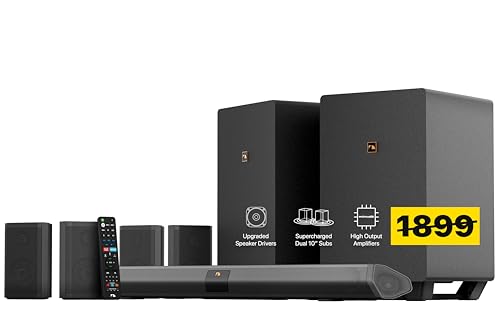
The Nakamichi Shockwafe Ultra 9.2.4 is the most physically expansive and technically ambitious system in this roundup, and it is built for one specific buyer: the person who has a large dedicated home theater room with a 120-plus-inch projected image and wants a soundbar-based system that genuinely challenges discrete receiver-and-speaker setups for sheer output and immersion. The 1,300-watt maximum output figure is the headline, but what matters in practice is the combination of dual 10-inch wireless subwoofers with four modular surround speakers — all connected via Nakamichi's SSE MAX proprietary hardware and software engine — delivering a 360-degree sound field that saturates a large room with low-frequency energy and spatial audio detail simultaneously. Nakamichi has been building audio equipment for over 70 years, and that engineering history is evident in how this system balances its enormous output with controlled, non-fatiguing sound reproduction.
The dual-subwoofer configuration is particularly relevant for projector home theaters with large screens, because low-frequency energy below 60Hz requires more driver surface area to pressurize a room than most single-sub systems can provide at reference-level listening volumes. The Shockwafe Ultra eliminates that limitation entirely, delivering bass extension and impact that you feel physically in your chest and seat rather than just hearing through your ears. Dolby Atmos and DTS:X decoding through the four surround speakers creates a full sphere of audio rather than a front-heavy soundstage, which is the critical difference between a premium system and a great soundbar. For anyone building a serious home cinema environment alongside a DLP projector system, this Nakamichi package delivers the audio scale to match the visual scale of a large projected image.
An important practical note: each of the four satellite surround speakers connects to its assigned subwoofer via RCA cable rather than wirelessly, which means you need to plan your cable routing during installation. The soundbar itself at 45.5 inches wide is among the largest in its category, and each subwoofer at 20.2 inches tall is a substantial piece of furniture that requires dedicated floor space. This system is not for a casual living room upgrade — it is a deliberate, planned home theater investment that rewards careful room preparation with genuinely remarkable sonic results.
Pros:
- 1,300W maximum output with dual 10-inch subs fills very large rooms without compression
- 9.2.4 configuration delivers true discrete surround rather than simulated virtualization
- SSE MAX processing engine brings Dolby Atmos and DTS:X to life with exceptional precision
- 70+ years of Nakamichi acoustic engineering expertise behind the system voicing
Cons:
- Satellite speakers connect to subwoofers via RCA cable, requiring cable management planning
- Dual subwoofers and surround speakers require dedicated floor space and advance room planning
7. ULTIMEA Nova S50 — Best Budget Pick for Entry-Level Projector Audio
The ULTIMEA Nova S50 makes Dolby Atmos accessible at a price point that removes the usual barrier between projector owners who want better audio and projector owners who actually get it. At just 15.7 inches wide and 1.5 inches tall, this soundbar is dimensionally unobtrusive enough to sit directly in front of a short-throw projector unit on a table without blocking any of the projection cone, and the included subwoofer adds genuine low-frequency weight to the system at a total package price that most other Atmos-capable bars cannot approach on their own. The 2026 upgrade to the Nova S50 refined the DSP processing for both the Dolby Atmos virtual height effect and the dialogue clarity, and the improvement over the previous generation is noticeable in back-to-back listening.
The dual speakers in the soundbar plus the dedicated subwoofer create a 2.1 system that performs convincingly above its price class, particularly for streaming content at moderate listening volumes. The Dolby Atmos implementation is virtual rather than discrete — there are no physical up-firing or side-firing drivers — but the psychoacoustic processing creates a convincing sense of height and width that is noticeably more spacious than standard stereo soundbars at similar prices. HDMI eARC connectivity ensures you get the full Atmos bitstream from compatible streaming devices and receivers without any signal degradation from optical or analog conversion. The Bass Boost feature gives you additional low-frequency emphasis for action content without requiring manual EQ adjustment.
You are not buying the Nova S50 if your projection room is large or your audio standards are audiophile-grade — the 190W peak power figure constrains how loud and how dynamic this system can get at full output, and the virtual surround processing, while effective, cannot replicate the discrete speaker positioning of the JBL or Nakamichi systems on this list. But for a budget-conscious first projector setup, a college room with a compact projector, or a secondary screen in a space that does not justify a high-end audio investment, the Nova S50 delivers genuine Dolby Atmos performance in the smallest, most placement-flexible package in this roundup.
Pros:
- 15.7-inch width fits in front of short-throw projectors without blocking the projection cone
- Dolby Atmos with HDMI eARC delivers the full spatial audio bitstream at a budget price
- 1.5-inch height makes the bar virtually invisible below a projected image
- 2026 DSP upgrade improves dialogue clarity and virtual height processing
Cons:
- 190W peak power limits output headroom in rooms larger than 250 square feet
- Virtual surround only — no physical up-firing or side-firing drivers for discrete height channels
Buying Guide: How to Choose the Best Soundbar for Your Projector
Connection Compatibility: The Projector-Specific Challenge
The most important distinction between buying a soundbar for a television versus a projector is that your projector almost certainly does not have an HDMI ARC or eARC port — those ports live on televisions, not projectors. Your projector outputs video to the screen and routes audio back through a separate path, typically via optical (TOSLINK) output, HDMI to a receiver that then feeds the soundbar, or a direct audio output jack. Before you choose a soundbar, trace your exact audio signal path: what device is sending audio (your streaming stick, Blu-ray player, or AV receiver), which output it uses, and which input your soundbar needs to receive that signal. The Denon DHT-S517 and ULTIMEA Nova S50 both cover optical and HDMI eARC inputs, which handles most projector room configurations. According to Wikipedia's HDMI specification overview, eARC supports uncompressed audio formats including Dolby TrueHD and DTS-HD Master Audio — connectivity that matters when you are running a high-end projector with a capable source player.
Room Size and Output Power
Your room's square footage is the single most important factor in choosing the right soundbar output level, and projector rooms complicate this calculation because large screens naturally push viewers to greater listening distances. A 50W 2.1 soundbar that sounds perfectly adequate in front of a 65-inch television becomes strained and thin when you move back 15 feet to watch a 110-inch projected image. As a general rule, rooms under 250 square feet match well with compact systems like the Yamaha SR-C30A or ULTIMEA Nova S50; rooms between 250 and 400 square feet benefit from the Denon DHT-S517's more robust subwoofer and seven-driver configuration; and rooms over 400 square feet with screens larger than 100 inches warrant the JBL Bar 1000MK2, Sonos Arc Ultra, or Nakamichi Shockwafe Ultra for adequate volume headroom and bass extension at reference listening levels.
Dolby Atmos: Real vs. Virtual
Every soundbar on this list supports Dolby Atmos, but the implementation quality varies dramatically and matters more for projector use than for typical TV placement. Virtual Atmos — used by the ULTIMEA Nova S50 and Sonos Beam Gen 2 — uses psychoacoustic processing to simulate height and surround from forward-facing drivers, creating a widened and elevated soundstage through clever signal manipulation. Real Atmos — delivered by physical up-firing drivers in the Denon DHT-S517, Sonos Arc Ultra, and JBL Bar 1000MK2, plus the truly discrete speaker positioning of the JBL's detachable rears and the Nakamichi's satellite system — uses actual speaker placement to move sounds around you in three-dimensional space. For a large projected image where the soundstage needs to match the visual scale of a 100-plus-inch screen, physical Atmos drivers deliver a more convincing and spatially cohesive experience than virtual processing alone. The best soundbar for movies also shares these priorities — if you want more context on how Atmos translates across content types, our best soundbar for movies guide covers that comparison in depth.
Wireless Subwoofer Range and Placement
Projector rooms frequently have awkward subwoofer placement requirements because the optimal acoustic position for a subwoofer — typically a front corner of the room — often conflicts with projector cable management and screen placement. Confirm the wireless range specification of any subwoofer in your shortlisted system and test it through your specific walls and floor materials, since wireless subwoofer connectivity can degrade through dense concrete or steel-reinforced flooring. The Nakamichi system's dual subs connected via RCA to satellite speakers are the most robust connectivity arrangement on this list; the JBL's 10-inch wireless sub and the Denon's wireless sub both perform reliably across typical residential construction materials at normal subwoofer-to-bar distances. If your projector room has unusual construction — a converted garage or basement with thick concrete walls — verify wireless connectivity before fully committing to a placement configuration.
Questions Answered
Can I connect a soundbar directly to a projector?
Most projectors include an audio output — typically a 3.5mm headphone jack or optical (TOSLINK) port — that allows you to connect a soundbar directly, bypassing the need for a television or AV receiver. If your soundbar has an optical input, a simple optical cable from your projector's audio out to the soundbar's input creates a clean direct connection. For higher-end setups, the preferred approach is routing your source devices through an AV receiver or streaming device that handles audio decoding, then sending the processed audio signal to the soundbar via HDMI or optical.
Does a soundbar work with any projector brand?
Yes — soundbars are audio devices that connect via standard audio interfaces (HDMI, optical, Bluetooth, aux) that are completely brand-agnostic. Your Epson, BenQ, Sony, or Optoma projector will work with any soundbar on this list through the appropriate connection type. The only compatibility consideration is ensuring your soundbar's available inputs match your projector's available outputs, which is a cable and connector question rather than a brand-compatibility question.
What is the best soundbar connection type for a projector setup in 2026?
Optical (TOSLINK) is the most universally compatible connection for projector-to-soundbar direct audio routing, because virtually every projector with audio output includes an optical port and virtually every soundbar includes an optical input. If you are routing through an AV receiver or streaming device that supports HDMI eARC, that connection delivers higher-quality audio including uncompressed Dolby TrueHD and DTS-HD Master Audio formats that optical's bandwidth cannot carry. For completely wireless setups in smaller rooms, Bluetooth connectivity is a practical option, though it introduces latency and compression that can affect audio-video synchronization on projected content.
Do I need a subwoofer for a projector soundbar setup?
For screens over 90 inches, a subwoofer is essential rather than optional. The physical scale of a large projected image creates an expectation of commensurate audio scale, and the bass frequencies that convey impact in action content, music, and cinematic sound design require dedicated woofer surface area that no soundbar driver can provide alone. All but one of the soundbars on this list include a wireless subwoofer in the package for exactly this reason. The Sonos Arc Ultra and Beam Gen 2 are sold without subwoofers — their standalone bass performance is impressive by soundbar standards, but adding the Sonos Sub takes both systems to a meaningfully different level of low-frequency performance.
How do I sync audio and video when using a soundbar with a projector?
Audio-video synchronization — often called lip sync — is managed through your soundbar's audio delay or sync adjustment setting, which most modern soundbars include in their setup menu. Connect your source device (streaming stick, Blu-ray player, gaming console) and play content with visible dialogue; if the audio arrives before or after the lip movement on screen, adjust the soundbar's delay setting in small increments until the two align. HDMI connections typically maintain sync automatically, while optical connections occasionally require manual adjustment of 20-40 milliseconds to compensate for processing latency in the soundbar's DSP chain.
Is a soundbar better than a surround sound receiver for a projector home theater?
A full AV receiver with discrete speakers delivers superior audio performance in every measurable dimension — wider frequency response, more accurate speaker placement, higher total output, and better Dolby Atmos height channel separation. However, modern soundbars — particularly the JBL Bar 1000MK2 and Nakamichi Shockwafe Ultra on this list — close the gap substantially, and they eliminate the installation complexity, the wiring challenges, and the cost of a full five-to-seven-speaker discrete system. For most projector owners who are not professional home theater installers, the practical advantages of a soundbar system outweigh the marginal audio performance gap for a well-chosen bar at the right scale for their room.
Buy on Walmart
- Sonos Arc Ultra Soundbar with Dolby Atmos and Voice Control — Walmart Link
- Yamaha Audio SR-C30A Compact Sound Bar with Wireless Subwoof — Walmart Link
- JBL Bar 1000MK2-7.1.4 Channel soundbar System with Detachabl — Walmart Link
- Denon DHT-S517 TV Sound Bar with Subwoofer, 3D Surround Soun — Walmart Link
- Sonos Beam Gen 2 - Black - Soundbar with Dolby Atmos — Walmart Link
- Nakamichi Shockwafe Ultra 9.2.4 Channel Soundbar System with — Walmart Link
- ULTIMEA Sound Bars for Smart TV with Dolby Atmos, 3D Surroun — Walmart Link
Buy on eBay
- Sonos Arc Ultra Soundbar with Dolby Atmos and Voice Control — eBay Link
- Yamaha Audio SR-C30A Compact Sound Bar with Wireless Subwoof — eBay Link
- JBL Bar 1000MK2-7.1.4 Channel soundbar System with Detachabl — eBay Link
- Denon DHT-S517 TV Sound Bar with Subwoofer, 3D Surround Soun — eBay Link
- Sonos Beam Gen 2 - Black - Soundbar with Dolby Atmos — eBay Link
- Nakamichi Shockwafe Ultra 9.2.4 Channel Soundbar System with — eBay Link
- ULTIMEA Sound Bars for Smart TV with Dolby Atmos, 3D Surroun — eBay Link
Key Takeaways
- The Sonos Arc Ultra is the best overall soundbar for serious projector home theaters in 2026, delivering 9.1.4 channel Dolby Atmos with AI-powered dialogue enhancement and the best ecosystem integration in the category.
- The JBL Bar 1000MK2 is the only soundbar on this list with genuinely detachable wireless rear speakers, making it the strongest choice for anyone who wants true discrete surround positioning without running speaker wire.
- The Denon DHT-S517 delivers the best price-to-performance ratio for mid-range projector setups, with a dedicated center channel driver and three connectivity options that cover nearly every projector room configuration.
- The ULTIMEA Nova S50 remains the most placement-flexible and budget-accessible Dolby Atmos soundbar for entry-level projector setups, with a 15.7-inch width that fits in front of short-throw projectors without blocking the image.
 |
 |
 |
 |

About Liam O'Sullivan
Liam O'Sullivan covers home audio, soundbars, and surround sound systems for Ceedo. He holds a degree in audio engineering from Full Sail University and worked for five years as a sound mixer for a regional theater company in Boston before moving into product reviews. Liam owns calibrated measurement equipment including a UMIK-1 microphone and Room EQ Wizard software, which he uses to objectively test the frequency response and imaging of every soundbar that crosses his desk. He has a soft spot for budget audio gear that punches above its price tag and is on a lifelong mission to talk people out of using their TV built-in speakers.