 ee
eeBest Home Projector Screens 2026
Which home projector screen will actually deliver the cinematic experience you've been chasing — and which ones will leave you squinting at washed-out images the moment a lamp turns on nearby? If you've spent any time browsing screens, you already know the category is cluttered with options ranging from budget pull-downs to sophisticated ambient-light-rejecting panels that cost as much as a mid-range television. The short answer: the Elite Screens Yard Master 2 earns our top pick for most buyers in 2026, combining genuine versatility, rock-solid build quality, and an accessible price that keeps the whole home theater budget intact.
Choosing the right screen isn't just about picking the biggest diagonal that fits your wall. You need to match screen gain to your projector's brightness output, align the screen type — fixed frame, motorized, portable, or floor-rising — with your room's layout and lighting conditions, and make sure the material handles the throw distance your projector requires. A 1.3-gain matte white surface works beautifully in a dedicated dark room, while an ambient-light-rejecting (ALR) surface becomes essential the moment you're dealing with windows, overhead recessed lights, or an open-plan living space. Browse our full projector category for recommendations on the projectors themselves, because a great screen paired with an underpowered projector still disappoints.
We evaluated seven screens across five distinct categories — portable outdoor, ALR fixed frame, standard fixed frame, motorized drop-down, curved fixed frame, and motorized floor-rising — to give you a clear comparison across every major use case. Whether you're building a dedicated home theater, setting up a backyard movie night, or integrating a laser projector into a bright living room, there's a screen on this list that fits your situation precisely. The reviews below cover real-world performance characteristics, material specs, build quality, and the trade-offs you'll face in each decision.
Contents
- Top Rated Picks of 2026
- In-Depth Reviews
- Elite Screens Yard Master 2 — Best Portable/Outdoor Screen
- Elite Screens Aeon CineGrey 5D — Best ALR Fixed Frame Screen
- Elite Screens 120" Fixed Frame — Best Large Fixed Frame Screen
- Cineperm Matt White Fixed Frame — Best Budget Fixed Frame
- VIVIDSTORM S PRO Floor Rising — Best for UST Laser Projectors
- Elite Screens Spectrum2 — Best Motorized Retractable Screen
- Elite Screens Lunette 2 — Best Curved Screen
- What to Look For When Buying
- Common Questions
Top Rated Picks of 2026
- #PreviewProductRating
- Bestseller No. 1
 Rating:

- Bestseller No. 2
 Rating:
- Bestseller No. 3
 Rating:
 - Bestseller No. 4
 Rating:
- Bestseller No. 5
 Rating:
- Bestseller No. 6
 Rating:
 - Bestseller No. 7
 Rating:

In-Depth Reviews
1. Elite Screens Yard Master 2, 100-Inch — Best Portable/Outdoor Screen
The Elite Screens Yard Master 2 sets the standard for portable projection in 2026, and it's easy to understand why this screen consistently tops buyer satisfaction surveys across the category. You get a genuine 100-inch diagonal viewing surface — 87 inches wide by 48.8 inches tall — wrapped in Elite's CineWhite UHD-B material, which carries ISF certification and delivers a 1.3 gain factor with a full 180-degree viewing angle. That gain level is essentially the sweet spot for outdoor use: bright enough to punch through ambient dusk light, yet controlled enough that you won't see hotspotting at typical viewing distances of 10 to 15 feet. The material is fully black-backed, so light bleed from behind the screen stays completely eliminated even when you're using it on a patio with interior lights visible through a window behind you.
Setup is one of this screen's clearest competitive advantages, and if you've wrestled with collapsible screens that require reading a 12-step instruction pamphlet, the Yard Master 2's snap-on assembly process is immediately refreshing. The lightweight silver aluminum square-tube frame goes together in minutes without tools, and the entire assembled unit breaks back down and fits into the included padded carry bag without any engineering effort. You can realistically pack this screen into a car, drive to a friend's backyard, and have it fully operational before the projector finishes its warm-up cycle. Cleaning is equally painless — the CineWhite UHD-B surface wipes clean with soap and water, which matters significantly for an outdoor screen that will inevitably encounter pollen, dust, and the occasional insect.
Compatibility with short-throw and ultra-short-throw projectors is officially confirmed, giving you flexibility that many competitors at this price tier cannot match. The 16:9 aspect ratio covers every streaming service's widescreen content natively, and the screen is rated for 4K Ultra HD as well as active 3D projection, so your investment is protected if you upgrade your projector later. If you're also building out your audio setup for movie nights, check our guide on the best soundbars for movies — pairing the right audio solution with this screen transforms a backyard gathering into something genuinely cinematic.
Pros:
- Tool-free assembly completes in minutes with snap-on aluminum frame construction
- CineWhite UHD-B material is ISF certified with 1.3 gain and 180-degree viewing angle
- Compatible with standard, short-throw, and ultra-short-throw projectors
- 4K Ultra HD and active 3D ready, protecting your long-term investment
- Padded carry bag included for clean transport and storage
Cons:
- Freestanding design requires flat, relatively stable ground for secure placement
- 1.3 gain CineWhite is not an ALR material, so performance in brightly lit environments is limited
2. Elite Screens Aeon CineGrey 5D, 128-Inch ALR — Best ALR Fixed Frame Screen
If you're projecting in a room where you genuinely cannot control ambient light — an open living room, a space with side windows, or anywhere with overhead recessed lighting that stays on during viewing — the Elite Screens Aeon CineGrey 5D is the fixed-frame screen you need to take seriously. The CineGrey 5D material combines CLR (ceiling light rejecting) and ALR (ambient light rejecting) technology in a single surface, using optical micro-structures to selectively redirect projected light toward viewers while absorbing light arriving from ceiling fixtures and angled side sources. You get a 1.5 gain figure with an 80-degree viewing angle — the narrower angle is a direct consequence of the ALR optics, so seating placement matters more here than with conventional matte white surfaces.
At 128 inches diagonal with a 111.5-inch-wide by 62.7-inch-tall viewing area, this screen commands a wall with genuine authority, and the award-winning edge-free design eliminates any border interruption at the projection boundary. The six-piece split aluminum frame is lightweight yet rigid, and Elite Screens includes all mounting hardware in the box along with installation video references on their website. ISF certification on the CineGrey 5D material confirms that color accuracy meets broadcast reference standards, so what you see on screen reflects what the content creator actually intended, rather than a shifted or oversaturated interpretation. GREENGUARD and GREENGUARD Gold (UL 2818) certification adds indoor air quality assurance, which is a meaningful consideration if you're installing this screen in a bedroom or children's viewing space.
One critical limitation you must acknowledge before purchasing: the CineGrey 5D is rated for standard-throw projectors only — not ultra-short-throw or short-throw units. The ALR optical layer is engineered to work with light arriving from a specific angle range, and UST projectors projecting from below the screen's base plane will not interact correctly with the material's rejection geometry. If you're running an ultra-short-throw laser projector, the VIVIDSTORM S PRO reviewed below is specifically designed for that application. For standard-throw setups in challenging lighting environments, however, the Aeon CineGrey 5D is the most technically capable screen on this list, and its 8K readiness ensures compatibility with any resolution standard you'll encounter in 2026 or beyond.
Pros:
- CineGrey 5D ALR material rejects ceiling and ambient light with optical micro-structures
- ISF certified for broadcast-reference color accuracy
- Edge-free frameless design eliminates visual border interruption
- 4K/8K and active/passive 3D ready
- GREENGUARD Gold certified for indoor air quality
Cons:
- 80-degree viewing angle requires careful seating placement compared to standard screens
- Compatible with standard-throw projectors only — not for UST or short-throw units
3. Elite Screens 120" Fixed Frame, CineWhite UHD-B — Best Large Fixed Frame Screen
The Elite Screens SB120WH2 delivers 120 inches of dedicated home theater performance at a price point that makes it one of the most compelling value propositions in the fixed-frame category for 2026. The CineWhite UHD-B surface carries a 1.3 gain rating with ISF certification, and when you pair that with a spring-tensioned mounting system that holds the screen permanently flat without any wrinkles or waves, you're looking at a projection surface that competes directly with screens costing significantly more. The viewing area measures 104.7 inches wide by 58.7 inches tall, and the overall frame footprint — 109.4 inches wide by 63.4 inches tall — fits comfortably on a standard dedicated theater wall without requiring architectural modifications.
The 2.75-inch aluminum frame wrapped in black velvet is a detail that separates this screen from cheaper alternatives in a very practical way. Velvet-wrapped frames absorb overshoot — projected light that misses the screen surface — so you don't see a bright band around the screen edges that breaks immersion during dark content. That velvet also increases perceived contrast at the image boundary, making blacks appear deeper and more defined without any processing intervention from your projector. Compatibility spans standard, short-throw, and ultra-short-throw projectors, so if you're planning to upgrade to a UST laser projector later in 2026, this screen transitions with you without requiring replacement.
Installation follows a standard fixed-frame process: the frame assembles from individual sections, the screen material attaches via hook-and-loop or tab connections around the perimeter, and the completed assembly mounts to the wall using included hardware. If you're setting up a complete home theater room and want guidance on the full audio side of the equation, our recommendations for the best soundbars for movies pair naturally with a screen at this size and quality level. The SB120WH2 is the fixed-frame recommendation for buyers who want genuine theater-grade image quality in a controlled lighting environment without stretching into the premium ALR price tier.
Pros:
- CineWhite UHD-B 1.3 gain material is ISF certified for accurate color reproduction
- Spring-tensioned system guarantees a permanently flat, wrinkle-free projection surface
- 2.75-inch velvet-wrapped frame absorbs overshoot and enhances perceived contrast
- Compatible with standard, short-throw, and ultra-short-throw projectors
- 4K/8K Ultra HD ready
Cons:
- Matte white surface is not ALR rated, so dedicated dark room is recommended for best results
- Fixed frame requires permanent wall mounting — not suitable for multi-use spaces
4. Cineperm Matt White Fixed Frame, 82-Inch — Best Budget Fixed Frame
The Cineperm Matt White Fixed Frame earns its place on this list as the practical entry point for buyers who want a dedicated fixed-frame surface without committing to a premium investment. At 82 inches diagonal, this screen covers the sweet spot for smaller dedicated rooms or bedroom home theaters where a 120-inch screen would simply be too large for the available throw distance. The matte white surface is the standard projection material for controlled environments, providing a neutral base that lets your projector's color processing do its work without the gain shifts or viewing angle restrictions that come with ALR and high-gain materials.
Where the Cineperm earns buyer loyalty is in its reliability and straightforward design — this is a screen without unnecessary complexity, built to give you a clean flat surface that installs correctly and stays flat over years of use. If you're putting together a smaller home cinema room and keeping the total budget in check, the 82-inch diagonal is a realistic match for projectors in the mid-range brightness category operating at standard throw distances of 8 to 12 feet. The fixed-frame construction means you get the permanence and flatness advantages of a rigid screen without any motorized mechanism to maintain or repair over time.
You should understand the limitations clearly before purchasing: there is no ALR capability here, so this screen performs best in a genuinely light-controlled room where you can manage your ambient lighting. It's also a smaller surface than the other fixed-frame options on this list, which makes it a deliberate choice for specific room dimensions rather than a compromise. For the buyer who has measured their space, confirmed the throw distance, and determined that 82 inches matches their viewing setup correctly, the Cineperm delivers honest, reliable performance at a price that leaves budget available for a stronger projector or audio upgrade.
Pros:
- Budget-accessible price makes fixed-frame ownership achievable at the entry level
- Standard matte white material works with any projector type in controlled lighting
- Fixed-frame construction provides permanent flatness without motorized complexity
Cons:
- 82-inch diagonal is the smallest on this list — not suitable for large room setups
- No ALR capability; requires a dark or well-controlled room for satisfying performance
- Fewer advanced material certifications compared to premium competitors
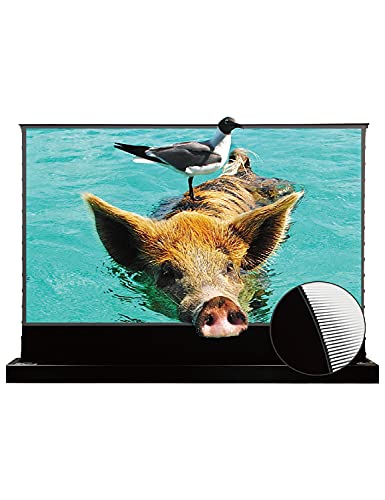
5. VIVIDSTORM S PRO Motorized Floor Rising, 100-Inch — Best for UST Laser Projectors
Ultra-short-throw laser projectors create a unique engineering challenge for screen selection that conventional screens simply cannot solve, and the VIVIDSTORM S PRO exists specifically to address that challenge. If you own an Epson, LG, Samsung, Sony, or any other UST laser projector that sits a foot or two in front of the screen and projects upward at a steep angle, you need an ALR material with optical geometry engineered for exactly that projection path. The S PRO's UST ALR material uses a special optical sawtooth microstructure combined with a light-suppression filter that channels the projector's upward-angled light directly toward viewers while blocking or absorbing ceiling light arriving from above and ambient light arriving from other directions. The result is a 97% ambient light resistance rating, which is exceptional performance for a living room environment with overhead lighting active during viewing.
The floor-rising motorized mechanism is the feature that makes this screen genuinely unique in the category. The screen housing sits at floor level — a sleek black enclosure — and the tensioned screen material rises smoothly to its full 100-inch viewing position at 87.17 inches wide by 49.02 inches tall when you activate the motor. When you're not watching content, the screen retracts completely into the housing and essentially disappears from the room, which is a meaningful quality-of-life feature in a living room or shared space where a permanent screen would look out of place. The 0.6 gain specification paired with the 170-degree viewing angle reflects the ALR material's characteristics — a lower gain figure is intentional with ALR because the ambient light rejection properties compensate for the reduced reflectivity in dark room conditions.
You must observe one firm limitation: this screen is only compatible with ultra-short-throw laser projectors — not standard throw, not short throw, and not ceiling-mounted units. The label explicitly states "Not Compatible for the projector suspended installed," and this is a consequence of the directional ALR optics rather than an arbitrary restriction. If you're running a UST laser projector and want to explore how it pairs with other room components, see our best motorized projector screens guide for additional options. For the correct use case, the S PRO delivers a combination of image quality, ambient light performance, and space-efficiency that no other screen type can match in 2026.
Pros:
- 97% ALR resistance specifically engineered for UST laser projector geometry
- Motorized floor-rising design allows the screen to disappear completely when not in use
- Optical sawtooth UST ALR material provides stunning performance in bright living rooms
- 4K/8K Ultra HD and active 3D ready with 170-degree viewing angle
- Eye-protection grade reflected light is easier on viewer eyestrain than emitted TV light
Cons:
- Compatible exclusively with ultra-short-throw laser projectors — not standard or short-throw units
- At 61.73 lbs gross weight, installation and positioning require two people minimum
- Premium pricing reflects the specialized UST ALR motorized engineering
6. Elite Screens Spectrum2, 120-Inch Motorized — Best Motorized Retractable Screen
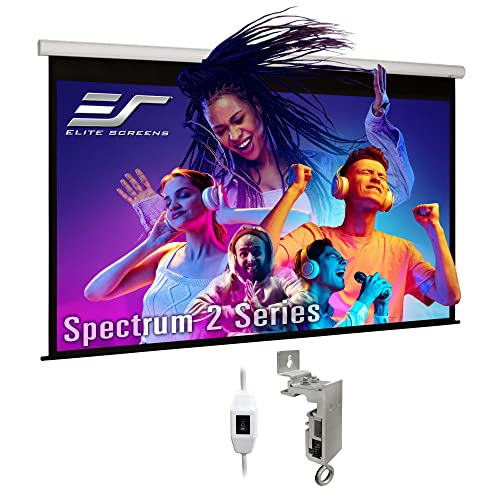
The Elite Screens Spectrum2 is the motorized drop-down screen recommendation for buyers who want a large permanent installation without committing to the visual presence of a fixed frame on the wall at all times. At 120 inches diagonal in 16:9 format — with a viewing area of 104.6 inches wide by 58.8 inches tall — this screen delivers the same cinematic scale as the fixed-frame options reviewed above, but it retracts into a ceiling or wall-mounted housing when the session ends, leaving your room with a clean wall surface. The 12-inch extra drop is an important practical feature: it gives you vertical adjustment flexibility to position the viewing area at the correct height for your seating, which is a common installation challenge in rooms where ceiling height doesn't precisely match the ideal screen position.
The MaxWhite FG material is a fiberglass-backed matte white surface with a 1.1 gain rating, which is a slightly more conservative gain than the CineWhite UHD-B surfaces used in the Yard Master 2 and the 120-inch fixed frame. The fiberglass backing gives the material structural integrity that prevents sagging between the motor-rolled deployment cycles, and the 180-degree viewing angle means you won't see image quality shifts as viewers move across the seating area. Full black backing prevents light transmission from behind, GREENGUARD and GREENGUARD Gold certification confirms indoor air quality compliance, and native support for 4K/8K Ultra HD, HDR, and active 3D ensures the screen keeps pace with the current and near-future projection ecosystem.
The tubular motor operates quietly — a specification that matters considerably during soft-spoken dialogue scenes where motor noise in cheaper alternatives becomes genuinely distracting. Floating wall and ceiling mount brackets are included and simplify alignment during installation by providing adjustment range in both axes. This is not a UST-compatible screen, so if you're running an ultra-short-throw projector, look to the VIVIDSTORM S PRO instead. For standard-throw setups in multi-use rooms where a permanent screen would be aesthetically disruptive, the Spectrum2 is the most complete motorized solution on the market at its price tier in 2026. Pair it with a quality portable projector for a truly versatile entertainment and presentation setup.
Pros:
- Motorized retraction keeps the wall clean and screen protected when not in use
- 12-inch extra drop provides critical vertical positioning flexibility during installation
- Quiet tubular motor delivers smooth, reliable operation without distracting noise
- MaxWhite FG fiberglass-backed material prevents sagging across the full 120-inch span
- GREENGUARD Gold certified for indoor air quality compliance
Cons:
- Not compatible with ultra-short-throw or short-throw projectors
- 1.1 gain is slightly lower than CineWhite UHD-B alternatives — requires a brighter projector in larger rooms
7. Elite Screens Lunette 2, 92-Inch Curved — Best Curved Screen
A curved projection screen is a specific solution to a specific problem, and if you're experiencing edge softness or barrel distortion from a wide-angle projector at close seating distances, the Elite Screens Lunette 2 addresses those issues in a way that no flat screen can. The submersive curved design wraps the screen surface at a gentle arc that matches the natural field of vision, placing the edges of the image at approximately equal distance from your eyes as the center point — a geometry that reduces the perception of edge blur that occurs when a projector's optical field doesn't quite match a flat plane at wide-angle settings. The 92-inch diagonal in 16:9 format delivers a 79.9-inch-wide by 45-inch-tall viewing area, which is sized for rooms where 100 to 120 inches would be physically too large for the available throw distance.
The CineWhite material on the Lunette 2 carries a 1.1 gain specification with a 160-degree viewing angle, and it's fully rated for 4K Ultra HD and active 3D projection. The 3.5-inch black velvet aluminum frame absorbs overshoot at the screen edges and enhances the perceived contrast of the image boundary in the same way as the velvet frame on the 120-inch fixed frame reviewed above. Adjustable fix plates distribute tension evenly across the curved projection surface with an updated rubber edge design that simplifies the installation process compared to earlier Lunette generations — a genuine improvement that buyers upgrading from the original Lunette will immediately appreciate. Compatible with standard, short-throw, and UHD/HD projectors, the Lunette 2 accommodates a broad range of projection setups.
The curved form factor is a deliberate aesthetic and optical choice, not a default recommendation for every buyer, and you should consider it carefully against your projector's lens characteristics and your room's seating geometry. According to Wikipedia's overview of projection screen types, curved screens provide their greatest benefit at short throw distances with wide-angle lenses and in dedicated home theater configurations with a single central seating position. If your setup uses a longer throw distance or a seating area that spans a wide horizontal range, the 160-degree viewing angle of the CineWhite surface on a flat screen will serve you better. For the right application — a purpose-built room with a quality standard-throw projector at close-to-medium distance — the Lunette 2 delivers an image presentation that no flat screen of comparable size can replicate.
Pros:
- Curved design reduces edge softness and barrel distortion at wide-angle throw distances
- CineWhite 1.1 gain material with 160-degree viewing angle and full 4K/3D compatibility
- 3.5-inch velvet-wrapped aluminum frame absorbs overshoot and enhances contrast
- Adjustable tension plates distribute even pressure across the curved surface
- Compatible with standard, short-throw, and HD/UHD projectors
Cons:
- Curved design provides maximum benefit only with wide-angle projectors at shorter throw distances
- 92-inch diagonal is the smallest fixed-frame screen on this list

What to Look For When Buying Home Projector Screens
Screen Type and Installation Format
The first decision you make when buying a projector screen is choosing between the four primary installation formats: fixed frame, motorized retractable, portable freestanding, and floor-rising. Fixed frames deliver the flattest, most consistent projection surface because the material stays permanently tensioned, but they require dedicated wall space and remain visible at all times. Motorized screens offer the aesthetic flexibility of a clean wall when the screen is retracted, at the cost of a more complex mechanical system that requires ceiling or upper-wall mounting. Portable freestanding screens — like the Yard Master 2 — give you maximum location flexibility and travel capability at the cost of assembly time and wind sensitivity outdoors. Floor-rising designs like the VIVIDSTORM S PRO are the niche solution for UST laser projector setups where the projector sits at floor level and requires a screen that rises from the same plane. Match your format choice to your room's architecture and your actual usage patterns — a motorized screen in a dedicated theater room adds complexity without benefit, while a fixed frame in a multipurpose living room creates visual clutter.
Screen Material: Gain, Viewing Angle, and ALR
Gain is the measure of how much light a screen reflects relative to a standard matte white surface at a 1.0 gain baseline. Higher gain figures — 1.3, 1.5, or above — increase image brightness at the center of the viewing angle at the cost of narrowing the usable viewing cone and potentially introducing hotspotting at closer viewing distances. Lower gain figures — 0.8 to 1.1 — distribute light more evenly across a wider viewing angle, which suits multi-row seating arrangements. Ambient light rejecting (ALR) materials add a third dimension to this decision: they use optical micro-structures to prioritize projected light from the projector's specific angle while absorbing light arriving from other directions. If you're projecting in a room with windows or overhead lights, an ALR screen is not optional — it's the difference between a watchable image and a washed-out gray surface. The ALR option comes with a narrower viewing angle, typically 80 degrees versus 160 to 180 degrees for standard matte white materials, so your seating must be arranged within that cone.
Size, Aspect Ratio, and Throw Distance
Screen size is not a decision you make independently from your projector's throw ratio and your room's physical dimensions. Throw ratio — the relationship between projection distance and image width — determines the exact screen size your projector produces at your specific installation distance. If your projector has a 1.5:1 throw ratio and sits 12 feet from the screen, it produces an image approximately 8 feet — 96 inches — wide, which corresponds to roughly a 110-inch diagonal 16:9 screen. Buying a 120-inch screen in that scenario means your image doesn't fill the screen. Buying a 100-inch screen means your image overflows it. Always calculate your throw distance against your projector's spec sheet before selecting screen size. Aspect ratio is simpler: 16:9 covers virtually all streaming, gaming, and broadcast content in 2026, and all seven screens reviewed above use the 16:9 format.
Frame Construction and Long-Term Durability
The frame on a fixed or fixed-curved screen does more than hold the material — it maintains the tension that keeps the surface flat over years of use and temperature cycling. Aluminum frames are the industry standard because the material combines rigidity with light weight, resists corrosion, and expands and contracts minimally with temperature changes that would cause wooden frames to warp. Velvet-wrapped frames add the functional benefit of absorbing projector overshoot at the screen boundary, which improves perceived contrast in a way that you notice immediately during side-by-side comparisons. For motorized screens, the quality of the tubular motor is the single most important durability factor: cheap motors introduce audible noise, develop speed inconsistencies over time, and can fail mid-retraction in ways that damage the screen material. The Elite Screens Spectrum2's motor specification earns its inclusion in this guide because it delivers genuinely quiet, consistent operation across thousands of deployment cycles.
Common Questions
What is the difference between ALR and standard matte white projection screens?
ALR (ambient light rejecting) screens use optical micro-structures that selectively reflect projected light toward viewers while absorbing ambient light arriving from ceiling fixtures, windows, and side sources. Standard matte white screens reflect all light equally in all directions, which means ambient room light washes out the image. If your projection space has any uncontrolled light sources that you cannot turn off during viewing, an ALR screen delivers dramatically better image quality. The trade-off is a narrower viewing angle — typically 80 degrees versus 160 to 180 degrees — which requires seating within a defined zone directly in front of the screen.
Can I use any projector screen with an ultra-short-throw laser projector?
No — ultra-short-throw laser projectors require screens specifically engineered for their steep upward projection angle. Standard matte white screens and conventional ALR screens are calibrated for light arriving from a projector positioned directly in front of the screen at standard throw angles. UST projectors project from below, and only UST-specific ALR materials — like the optical sawtooth surface in the VIVIDSTORM S PRO — handle that projection geometry correctly. Using a standard screen with a UST projector results in inconsistent brightness, visible optical artifacts, and poor ambient light performance.
What screen size should I buy for my room?
Start with your projector's throw ratio specification and your measured projection distance. Multiply the projection distance by the throw ratio to calculate your projected image width, then use a diagonal calculator to find the corresponding screen diagonal for a 16:9 aspect ratio. As a practical guideline, viewing distance should be approximately 1.5 times the screen width for a fully immersive experience — so a 100-inch screen with an 87-inch width pairs best with seating approximately 130 inches, or about 11 feet, from the screen. Always verify against your projector's specific throw ratio rather than using generic rules.
Is a higher gain screen always better for brightness?
Higher gain increases brightness at the center of the viewing cone but narrows the angle at which brightness remains consistent, and it can introduce hotspotting — a brighter center area visible when the projector's light doesn't distribute perfectly evenly. For a dedicated dark room with a single central seating position, 1.3 gain works well. For a wide seating arrangement across multiple rows or seats, a 1.0 to 1.1 gain screen distributes light more evenly and avoids the visible brightness variation that high-gain screens can show at off-center positions. Match your gain selection to your room's seating geometry and your projector's lumen output.
How do I clean a projector screen without damaging it?
Most high-quality screens — including the CineWhite UHD-B surfaces used by Elite Screens — are cleanable with mild soap and lukewarm water applied with a soft, lint-free cloth. Always use gentle circular motions and avoid abrasive materials, paper towels, or solvents that can permanently damage the optical coating or material surface. For dust accumulation, a soft brush or compressed air at low pressure is safer than wiping. Check your specific screen's manual before cleaning because ALR microstructure surfaces can be more sensitive than standard matte white materials to cleaning agents and pressure.
What is the advantage of a fixed frame screen over a motorized one?
Fixed frame screens maintain perfect, consistent tension on the projection surface at all times because the material is permanently attached to a rigid frame — there's no rolling, unrolling, or mechanical cycling that can introduce inconsistencies over time. Motorized screens add convenience at the cost of mechanical complexity, a motor that can fail, and the potential for slight edge ripples that develop in rolled screen materials over years of cycling. For a dedicated home theater where the screen is always in use during viewing, a fixed frame is the more reliable long-term investment. For multipurpose rooms where the screen needs to disappear when not in use, the motorized option's convenience justifies the trade-off.
Buy on Walmart
- Elite Screens Yard Master 2, 100-INCH Outdoor Indoor Project — Walmart Link
- Elite Screens Aeon CineGrey 5D Series, 128-Inch ALR Projecto — Walmart Link
- Elite Screens 120" Fixed Frame Projector Screen 16:9, 4K/8K — Walmart Link
- Cineperm Matt White Fixed Frame Projection Screen Viewing Ar — Walmart Link
- VIVIDSTORM S PRO Motorized Tension Floor Rising Projector Sc — Walmart Link
- Elite Screens Spectrum2, 120-inch 16:9, 12-inch Drop, Electr — Walmart Link
- Elite Screens Lunette 2 Series, 92-inch Diagonal 16:9, Curve — Walmart Link
Buy on eBay
- Elite Screens Yard Master 2, 100-INCH Outdoor Indoor Project — eBay Link
- Elite Screens Aeon CineGrey 5D Series, 128-Inch ALR Projecto — eBay Link
- Elite Screens 120" Fixed Frame Projector Screen 16:9, 4K/8K — eBay Link
- Cineperm Matt White Fixed Frame Projection Screen Viewing Ar — eBay Link
- VIVIDSTORM S PRO Motorized Tension Floor Rising Projector Sc — eBay Link
- Elite Screens Spectrum2, 120-inch 16:9, 12-inch Drop, Electr — eBay Link
- Elite Screens Lunette 2 Series, 92-inch Diagonal 16:9, Curve — eBay Link
Buy for your room's light conditions first, your projector's throw distance second, and the screen's size last — in that order, every time.
 |
 |
 |
 |

About Sarah Whitford
Sarah Whitford is Ceedo's resident projector and home theater expert. She got her start as a custom AV installer for a regional integrator in the Pacific Northwest, where she designed and installed media rooms and conference spaces for residential and small business clients for over six years. Sarah earned her CTS certification from AVIXA and has personally calibrated more than 150 projectors using Datacolor and SpyderX colorimeters. She is opinionated about throw distance math, contrast ratios, and the realities of ambient light, and she will happily explain why most people should not buy a 4K projector. Sarah lives in Portland with her partner and an aging Akita.