 ee
eeBest Outdoor Projector Screens 2026
You've spent weeks researching projectors, finally landed on the right one, and now you're standing in your backyard on a warm evening — only to realize the white sheet you hung between two trees is ruining every dollar you spent on that 4K image. A quality outdoor projector screen is the single most impactful upgrade you can make to your home theater setup, and in 2026 the options range from budget-friendly foldable panels to weather-resistant motorized units that deploy at the push of a button.
Choosing the right screen means balancing portability, screen material, stability in wind, and whether you need front-only or dual-sided projection. For backyard movie nights with a casual crowd, a lightweight foldable screen is plenty. For a permanent patio setup or frequent entertaining, a motorized or heavy-duty freestanding frame pays for itself in convenience and image quality. Our projector picks cover every use case, from weekend camping to full backyard cinema installations.
We evaluated seven of the top-rated outdoor projector screens available in 2026, considering screen gain, aspect ratio, setup complexity, wind stability, and overall value. Whether you pair your screen with one of the best 5000 lumen projectors for bright outdoor use or a compact portable unit, you'll find the right match in this list. Read on for the full breakdown.

Contents
- Top Rated Picks of 2026
- Product Reviews
- Elite Screens OMS120H2 — Best Overall
- Mdbebbron 120 Inch — Best Budget Pick
- Talvania 12 Feet Inflatable — Best Inflatable Screen
- Elite Screens Yard Master Electric — Best Motorized
- Elite Screens Yard Master 2 DUAL — Best Dual Projection
- 120-Inch Screen with Stand — Best for Wind Resistance
- Kodak 100" Tripod Screen — Best Compact Option
- Choosing the Right Outdoor Projector Screen
- What People Ask
- Final Thoughts
Top Rated Picks of 2026
- #PreviewProductRating
- Bestseller No. 1
 Rating:

- Bestseller No. 2
 Rating:
 - Bestseller No. 3
 Rating:
 - Bestseller No. 4
 Rating:
- Bestseller No. 5
 Rating:
 - Bestseller No. 6
 Rating:
 - Bestseller No. 7
 Rating:
Product Reviews
1. Elite Screens 120-Inch OMS120H2 — Best Overall Freestanding Screen
The Elite Screens OMS120H2 sets the standard for freestanding outdoor screens in 2026, combining a silver aluminum frame with CineWhite UHD-B tensioned matte white material that delivers a 1.3 gain and true 180-degree viewing angles. The 120-inch diagonal panel, formatted at the standard 16:9 aspect ratio, measures 59 inches high by 104.7 inches wide in the viewing area, giving your backyard crowd a legitimate cinema-scale experience. Setup requires zero tools and typically takes under ten minutes, since the lightweight aluminum square tubing clicks together intuitively and the screen itself attaches with integrated clips along the frame perimeter.
What distinguishes this screen from cheaper freestanding alternatives is the full black-backed projection surface, which eliminates light bleed-through and sharpens perceived contrast significantly, especially during darker movie scenes. The CineWhite UHD-B surface is rated 4K Ultra HD and Active 3D ready, and it meets ISF standards for color accuracy, dynamic range, and color temperature — meaning the image your projector produces is reproduced faithfully rather than shifted by a low-quality screen material. The included padded carrying bag makes transporting the assembled frame straightforward, and Elite's compatibility with short-throw and ultra-short-throw projectors gives you flexibility in how you arrange your outdoor setup.
The assembled height of just under 89 inches makes this screen visible from seated positions across a wide yard without any elevation adjustment. Cleaning is straightforward with mild soap and water, and the overall construction quality is noticeably above average for a screen in this price tier, making it the top recommendation for buyers who want one screen that handles every occasion reliably.
Pros:
- CineWhite UHD-B material delivers accurate color with 1.3 gain and full 180-degree viewing
- Tool-free assembly completes in under ten minutes for effortless setup and breakdown
- ISF-certified surface supports 4K Ultra HD, Active 3D, and short-throw projector compatibility
- Black-backed fabric prevents light bleed-through for sharper contrast in any lighting condition
- Padded carrying bag included for easy transport and storage between uses
Cons:
- Front-projection only — no rear-projection capability for crowd-on-both-sides setups
- The overall assembled width of nearly 110 inches demands significant clear floor space
2. Mdbebbron 120-Inch Foldable Screen — Best Budget Pick
The Mdbebbron 120-inch foldable screen proves that a tight budget does not mean you have to accept a poor image, delivering a 16:9 thickened polyester fabric surface that resists creasing even after repeated folding and storage in a backpack or luggage bag. The screen is a single-piece design with no frame to assemble, which means your setup time drops to near zero — you hang it, tension it if needed, and you're projecting within minutes. The anti-crease natural polyester material absorbs and diffuses projected light more effectively than many entry-level screens, producing an image that feels noticeably sharper and brighter than you'd expect from this price range.
This is a screen material only, not a freestanding unit, so you'll need a separate hanging solution — a tension line between two trees, a backdrop stand, or hooks on an exterior wall all work well. That flexibility is actually a major advantage in variable outdoor settings where you don't always have flat ground for a tripod frame. The screen supports double-sided projection, meaning you can position your projector behind the screen and still get a usable image on the front, which opens up creative venue layouts for parties and events.
For buyers who travel to parks, campgrounds, or different outdoor venues regularly, the compact fold-down size is unbeatable — this screen genuinely fits in a daypack alongside other gear. You'll want to pair it with one of the best smartphone projectors for a fully portable outdoor cinema kit that fits in a single bag and costs less than most standalone screens.
Pros:
- Extremely compact folded size fits in a backpack or suitcase for maximum portability
- Anti-crease polyester fabric stays smooth and wrinkle-free after repeated folding cycles
- Supports double-sided projection for flexible crowd and projector positioning
- Near-zero setup time with no frame assembly required
- Most affordable path to a 120-inch projection surface on this list
Cons:
- Requires a separate hanging solution — no stand or frame is included
- Fabric can bow or ripple in wind without adequate tensioning from the hanging system
3. Talvania 12-Foot Inflatable Screen — Best Inflatable Option
There is something genuinely impressive about watching a 12-foot screen inflate from a deflated bundle to a fully rigid display surface in under a few minutes, and the Talvania inflatable screen delivers exactly that experience with a complete kit that includes the blower motor, tie-down straps, ground stakes, sandbags, and a storage bag. The white polyester cloth projection surface provides a clean, vibrant backdrop for movies, sports, and TV, with a surface quality that holds up well to both front and rear projection configurations — allowing your audience to stand or sit on either side of the display for maximum flexibility in open outdoor spaces.
The fully integrated screen-and-frame system means the projection surface is always perfectly tensioned with no sagging or bowing, since the inflated frame provides uniform pressure across the entire display area simultaneously. This is a meaningful advantage over traditional frame-and-fabric designs, which can develop slack over time as fabric stretches or frame joints loosen. The tie-down system with stakes and sandbags handles mild to moderate wind conditions reliably, making this a practical choice for camping trips, park events, and backyard screenings where ground anchoring is possible.
According to Wikipedia's coverage of outdoor cinema, inflatable screens have become a staple of public outdoor movie events since the early 2000s, and commercial-grade versions like this have brought that same visual impact down to the consumer price point. Kids and adults alike are immediately drawn to the novelty of an inflated screen, making it a crowd-pleasing centerpiece for events beyond standard family movie nights.
Pros:
- Complete kit includes blower, tie-downs, stakes, sandbags, and storage bag — ready to use out of the box
- Front and rear projection support maximizes venue flexibility for large crowds
- Inflated frame maintains perfect surface tension without any sagging or bowing
- Immediate visual impact makes it a standout choice for parties and public events
- Multicolor frame design adds festive energy to outdoor entertainment settings
Cons:
- Blower motor must run continuously during the screening to maintain inflation
- Strong wind conditions can stress the tie-down system and require extra anchoring
4. Elite Screens Yard Master Electric OMS120H-ELECTRIC — Best Motorized Screen
The Elite Screens Yard Master Electric brings true one-touch motorized convenience to your outdoor setup, deploying or retracting the 120-inch 16:9 screen with a single press of the included RF remote or a 12V trigger signal — which means you can integrate it directly into a smart home automation system if you're building a permanent outdoor theater space. The sleek black casing houses the retracted screen cleanly, giving your patio or backyard a polished, uncluttered appearance when the screen is not in use, unlike freestanding alternatives that must be disassembled and stored after every use.
The screen's IP33 rain and water protection rating is the headline feature for buyers in regions with unpredictable weather, since it means a light shower during your screening won't immediately damage the unit. The viewing area measures 59 inches by 104.7 inches across the 16:9 panel, consistent with the other 120-inch options on this list, and the magnetic weight bar along the bottom edge combined with the included ground stake kit keeps the screen flat and steady against mild wind without any manual tensioning. The overall assembled size of 77.8 inches high by 112.3 inches wide with a depth of just under 4 inches keeps the footprint minimal for a motorized unit.
Rated for 8K and 4K Ultra HD content delivery, this screen handles the highest-resolution source material available in 2026 without any visible quality degradation, and the smooth rolling motion of the motor mechanism means you never get visible creases or tension marks from repeated deployments. If you're pairing this with a high-output projector and want to complete your audio setup, check out our guide to the best soundbars for projector setups to match the visual quality with equally impressive sound.
Pros:
- RF remote and 12V trigger enable one-touch motorized deployment and retraction
- IP33 water protection rating handles light rain without equipment damage
- Magnetic weight bar and ground stake kit maintain flat, stable screen surface in mild wind
- Sleek black housing presents a clean appearance when the screen is retracted
- 8K and 4K Ultra HD ready with smooth motor mechanism that prevents crease formation
Cons:
- Premium pricing reflects the motorized mechanism — budget buyers should look elsewhere
- IP33 is splash-resistant, not fully waterproof — heavy rain still requires shelter or postponement
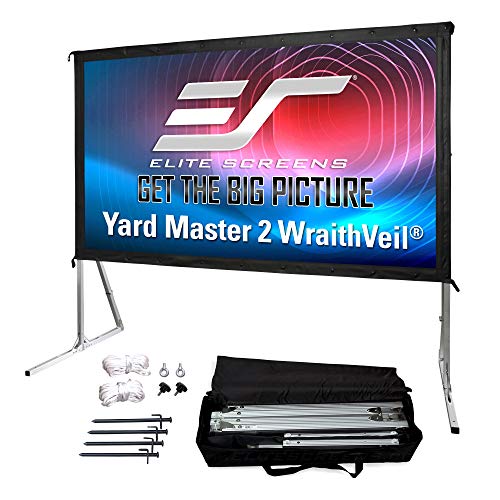
5. Elite Screens Yard Master 2 DUAL OMS120H2-Dual — Best for Dual Projection
The Elite Screens Yard Master 2 DUAL is the screen to choose when you need audiences on both sides of the display to see a clear, high-quality image simultaneously — whether you're dividing a crowd at a backyard event, setting up a transparent display at a trade show, or projecting content from the rear to avoid throw-distance limitations in your layout. The Wraith Veil Dual material delivers a 0.8 gain with a 150-degree wide viewing angle on both the front and rear projection surfaces, maintaining consistent brightness and color accuracy regardless of which side the projector illuminates.
The screen dimensions scale up significantly compared to the standard OMS120H2 — at 120 inches diagonal with a 16:9 ratio, the view area measures 73.5 inches high by 130.8 inches wide, and the overall assembled size reaches 111.3 inches high and 136.7 inches wide, making this the largest footprint screen on this list. The PVC construction ensures uniform flatness across the entire surface without edge tension issues, and the Wraith Veil Dual material is rated for 4K Ultra HD, HDR, and Active 3D projection, covering all current and near-future content standards well into 2026 and beyond.
Assembly uses the same tool-free aluminum square-tube system as the standard OMS120H2, with a padded carrying bag included to make transport between locations manageable despite the larger size. Elite's US-based two-year warranty provides meaningful coverage and accessible customer support — a differentiating factor when you're investing in a premium dual-projection unit that you plan to use regularly for years.
Pros:
- Wraith Veil Dual material enables true simultaneous front and rear projection capability
- 150-degree wide viewing angle delivers consistent image quality across a large spread of seating positions
- PVC construction maintains uniform flatness without edge tension issues across the full panel
- 4K Ultra HD, HDR, and Active 3D ready for full compatibility with all current source formats
- US-based two-year warranty with accessible support backs long-term ownership confidence
Cons:
- 0.8 gain is lower than front-only screens, requiring a brighter projector for optimal outdoor performance
- Overall assembled size of over 136 inches wide demands significant clear space in your setup area
6. 120-Inch Outdoor Screen with Stand — Best for Wind Resistance
If wind stability is your primary concern — and for anyone setting up in an open backyard, patio, or campsite, it absolutely should be — this 120-inch screen with stand delivers the most robust ground anchoring system on this list, combining an extended and reinforced premium steel base with four ground stakes, tie-down ropes, and four sandbags that all work together to resist wind loads that would topple lighter aluminum-frame competitors. The screen stand is engineered specifically to address the instability issues that plague standard tripod and square-frame designs, with a wide reinforced base that distributes weight low and outward for maximum lateral stability.
The projection surface itself is a premium washable milk silk fabric that integrates seamlessly with the frame — meaning no edge wrinkles or fabric sag even at full stretch. The material delivers 4K HD visuals with a 160-degree ultra-wide viewing angle and supports both front and rear projection configurations, giving your setup genuine flexibility in how you position the projector relative to the audience. The integrated design keeps the fabric perfectly tensioned within the frame perimeter, so the first frame in every movie looks as sharp as the last.
Post-screening cleanup is straightforward since the fabric is washable, and the screen folds flat for storage without any special packing requirements. The carry bag handles transport to remote locations, and the complete windproof accessory kit means you're not scrambling to source stakes and sandbags separately before your first outdoor use. For a complete outdoor entertainment system, pairing this screen with one of the top choices from our best projector screen guide will give you a full comparison of indoor and outdoor mounting options.
Pros:
- Extended reinforced steel base with stakes, ropes, and sandbags provides superior wind resistance
- Milk silk fabric is washable and maintains edge-to-edge flatness with no wrinkles in any position
- 160-degree ultra-wide viewing angle accommodates large crowds spread across wide seating areas
- Front and rear projection support adds layout flexibility for varied venue configurations
- Complete kit requires no additional purchases before your first outdoor screening
Cons:
- Steel frame accessories add weight compared to aluminum competitors, making solo transport more demanding
- Less recognizable brand name means fewer owner reviews to benchmark against for long-term reliability data
7. Kodak 100" Tripod Projector Screen — Best Compact Portable Option
The Kodak 100-inch tripod projector screen is the most versatile entry on this list, transitioning effortlessly between outdoor movie nights, office presentations, classroom settings, and church events with a tripod-mounted design that adjusts in height and folds down to a compact rolled screen with a standalone tripod for single-carry transport. The premium matte white PVC and Terylene fabric surface delivers a 1.0 gain with a 160-degree viewing angle, providing accurate ambient light control, wrinkle prevention, and minimized pixelation across the full 16:9 panel — solid optical performance that matches screens costing significantly more.
The rugged black metal alloy tripod uses nonslip feet and a simple locking frame mechanism that sets up and breaks down without tools in a few minutes, and the height adjustment allows you to position the screen optimally for both seated and standing audiences. The screen itself rolls onto the tripod's carry post, so the entire system packs into one compact unit that fits in a car trunk, storage closet, or equipment room without any disassembly beyond folding the tripod legs. Compatibility extends to LED, LCD, and DLP projectors as well as 8K, 4K Ultra HD, and Active 3D sources, covering the full range of current projection technology.
At 100 inches rather than the 120-inch standard of most competitors, the display area is measurably smaller — but for intimate backyard gatherings of ten or fewer, or for any indoor application, 100 inches is genuinely comfortable viewing at normal throw distances. The Kodak brand backing gives buyers confidence in the quality control standards and the ability to source replacement parts or customer support if needed, which is a meaningful advantage over generic alternatives at similar price points.
Pros:
- All-in-one tripod design rolls up and carries as a single compact unit for maximum portability
- 1.0 gain matte white surface with 160-degree viewing angle handles both indoor and outdoor use effectively
- Adjustable tripod height accommodates seated and standing audience configurations without separate accessories
- Compatible with all projector types — LED, LCD, DLP — and all current resolution standards through 8K
- Trusted Kodak brand backing provides quality assurance and accessible support infrastructure
Cons:
- 100-inch screen is noticeably smaller than the 120-inch options on this list for large outdoor crowds
- Tripod base offers less wind stability than weighted freestanding frame designs
Choosing the Right Outdoor Projector Screen: A Buying Guide
Screen Size and Aspect Ratio
The overwhelming majority of outdoor projector screens in 2026 are built around the 16:9 widescreen aspect ratio, which matches modern HD, 4K, and 8K content natively, and the 120-inch diagonal size has become the de facto standard for backyard use because it scales well to typical outdoor throw distances of 10 to 20 feet. When you're calculating ideal screen size for your space, a useful baseline is that every viewer should sit at a distance of no less than 1.5 times and no more than 6 times the screen's diagonal measurement — so a 120-inch screen works comfortably for viewers seated anywhere from 15 to 60 feet away.
- Under 100 inches: Best for intimate gatherings of 5–10 people at close range, or for indoor multi-use screens that also serve presentation roles.
- 100–120 inches: The sweet spot for most backyard setups, accommodating 10–30 viewers comfortably at typical outdoor seating distances.
- 120+ inches (inflatable): Ideal for large crowd events, public screenings, and situations where the screen is the centerpiece of the entertainment experience.
Screen Gain and Viewing Angle
Screen gain is a measure of how reflective the screen surface is relative to a neutral white reference surface — a gain of 1.0 means the screen reflects light equally in all directions, while a gain above 1.0 concentrates reflected light toward the center of the viewing area for a brighter image in that zone. For outdoor use in ambient light conditions, a gain between 1.0 and 1.3 delivers the best balance of brightness and wide-angle viewing coverage without introducing hot spots visible from off-axis seating positions.
- 0.8 gain (Wraith Veil Dual): Required for dual-sided projection — lower gain distributes light evenly to both sides but needs a brighter projector to compensate.
- 1.0 gain: Neutral, balanced performance suitable for all projector types and wide seating spreads.
- 1.3 gain (CineWhite UHD-B): Delivers 30% more brightness to the central viewing zone — ideal when your projector's lumen output is moderate.
Portability vs. Stability Trade-offs
Every outdoor screen design involves a trade-off between how easily you can move and store it and how stable it is when the wind picks up during a screening. Foldable fabric screens without frames win on portability but require a separate hanging solution and have no inherent wind resistance. Tripod screens collapse to a single carry unit and set up quickly, but the three-point base is the least wind-stable configuration. Freestanding aluminum-frame screens offer a balance of portability and stability with their wide-base four-leg designs, while reinforced steel-base screens with full anchoring kits sacrifice some portability for the strongest outdoor stability available in the consumer segment.
- Fabric-only screens: Maximum portability, minimum stability — best for calm-weather camping and travel.
- Tripod screens: Good portability with moderate stability — best for indoor/outdoor multi-use scenarios.
- Aluminum freestanding frames: Balanced portability and stability — best for regular backyard use without permanent installation.
- Steel-base with anchoring kit: Limited portability, maximum stability — best for open exposed locations with consistent wind exposure.
- Inflatable screens: Moderate portability, good stability with full anchor kit — best for events and large-crowd outdoor screenings.
Projection Type and Material Compatibility
Most outdoor screens support front projection only, meaning the projector must be positioned in front of the screen on the audience's side. Rear projection screens allow the projector to be placed behind the screen, which eliminates projector shadows from people walking between the unit and the display — a significant advantage for public events and larger gatherings. Dual projection screens like the Yard Master 2 DUAL support both simultaneously, but the reduced gain requires a more powerful projector to compensate for the light diffusion through both sides of the material.
- Front-only: Higher gain, sharper contrast, simpler setup — the right choice for dedicated backyard setups with a fixed projector position.
- Rear projection: Eliminates audience shadow interference — essential for events where people circulate between the projector and the screen.
- Dual projection: Serves audiences on both sides simultaneously — best for trade shows, divided outdoor spaces, and unique venue layouts.
What People Ask
What is the best outdoor projector screen for backyard use in 2026?
The Elite Screens OMS120H2 is the top choice for most backyard setups, combining a 120-inch CineWhite UHD-B surface with 1.3 gain, 180-degree viewing angles, tool-free aluminum frame assembly, and full 4K Ultra HD readiness into a package that performs reliably across a wide range of outdoor conditions and projector types.
Do outdoor projector screens work during the day?
Most outdoor projector screens work best in low-light conditions — after sunset or in a shaded area — since ambient sunlight significantly overwhelms the projected image on standard gain surfaces. If you need daytime outdoor projection, look for a high-gain screen material (1.3 or above) and pair it with a projector rated at 5,000 lumens or more to compete with ambient light effectively.
What size projector screen do I need for a backyard movie night?
A 120-inch diagonal screen is the standard for backyard use and works well for audiences of 10 to 30 people seated at distances of 15 to 60 feet from the screen. For smaller intimate gatherings of 5 to 10 people at closer distances, a 100-inch screen provides a more proportionate experience without requiring as much space between the projector and the display surface.
Can outdoor projector screens get wet?
Most outdoor projector screens use water-resistant materials that can handle light moisture and dew without damage, but standard screens are not designed for exposure to heavy rain. The Elite Screens Yard Master Electric stands out with an IP33 water protection rating that handles light rain on the housing unit, while fabric screens like the Mdbebbron and the milk silk fabric screens are washable and resist spotting from minor moisture exposure.
What is the difference between front and rear projection screens?
Front projection screens reflect light from a projector positioned in front of the screen back toward the audience — delivering higher brightness and contrast for dedicated setups with a fixed projector location. Rear projection screens allow the projector to be placed behind the screen, transmitting light through the material to the audience on the opposite side, which eliminates the risk of shadows from people walking between the projector and the display during events.
How do I keep my outdoor projector screen stable in wind?
The most effective approach combines a low-center-of-gravity wide-base frame design with physical ground anchoring — stakes, tie-down ropes, and sandbags placed at all base corners. The 120-inch screen with reinforced steel stand on this list provides the most comprehensive wind resistance solution with its extended base design, full staking kit, and sandbag weights working in combination. For any screen in moderate wind, positioning it perpendicular to the prevailing wind direction reduces lateral loading significantly.
Buy on Walmart
- Elite Screens 120-INCH Projector Screen|Outdoor Indoor Movie — Walmart Link
- Mdbebbron 120 inch Projector Screen 16:9 Foldable Anti-Creas — Walmart Link
- Talvania 12 Feet Inflatable Projector Screen for Outdoor and — Walmart Link
- Elite Screens Yard Master Electric, 120 Inch 16:9, Outdoor M — Walmart Link
- Elite Screens Yard Master 2 DUAL Projector Screen, 120-INCH — Walmart Link
- 120inch Outdoor Projector Screen with Stand: 16:9 4K HD Port — Walmart Link
- Kodak 100” Projection Screen | Portable Lightweight White 16 — Walmart Link
Buy on eBay
- Elite Screens 120-INCH Projector Screen|Outdoor Indoor Movie — eBay Link
- Mdbebbron 120 inch Projector Screen 16:9 Foldable Anti-Creas — eBay Link
- Talvania 12 Feet Inflatable Projector Screen for Outdoor and — eBay Link
- Elite Screens Yard Master Electric, 120 Inch 16:9, Outdoor M — eBay Link
- Elite Screens Yard Master 2 DUAL Projector Screen, 120-INCH — eBay Link
- 120inch Outdoor Projector Screen with Stand: 16:9 4K HD Port — eBay Link
- Kodak 100” Projection Screen | Portable Lightweight White 16 — eBay Link
Final Thoughts
The right outdoor projector screen transforms a good projector into a complete backyard cinema experience, and in 2026 there is a well-matched option for every setup style and budget on this list — from the tool-free Elite Screens OMS120H2 that handles everything from casual movie nights to HDR-quality 4K screenings, to the Talvania inflatable unit that turns any open space into an event. Pick the screen that matches your portability needs, your typical wind conditions, and your projector's lumen output, then head to Amazon to check current pricing and lock in your outdoor cinema setup before your next warm-weather gathering.
 |
 |
 |
 |

About Sarah Whitford
Sarah Whitford is Ceedo's resident projector and home theater expert. She got her start as a custom AV installer for a regional integrator in the Pacific Northwest, where she designed and installed media rooms and conference spaces for residential and small business clients for over six years. Sarah earned her CTS certification from AVIXA and has personally calibrated more than 150 projectors using Datacolor and SpyderX colorimeters. She is opinionated about throw distance math, contrast ratios, and the realities of ambient light, and she will happily explain why most people should not buy a 4K projector. Sarah lives in Portland with her partner and an aging Akita.