 ee
eeBest Projectors Under $500
You're scrolling through projector listings at midnight, trying to figure out whether 3,000 lumens is enough for your living room or if you're overpaying for specs you'll never use. Sound familiar? Finding a great projector under $500 in 2026 is entirely doable — but you need to know what separates the genuinely useful machines from the ones that disappoint the moment you turn the lights on.
The good news: this price range has never been stronger. You can get a true 1080p projector with low input lag, built-in streaming, or a portable battery-powered unit without blowing your budget. The bad news: the sheer number of options makes it easy to pick the wrong one for your specific setup. Whether you're building a home theater, looking for a capable gaming projector, or want something you can take outside, the right choice depends entirely on how you plan to use it.
We've broken down the seven best projectors under $500 available right now, covering home theater workhorses, gaming-focused picks, and ultra-portable options. Every product on this list has been evaluated on image quality, brightness, feature set, and real-world value. Browse the full projectors category for even more options, and let's get into it.

Contents
Top Rated Picks of 2026
- #PreviewProductRating
- Bestseller No. 1
 Rating:

- Bestseller No. 2
 Rating:
 - Bestseller No. 3
 Rating:
- Bestseller No. 4
 Rating:
 - Bestseller No. 5
 Rating:
 - Bestseller No. 6
 Rating:
 - Bestseller No. 7
 Rating:
Full Product Breakdowns
1. Epson Home Cinema 2200 — Best Overall Projector Under $500
The Epson Home Cinema 2200 earns the top spot by doing everything well. It uses Epson's 3-chip 3LCD technology — meaning all three color channels (red, green, blue) are processed simultaneously. The result is that you get 2,700 lumens of both color brightness and white brightness, without the rainbow artifacts or color dimming you sometimes see with single-chip DLP projectors. That 35,000:1 contrast ratio renders dark scenes with real depth, and 1080p content looks genuinely sharp at screen sizes up to 150 inches.
What sets the 2200 apart from its competition is the built-in Android TV interface. You get the full Google Assistant ecosystem, voice search, and access to Netflix, Hulu, HBO Max, YouTube, and thousands of other apps right out of the box — no streaming stick required. The included remote is well-designed, and setup takes under 20 minutes. The built-in speaker handles casual viewing, though you'll want an external soundbar for a real home theater experience. The 3D capability (with optional glasses) is a bonus that few competitors offer at this price point.
If you're building a primary home theater setup and want the most complete package under $500, this is your projector. It's a mature product with consistent brightness, reliable software, and Epson's three-year warranty backing it up.
Pros:
- 3LCD technology delivers accurate, consistent color with no rainbow effect
- Built-in Android TV with Google Assistant eliminates need for external streaming device
- 2,700 lumens works in rooms with moderate ambient light
- 35,000:1 contrast ratio produces deep blacks and vivid highlights
- 3D capable with optional active glasses
Cons:
- Built-in speaker is adequate but not impressive for movie audio
- Larger and heavier than portable alternatives — designed for fixed installation
2. Optoma HD146X — Best Budget Home Theater Projector
The Optoma HD146X is the entry point into quality 1080p home theater projection. It punches above its price with a bright, sharp image and a dedicated Game Display Mode that reduces input lag for console gaming. If you want a no-fuss projector that delivers a true full-HD picture for movie nights without any complicated setup, this is the one to get. It's a single-chip DLP projector, which means it's compact and lightweight — easy to place on a coffee table or mount on a shelf.
The HD146X focuses on doing the basics right. You get clean 1080p resolution, enough brightness for a darkened room, and straightforward HDMI connectivity. There's no built-in streaming or smart platform — you'll connect a Fire Stick, Roku, or your game console directly. That keeps the price down and the interface simple. The image quality is solid for the cost, and the high-contrast mode makes darker content look more defined than you'd expect at this price.
This is the projector you recommend to someone who asks "what's the cheapest way to get a big screen?" and means it literally. It delivers the core experience without extras. If you eventually want to step up, check out our guide to the best projectors under $1,000 for more premium options.
Pros:
- Genuine 1080p resolution at a genuinely low price point
- Game Display Mode lowers input lag for smoother console play
- Compact DLP design — easy to position and reposition
- Straightforward setup with no bloated software
Cons:
- No built-in streaming platform — requires external device
- DLP rainbow effect may be noticeable to sensitive viewers
- Audio output is minimal
3. NEBULA Capsule 3 GTV — Best Portable Projector Under $500
The NEBULA Capsule 3 is a legitimately impressive piece of engineering. It fits in the palm of your hand, runs on a built-in battery for 2.5 hours, outputs a 1080p image up to 120 inches, and runs Google TV with officially licensed Netflix — not a sideloaded workaround, but the real Netflix app. Anker has nailed the form factor: this is a projector you actually carry with you, whether that means your bedroom, a friend's backyard, or a camping trip. If you want a dedicated outdoor option, it's also worth reading our roundup of the best portable projectors for camping.
The 200 lumens rating is the honest limitation here. You need a dark environment to get a watchable image. In a pitch-dark room or outside after sunset, the picture quality is surprisingly good for the size. Colors are accurate, the 1080p resolution is real, and Dolby Digital audio support through compatible streaming apps adds to the immersion. The Google TV interface is smooth and well-integrated — you get access to the full Play Store, so streaming services, casting, and app support are all covered.
Where the Capsule 3 wins is convenience. It's the only projector on this list you can charge with USB-C and toss in a backpack. If your priority is portability over raw brightness, this is the most capable machine in its class.
Pros:
- Officially licensed Netflix — no workarounds needed
- Genuinely pocket-sized with 2.5-hour built-in battery
- Google TV gives access to full Play Store ecosystem
- True 1080p resolution — not upscaled
- Dolby Digital audio support
Cons:
- 200 lumens requires dark viewing conditions — not for bright rooms
- Battery life limits longer movie sessions without power nearby
4. Optoma HD28HDR — Best for HDR Gaming and High-Brightness Viewing
The Optoma HD28HDR is the brightness king of this list. At 3,600 lumens, this is the projector you want if you can't fully darken your room — think afternoon viewing with blinds partially closed, or a living room with overhead lighting you'd rather leave on. The 50,000:1 contrast ratio is exceptional for the price, and the HDR10 support with 4K input means you're getting real high-dynamic-range processing even at 1080p native resolution. Whites are bright, blacks are deep, and the 6-segment color wheel (red, yellow, green, cyan, white, blue) produces accurate, saturated color.
For gaming, the HD28HDR supports a 120Hz refresh rate and enhanced gaming mode, which pushes input lag down to 8.4ms at 1080p. That's competitive with budget gaming monitors. If you're playing fast-paced shooters or fighting games on a big screen, you'll notice the difference compared to a projector running at 60Hz with higher latency. The backlit remote is a nice touch that adds usability in dark rooms.
The HD28HDR doesn't have built-in smart features, but at 3,600 lumens and 8.4ms response time, it earns its place as the best-performing projector on pure image and gaming metrics in this price range. Connect your preferred streaming stick and you have a complete setup.
Pros:
- 3,600 lumens handles ambient light better than any other pick here
- HDR10 support with 4K input capability
- 120Hz refresh rate with 8.4ms gaming mode response time
- 50,000:1 contrast ratio delivers impressive image depth
- sRGB and REC.709 color profiles for accurate reproduction
Cons:
- No built-in smart TV platform
- Fan noise at 26dB is audible in quiet rooms
5. BenQ TH575 — Best Dedicated Indoor Gaming Projector
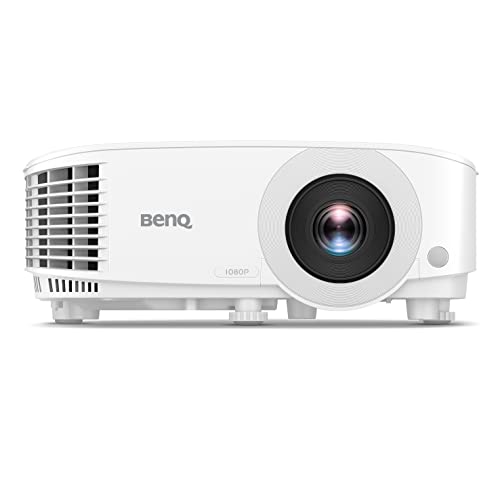
BenQ built the TH575 specifically for gamers, and it shows. Released in 2023 with an upgraded spec set over its predecessor (the TH585P), it delivers 3,800 ANSI lumens — the highest brightness on this list — alongside a 15,000:1 contrast ratio and 16ms input lag at 1080p/60Hz. That combination of brightness and low latency makes it the best choice if you're primarily using a projector for gaming in a space that isn't fully light-controlled. You can run it in daylight with the blinds down and still get a watchable, vibrant image.
The Enhanced Game Mode and Auto Vertical Keystone make setup and calibration quick. Dual HDMI inputs let you keep two devices connected simultaneously — a console and a streaming box, for example — without swapping cables. The 3D Ready capability and 1.1x zoom give you flexibility in screen sizing and room placement. BenQ's three-year warranty on this model is notably generous for the price point and shows real confidence in the hardware.
The TH575 isn't the best choice for cinephiles chasing perfect color accuracy — it's tuned for gaming performance. But if your primary use case is gaming and you want a big screen in a real living room environment, this is the most capable machine under $500 for that job. For more gaming-focused options, our full guide to the best gaming projectors in 2026 covers a wider price range.
Pros:
- 3,800 ANSI lumens — the brightest projector on this list
- 16ms input lag (1080p/60Hz) with Enhanced Game Mode
- Dual HDMI inputs for simultaneous device connections
- Auto Vertical Keystone for fast, hassle-free setup
- Three-year warranty — best coverage in this roundup
Cons:
- Color accuracy prioritizes gaming vibrancy over cinema realism
- No built-in streaming or smart OS
6. XGIMI Halo+ GTV — Best Smart Portable Projector
The XGIMI Halo+ sits between the Capsule 3's ultra-portability and the fixed home theater projectors on this list. It's portable enough to move between rooms or take outdoors, but powerful enough at 700 ISO lumens to use in partially lit spaces. Google TV with officially licensed Netflix means you're getting the same app ecosystem as a smart TV, and XGIMI's Intelligent Screen Adaptation (ISA) automatically handles keystone correction, obstacle avoidance, and focus — so setup takes seconds, not minutes.
The Harman Kardon speakers (2×5W) are the best built-in audio on any portable projector under $500. You won't need to pair a Bluetooth speaker for casual viewing — the audio is genuinely good for the size. The 2.5-hour battery life matches the Capsule 3, but the Halo+ is a larger device — it's more of a "carry it to the backyard" portable than a "fits in your pocket" portable. The 1080p image quality at 700 lumens is crisp and well-calibrated, with accurate color and solid contrast for an LED-powered unit.
If you want a projector that functions as a smart TV in your bedroom, works on your patio after dark, and still looks great inside — all without hunting for HDMI cables — the Halo+ is the most versatile all-rounder in this category.
Pros:
- 700 ISO lumens works in partial ambient light — much brighter than the Capsule 3
- Google TV with licensed Netflix built in
- Harman Kardon dual speakers — best built-in audio in this roundup
- Auto focus, keystone correction, and obstacle avoidance via ISA
- 2.5-hour battery for outdoor and room-to-room use
Cons:
- Larger form factor than true pocket projectors
- 700 lumens still requires dim conditions for best picture quality
7. Optoma ML1080ST — Best Short Throw Portable Laser Projector
The Optoma ML1080ST is the most technically interesting projector on this list. It's the world's smallest RGB triple laser projector — a meaningful distinction, because RGB laser delivers color accuracy that LED and lamp projectors simply can't match at this size. The ML1080ST covers 100% of the REC.709 color space and 98% of DCI-P3, which is cinema-level color performance. The short throw ratio means you can set it closer to your wall and still get a large image — perfect for small apartments and dorm rooms where you don't have six feet of throw distance to work with.
The Time of Flight (ToF) Auto Focus keeps the image sharp automatically, adjusting in real time as you reposition the projector. At 23ms input lag (1080p/60Hz and 4K/60Hz), gaming performance is solid — not quite as responsive as the BenQ TH575, but competitive. The Auto Low Latency Mode (ALLM) automatically switches to game mode when it detects a compatible source. At 1,200 lumens, it's brighter than the portable competition but won't stand up to ambient light the way the BenQ or Optoma HD28HDR will.
The ML1080ST is the right choice if you're working in a tight space, prioritize color accuracy over raw brightness, and want a laser light source that lasts 20,000+ hours without lamp replacement. It's the most future-proof purchase on this list from a maintenance standpoint. For a deeper look at how projectors work technically, Wikipedia's overview of projection technology is a solid reference.
Pros:
- RGB triple laser delivers 100% REC.709 and 98% DCI-P3 color accuracy
- Short throw ratio ideal for small rooms and tight spaces
- ToF Auto Focus — no manual focus adjustment needed
- 20,000+ hour laser light source — no lamp replacements ever
- ALLM support for automatic game mode switching
Cons:
- 1,200 lumens limits use to controlled lighting environments
- Higher price point within the under-$500 bracket
What to Look For When Buying a Projector Under $500
Brightness: ANSI Lumens Matter More Than Marketing Claims
Brightness is the single most important spec, and it's also the most frequently exaggerated. Always look for ANSI lumens — this is a standardized measurement. Any spec listed as just "lumens" without the ANSI qualifier can be marketing noise.
- Under 500 lumens: Requires a fully darkened room — portable projectors, outdoor use after sunset only
- 1,500–2,700 lumens: Works well in a darkened room with blackout curtains, some ambient light tolerance
- 3,000+ lumens: Can handle rooms with blinds drawn, some overhead lighting — best for living rooms without full light control
If you can't black out your room, prioritize brightness above everything else. The BenQ TH575 (3,800 lumens) and Optoma HD28HDR (3,600 lumens) are your best options in this list for brighter environments.
Resolution and Image Technology
Every projector on this list is native 1080p, which is the right baseline for a $500 budget. The technology behind the pixel matters too:
- 3LCD (Epson): Three separate chips for red, green, and blue. No rainbow effect, accurate color, consistent brightness across the full color spectrum.
- DLP (Optoma, BenQ): Single chip with a spinning color wheel. Compact, often higher contrast, but some viewers notice a rainbow effect on fast-moving content.
- RGB Laser (Optoma ML1080ST): Light source produces all three colors simultaneously. Exceptional color accuracy, long lifespan, no warm-up time.
- LED (NEBULA, XGIMI): LED light source — efficient, long-lasting, cool-running. Lower brightness than lamp projectors but improving rapidly.
Input Lag and Gaming Performance
If you play games on a projector, input lag is a non-negotiable consideration. Standard cinematic projection runs at input lag values of 40–100ms — acceptable for movies, sluggish for games.
- Under 20ms: Competitive gaming quality — BenQ TH575 (16ms), Optoma HD28HDR (8.4ms)
- 20–35ms: Casual gaming, fine for most players — Optoma ML1080ST (23ms)
- 35ms+: Movie-first projectors — noticeable lag in fast-paced genres
Most projectors in 2026 include a dedicated Game Mode that reduces processing to minimize lag. Always enable it when gaming — the difference is measurable.
Portability vs. Fixed Installation
Know how you intend to use your projector before you buy:
- Fixed home theater: Epson Home Cinema 2200 or Optoma HD28HDR — prioritize brightness, image quality, and features over size
- Room-to-room portable: XGIMI Halo+ — battery + smart OS + quality image in a portable form
- True pocket portable: NEBULA Capsule 3 — fits in a bag, works anywhere with a surface and darkness
- Small room / tight space: Optoma ML1080ST short throw — requires minimal distance to wall
Fixed projectors universally outperform portable ones on brightness and image quality at this price point. If you have a dedicated space, don't pay the portability premium unnecessarily.
What People Ask
What is the best projector under $500 in 2026?
The Epson Home Cinema 2200 is the best overall projector under $500 in 2026. It combines 3LCD technology for accurate color, 2,700 lumens of brightness, built-in Android TV, and a 35,000:1 contrast ratio into a complete home theater package. For gaming specifically, the BenQ TH575 edges it out with 3,800 lumens and 16ms input lag.
How many lumens do I need for a projector in a living room?
For a typical living room where you can partially dim the lights but not fully black it out, you need at least 2,500–3,000 ANSI lumens. If you have full blackout curtains, 2,000 lumens is sufficient. Bright rooms with overhead lighting require 3,500+ lumens. The BenQ TH575 (3,800 lumens) and Optoma HD28HDR (3,600 lumens) are the strongest options for uncontrolled lighting environments.
Is a 1080p projector good enough or do I need 4K?
For screens up to 120–130 inches viewed from a normal seating distance of 8–12 feet, native 1080p delivers a sharp, cinematic image. True 4K projectors under $500 don't exist — any projector claiming "4K" at this price point is upscaling from a lower native resolution. Every projector on this list is genuine native 1080p, which is the right choice for this budget in 2026.
Can I use a projector under $500 for outdoor movies?
Yes, but you need to manage expectations around brightness and timing. Portable projectors like the NEBULA Capsule 3 (200 lumens) and XGIMI Halo+ (700 lumens) work well outdoors after full dark. For outdoor viewing before complete darkness, you need at least 2,000 ANSI lumens and a high-contrast screen or white wall. Fixed projectors like the Epson 2200 or BenQ TH575 can work outdoors on an extension cord and deliver better image quality than battery-powered portables.
Do projectors under $500 have built-in streaming apps like Netflix?
Some do — the Epson Home Cinema 2200 runs Android TV with access to most major streaming apps, the NEBULA Capsule 3 and XGIMI Halo+ both run Google TV with officially licensed Netflix. The Optoma models and BenQ TH575 do not have built-in smart platforms and require an external streaming device (Roku, Fire Stick, Apple TV, or a connected gaming console).
What is the difference between DLP and LCD projectors?
DLP (Digital Light Processing) uses a single chip with a spinning color wheel — these projectors are compact and high-contrast, but some viewers notice a "rainbow effect" on fast-moving bright objects. LCD (including Epson's 3LCD) uses separate chips for red, green, and blue, producing more consistent color brightness with no rainbow effect but slightly larger form factors. For color-critical home theater use, 3LCD tends to have an edge. For gaming and bright-room performance, DLP projectors like the BenQ TH575 and Optoma HD28HDR lead the field at this price.
Buy on Walmart
- Epson Home Cinema 2200 (3D Edition) 3-chip 3LCD 1080p Projec — Walmart Link
- Optoma HD146X 1080P Full HD Vibrant Home Theater Projector — Walmart Link
- NEBULA Capsule 3 GTV Portable Mini Projector, Netflix Offici — Walmart Link
- Optoma HD28HDR 1080p Home Theater Projector for Gaming and M — Walmart Link
- BenQ TH575 1080p Indoor Gaming Projector, 3800 LMS, 16.7ms L — Walmart Link
- XGIMI Halo+ GTV NEW Portable Projector, Google TV with Licen — Walmart Link
- Optoma ML1080ST Ultra-Portable Short Throw Full HD Laser Pro — Walmart Link
Buy on eBay
- Epson Home Cinema 2200 (3D Edition) 3-chip 3LCD 1080p Projec — eBay Link
- Optoma HD146X 1080P Full HD Vibrant Home Theater Projector — eBay Link
- NEBULA Capsule 3 GTV Portable Mini Projector, Netflix Offici — eBay Link
- Optoma HD28HDR 1080p Home Theater Projector for Gaming and M — eBay Link
- BenQ TH575 1080p Indoor Gaming Projector, 3800 LMS, 16.7ms L — eBay Link
- XGIMI Halo+ GTV NEW Portable Projector, Google TV with Licen — eBay Link
- Optoma ML1080ST Ultra-Portable Short Throw Full HD Laser Pro — eBay Link
The best projector under $500 is the one matched to your room — get the brightness right first, and everything else follows.
 |
 |
 |
 |

About Sarah Whitford
Sarah Whitford is Ceedo's resident projector and home theater expert. She got her start as a custom AV installer for a regional integrator in the Pacific Northwest, where she designed and installed media rooms and conference spaces for residential and small business clients for over six years. Sarah earned her CTS certification from AVIXA and has personally calibrated more than 150 projectors using Datacolor and SpyderX colorimeters. She is opinionated about throw distance math, contrast ratios, and the realities of ambient light, and she will happily explain why most people should not buy a 4K projector. Sarah lives in Portland with her partner and an aging Akita.