 ee
eePrinters ›
Best Printer For Infrequent Use 2026
What is the single best printer for someone who prints only once or twice a month — a machine that never jams, never dries out, and never demands a costly ink replacement the moment you actually need it? If you have been wrestling with that question, you are in exactly the right place, because this guide cuts through the noise and names names. The top pick for 2026 is the Brother HL-L2460DW, a wireless monochrome laser printer that combines blistering 36-page-per-minute speeds with automatic duplex printing and a toner cartridge that can sit idle for weeks without losing a drop of performance. It is the kind of machine that rewards the occasional user who wants reliability above all else.
Printing infrequently sounds simple until you factor in the real-world pitfalls: inkjet cartridges that clog after two weeks of disuse, ink bottles that cost more per milliliter than fine cologne, and printers that somehow forget your Wi-Fi password every time you reboot them. The good news is that the printer market in 2026 has genuinely excellent options across laser and tank-based inkjet categories, and each one on this list has been selected because it handles extended dormancy without punishing you for it. Whether you need sharp black-and-white documents for tax season or vivid color prints for the occasional school project, there is a machine here that fits your workflow and your budget. For a broader look at versatile devices, check out our roundup of the Best Multifunction Printer 2026 picks as well.
The printers featured in this guide span a range of sizes, technologies, and price points, from the palm-sized HP LaserJet Pro M15w to the full-featured Epson EcoTank ET-4850 with fax, ADF, and Ethernet. All seven machines are available on Amazon, all have active support ecosystems, and all address the core challenge of the infrequent user: staying ready without constant maintenance. You can also explore the full printers category on our site if you want to browse beyond today's picks. Before diving into individual reviews, understand that laser printers win on per-page cost and idle stability, while EcoTank inkjets win on color versatility and long-term savings once the high upfront cost is absorbed — and both approaches are represented here.
Contents
- Top Rated Picks of 2026
- Full Product Breakdowns
- HP LaserJet Pro M15w — Best Compact Laser
- Brother HL-L2460DW — Best for Speed & Duplex
- Epson EcoTank ET-2800 — Best for Color Printing
- HP LaserJet MFP M140w — Best Compact All-in-One
- Brother DCP-L2640DW — Best MFP for Small Business
- Epson EcoTank ET-4850 — Best Full-Featured Supertank
- Canon imageCLASS LBP122dw — Best Budget Laser
- Choosing the Right Printer for Infrequent Use
- FAQs
Top Rated Picks of 2026
- #PreviewProductRating
- Bestseller No. 1
 Rating:

- Bestseller No. 2
 Rating:
- Bestseller No. 3
 Rating:
 - Bestseller No. 4
 Rating:
 - Bestseller No. 5
 Rating:
 - Bestseller No. 6
 Rating:
 - Bestseller No. 7
 Rating:
Full Product Breakdowns
1. HP LaserJet Pro M15w Wireless Monochrome Printer — Best Compact Laser for Tight Spaces
If desk space is your primary constraint, the HP LaserJet Pro M15w is the printer you have been waiting for — it is the world's smallest LaserJet Pro in its class, measuring 35% smaller than its predecessor while still delivering the crisp, smear-proof black-and-white output that laser printing is known for. You can tuck this machine onto a corner shelf, a nightstand, or even a filing cabinet top, and it will not dominate the room the way traditional desktop lasers do. Despite its miniaturized footprint, it prints at up to 19 pages per minute with a first-page-out time of just 8.1 seconds, which means you are never waiting long when that rare printing need arises.
Wireless connectivity works through HP's 2.4GHz 802.11n network, and the HP Smart app makes setup genuinely painless — you scan from your smartphone, order toner directly from the app, and print from cloud storage services like iCloud, Google Drive, and Dropbox without touching a cable. For an infrequent user, the toner cartridge in a laser printer is a significant advantage over inkjet: toner is a dry powder, so it does not dry out or clog after weeks of sitting idle. The starter cartridge included in the box prints around 500 pages, and replacement cartridges are widely available and reasonably priced. Alexa voice printing support is a genuinely useful bonus if you already live in an Amazon ecosystem.
The M15w is a print-only device, so you will not find a scanner or copier here — it does one thing and does it well, which keeps both the price and the footprint impressively low. If you occasionally need to scan documents, you will want to pair this printer with a standalone scanner or step up to the HP M140w reviewed later in this guide. The manual paper tray holds 150 sheets, which is adequate for most home users printing in small bursts, and the output tray catches pages cleanly without curling. This is the right pick if you prioritize a tiny footprint, wireless convenience, and the long-term reliability of laser toner over cartridge ink.
Pros:
- World's smallest LaserJet Pro in its class — genuinely fits anywhere
- Laser toner never dries out during extended idle periods
- HP Smart app enables cloud and mobile printing with zero setup friction
Cons:
- Print-only — no scan or copy function
- No duplex printing, which increases paper consumption for longer documents
2. Brother HL-L2460DW Wireless Compact Monochrome Laser Printer — Best for Speed & Automatic Duplex
The Brother HL-L2460DW is the overall top pick for infrequent users in 2026, and it earns that title by combining exceptional print speed, automatic two-sided printing, and a dual-band wireless radio into a compact chassis that is deceptively capable for its size. At 36 pages per minute, this is one of the fastest monochrome laser printers available at its price point, which matters to occasional users because when you finally do need to print something, you want it done immediately rather than waiting through a warm-up cycle that feels like it belongs to a photocopier from the previous decade. Built-in automatic duplex printing saves both paper and time on any document longer than a single page.
Brother's dual-band wireless implementation — supporting both 2.4GHz and 5GHz networks — sets this printer apart from budget competitors that lock you into the slower, more congested 2.4GHz band only. Your print jobs travel over your network reliably, and the Brother Mobile Connect app lets you manage print queues, check toner levels, and order Brother Genuine Supplies directly from your phone. The HL-L2460DW also includes an Ethernet port for wired network connection and a USB interface for direct PC connectivity, giving you three ways to connect without any adapters or workarounds. Brother's Refresh Subscription Trial, included in the box, is a toner replenishment program that monitors your usage and ships replacements automatically — a genuinely smart feature for people who forget to stock up until the cartridge runs dry mid-document.
According to laser printing technology principles, toner-based printers are particularly well-suited to low-frequency use because toner powder does not evaporate or dry out the way liquid ink does, meaning the HL-L2460DW will be just as ready on the day you print your annual tax return as it is the day after unboxing. The starter toner cartridge prints approximately 700 pages, with high-yield replacements pushing past 3,000 pages per cartridge — an excellent cost-per-page figure that rewards infrequent, high-volume bursts of printing when they do occur. This is the printer you buy once, configure once, and then simply use whenever you need it, without weekly maintenance rituals or ink anxiety.
Pros:
- 36 ppm print speed — among the fastest in this class
- Dual-band Wi-Fi (2.4GHz/5GHz) plus Ethernet and USB connectivity
- Automatic duplex printing saves paper on every multi-page document
Cons:
- Monochrome only — no color printing capability
- No scanner or copier function for document capture needs
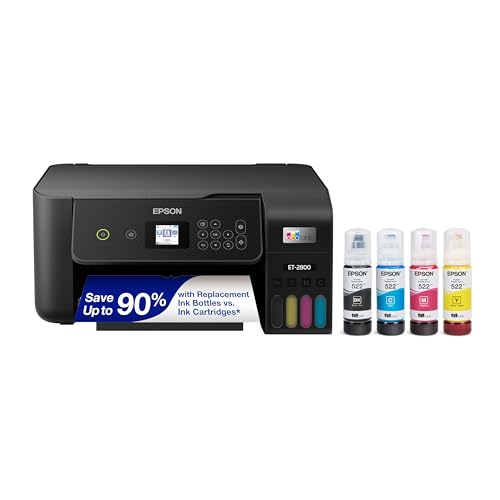
3. Epson EcoTank ET-2800 Wireless Color All-in-One — Best for Color Printing Without Cartridge Costs
The Epson EcoTank ET-2800 flips the traditional inkjet economics on their head by replacing expensive cartridges with large refillable ink tanks that hold enough ink to print thousands of pages before you ever need to reach for your wallet again. Each ink bottle set included with the ET-2800 is equivalent to approximately 80 individual cartridges, which is a remarkable figure that translates to printing up to 4,500 black pages or 7,500 color pages per fill — numbers that make this printer extraordinarily cost-effective for an infrequent user who prints in color, even if those printing sessions happen only a few times a year. The higher upfront cost of an EcoTank pays for itself faster than most people expect.
Epson's Micro Piezo Heat-Free Technology is the engineering behind the ET-2800's output quality, using mechanical pressure rather than heat to deposit ink droplets onto the page, which produces vivid, detailed color prints across both text documents and photos without the nozzle clogging issues that plagued earlier budget inkjet designs. You get scan and copy functions built in, making this a true all-in-one solution for a home office or student workspace where space and budget both matter. The 1200 x 2400 dpi scan resolution is more than adequate for digitizing documents, and if you are looking to complement your scanning setup, our guide to the Best Flatbed Scanners 2026 covers dedicated scanning hardware worth pairing with a printer like this.
Wireless connectivity is 2.4GHz 802.11n — single-band only, which is worth noting if your home network is congested — and the Epson Smart Panel app enables mobile printing from iOS and Android devices with minimal configuration. Print speeds land at 10 pages per minute in black and around 5 pages per minute in color, which is slower than the laser printers on this list but entirely acceptable for occasional use when speed is not the primary concern. You are buying the ET-2800 for color versatility and long-term ink economy, not raw throughput, and on those terms it delivers outstanding value in 2026.
Pros:
- Cartridge-free design eliminates dried-out ink and costly per-cartridge replacement
- Prints up to 7,500 color pages per ink bottle set — exceptional long-term economy
- All-in-one design includes scan and copy at a very accessible price point
Cons:
- Single-band 2.4GHz Wi-Fi only — can be unreliable on crowded networks
- Slower print speeds than laser alternatives on this list

4. HP LaserJet MFP M140w Wireless Black & White Printer — Best Compact All-in-One for Small Teams
The HP LaserJet MFP M140w takes everything that made the M15w compelling — the world's-smallest-in-class laser engineering — and adds a flatbed scanner and copier to produce a genuine multifunction device in a chassis that still occupies surprisingly little desk real estate. This is America's most trusted printer brand delivering print, scan, and copy capability to a small team of one to three people, and it does so with 21-page-per-minute black-and-white output that handles document bursts efficiently when your workload occasionally spikes. The laser engine means you get the same toner-based reliability that ensures the printer performs perfectly whether you last used it yesterday or three months ago.
Wireless setup through the HP Smart app is the same streamlined experience as the M15w, and the app extends to cloud printing from Google Drive, Dropbox, and iCloud, which is increasingly how home-office workers access their documents in 2026. The flatbed scanner scans at 600 dpi optical resolution, which is adequate for document digitization but not the tool you reach for when scanning photographs or large-format materials — for serious scanning needs, our comprehensive guide to the Best Large Format Printers 2026 will point you in the right direction. The M140w's copy function works through the scanner bed without needing a PC in the loop, making it a genuinely standalone device for home offices that occasionally need to duplicate a physical document.
The paper input tray holds 150 sheets, and the output capacity is 100 sheets, which aligns well with the light-to-moderate use patterns of the target user. There is no automatic document feeder and no duplex printing, which means long documents require manual page flipping and multi-page scan jobs require lifting and placing each sheet individually — limitations that are entirely reasonable at this price point and footprint. If your printing and scanning needs stay modest and you want the reassurance of HP's ecosystem behind your device, the M140w is an excellent choice that punches above its weight in the compact all-in-one category.
Pros:
- Compact laser MFP with print, scan, and copy in one footprint-friendly unit
- 21 ppm print speed with laser reliability during extended idle periods
- HP Smart app integration for mobile and cloud printing
Cons:
- No automatic duplex printing — two-sided documents require manual intervention
- No ADF — multi-page scanning is a manual, one-sheet-at-a-time process
5. Brother DCP-L2640DW Wireless Compact Monochrome Laser Printer — Best MFP for Small Businesses
The Brother DCP-L2640DW is the multifunction evolution of the HL-L2460DW reviewed earlier, adding a flatbed scanner, copier, and a 50-page automatic document feeder to the same impressive 36-page-per-minute laser engine — which makes it one of the most capable compact MFPs available for small business users who print, copy, and scan regularly but not necessarily every day. The ADF is a significant practical upgrade over flatbed-only machines like the HP M140w, because it allows you to stack a multi-page contract, a stack of receipts, or a ten-page report and walk away while the machine handles the entire scan job automatically, at up to 23.6 images per minute for black-and-white documents.
Connectivity is the same best-in-class package as the HL-L2460DW: dual-band wireless at 2.4GHz and 5GHz, Ethernet for wired network attachment, and USB for direct connection to a single workstation. The Brother Mobile Connect app provides remote printer management, toner ordering, and mobile print-from-anywhere capability that is particularly useful in small offices where the printer is shared across multiple people with different devices. Automatic duplex printing is included here as well, so your two-sided reports come out of the machine ready to read without any manual page flipping. The 250-sheet paper cassette — larger than the HP M140w's 150-sheet tray — accommodates a full ream of standard letter paper when you know a busy period is ahead.
Brother includes its Refresh Subscription Trial with this model as well, which is worth activating because it gives you the peace of mind of knowing that toner replenishment is handled automatically before you ever run out. The DCP-L2640DW occupies a compelling position in the lineup: it costs more than the print-only HL-L2460DW but delivers substantially more functionality per dollar than buying a printer and a separate scanner, and if you are comparing against our roundup of the Best Multifunction Printer 2026 options, you will find this Brother holds its own against machines at significantly higher price points. For a small business printing shipping labels, invoices, and contracts on an irregular schedule, this is a highly dependable workhorse.
Pros:
- 50-page ADF enables hands-free multi-page scanning and copying
- 36 ppm print speed with automatic duplex — the fastest MFP on this list
- Dual-band Wi-Fi plus Ethernet ensures reliable network connectivity in any office
Cons:
- Monochrome only — not the right choice if color printing is part of your workflow
- Higher upfront cost than single-function laser options
6. Epson EcoTank ET-4850 Wireless All-in-One Supertank Printer — Best Full-Featured Supertank for Home Offices
The Epson EcoTank ET-4850 is what you buy when you want the ink economy of an EcoTank but refuse to compromise on professional office features — it packs a fax machine, an automatic document feeder, an Ethernet port, and 4800 x 1200 dpi print resolution into a white desktop unit that covers every function a productive home office demands without requiring multiple devices cluttering your workspace. At 15.5 pages per minute in black and 8.5 pages per minute in color, the ET-4850 is faster than its smaller ET-2800 sibling, and the output quality is visibly superior for graphics and photos thanks to the higher resolution print engine that renders fine text and detailed imagery with genuine sharpness.
The ADF handles up to 35 sheets for multi-page scan and fax operations, and the rear paper support accommodates a wide range of media types including envelopes, card stock, and photo paper — giving you flexibility that narrowly focused monochrome laser printers simply cannot match. The Epson Smart Panel app provides the same mobile printing and remote management capability you expect from a 2026-era printer, and Epson Scan to Cloud enables direct scanning to online services without routing through a PC. The included ink bottles provide enough ink to print up to 4,500 black or 7,500 color pages, and replacement bottles cost a fraction of equivalent-output cartridge sets, making the long-term cost calculation strongly favorable compared to traditional inkjet machines.
Where the ET-4850 asks for patience is in its warm-up behavior: the device takes a moment to initialize after extended periods of inactivity, and color print jobs run noticeably slower than what you get from the laser printers on this list. However, for an infrequent user who values color quality and full office functionality over raw speed, those are acceptable trade-offs. The ET-4850 is also noticeably larger than the compact laser options reviewed here, so make sure you have the counter or desk space to accommodate it before ordering. If your home office workflow includes faxing, frequent multi-page scanning, and color document production, this is the definitive choice in the EcoTank lineup.
Pros:
- Full-featured all-in-one with fax, ADF, Ethernet, and color printing in one unit
- 4800 x 1200 dpi resolution delivers vivid, detailed color output
- EcoTank ink economy makes per-page color printing cost dramatically cheaper than cartridges
Cons:
- Large physical footprint — requires dedicated desk or counter space
- Color print speeds are slower than monochrome laser alternatives
7. Canon imageCLASS LBP122dw Monochrome Duplex Wireless Laser Printer — Best Budget Laser for Home Offices
Canon's imageCLASS LBP122dw carves out a specific niche on this list: it is the lean, no-frills monochrome laser printer for someone who wants duplex printing and wireless connectivity at the lowest possible entry price, without the added cost of scanning hardware they may never use. The Canon PRINT app supports wireless printing from iOS, Android, and compatible cloud services, and the built-in duplex engine prints both sides of the page automatically, making it one of the most paper-efficient options for someone who prints contracts, reports, or reference documents in moderate volumes a few times per month. At 30 pages per minute, it delivers professional print speeds that make short work of any document queue.
The LBP122dw uses Canon's Single Cartridge System, which integrates toner and drum into one replaceable unit — a design that simplifies replacement to a single swap rather than the two-component dance of separate drum and toner cartridges. This is a welcome feature for infrequent users who want maintenance to be as straightforward as possible when the time comes. The 250-sheet paper cassette is a generous capacity for a budget machine, and the output tray holds up to 100 sheets, so you can walk away from a longer print job without babysitting the output stack. The printer's footprint is compact without being as aggressively miniaturized as the HP M15w, giving it a slightly more traditional desktop laser aesthetic.
Where the Canon LBP122dw asks you to compromise is on ecosystem depth: the Brother and HP apps offer more robust toner monitoring, remote management, and supply ordering features than Canon's PRINT app, and the Canon machine lacks Ethernet connectivity, which limits shared-office network integration compared to the Brother DCP-L2640DW. It is also a print-only device with no scan or copy capability, so you pair it with a dedicated scanner if document digitization is part of your workflow — our picks for the Best Flatbed Scanners 2026 offer excellent options that complement a printer like this perfectly. Within its intended scope of reliable monochrome laser printing at a budget-friendly price, the LBP122dw is a strong, dependable performer.
Pros:
- Strong 30 ppm print speed with automatic duplex at a competitive price point
- Single Cartridge System makes toner replacement simple and foolproof
- 250-sheet paper cassette handles larger paper loads without constant refilling
Cons:
- Print-only — no scan, copy, or fax capability
- No Ethernet port — wireless-only network connectivity
Choosing the Right Printer for Infrequent Use: A Buying Guide
Laser vs. Inkjet: The Technology Decision That Matters Most
For infrequent users, the technology inside the printer is more consequential than almost any other specification, because the failure modes of laser and inkjet printers are fundamentally different. Inkjet printers — including traditional cartridge-based models not featured in this guide — are vulnerable to ink drying and nozzle clogging when left idle for extended periods, which means you could return to your printer after a month and find that your first attempt produces streaky, unusable output while the printer runs a cleaning cycle that wastes the ink you were hoping to conserve. Laser printers use dry toner powder that has no evaporation mechanism, so the Brother HL-L2460DW sitting dormant on your desk for six weeks will produce the same sharp print on day 43 as it did on day one.
EcoTank-style inkjets occupy a useful middle ground: the large ink reservoirs and Epson's Micro Piezo Heat-Free Technology significantly reduce clogging risk compared to cartridge inkjets, and the ET-2800 and ET-4850 both handle moderate idle periods better than conventional inkjet designs. However, if you go more than two to three months between print sessions, a monochrome laser printer is still the safer choice for reliable first-print performance without any warm-up or cleaning ritual. Your decision tree is straightforward: if you never need color, choose a laser printer; if you need color and can commit to printing at least once every four to six weeks, choose an EcoTank.
Functionality Requirements: Print-Only vs. All-in-One
Deciding whether you need scan and copy functions alongside printing is the second most important choice you will make in this category, because it determines whether a compact single-function machine serves you adequately or whether you need an MFP with a scanner bed and potentially an ADF. If your infrequent printing needs are purely output-based — printing forms, boarding passes, documents received digitally — then the HP M15w, Brother HL-L2460DW, or Canon LBP122dw are all excellent choices that deliver printing without the added cost and footprint of scanning hardware. If you also need to digitize physical documents, contracts, or receipts on an irregular basis, the HP M140w, Brother DCP-L2640DW, or either Epson EcoTank gives you everything in one unit.
The ADF differentiates the Brother DCP-L2640DW and the Epson ET-4850 from the flatbed-only HP M140w: if you regularly need to scan stacks of multi-page documents — think tax records, legal papers, or business receipts — the 50-page ADF on the Brother and the 35-page ADF on the Epson eliminate the tedious manual feed-one-page-at-a-time process that flatbed-only scanners require. For users who scan infrequently and in small volumes, a flatbed-only all-in-one is perfectly adequate and costs noticeably less than ADF-equipped alternatives.
Connectivity and App Ecosystems in 2026
Every printer on this list supports wireless printing, but the quality of that wireless implementation varies in ways that matter in practice. Dual-band Wi-Fi — supporting both 2.4GHz and 5GHz — is available on the two Brother machines and gives you the option of connecting to the less-congested 5GHz band, which translates to faster job transmission and fewer dropped connections in households with many wireless devices competing for bandwidth. Single-band 2.4GHz printers like the HP models and Epson EcoTanks work reliably in most environments but can experience interference in apartments or dense suburban neighborhoods with many overlapping networks. If your home has a dual-band or tri-band router — which most routers sold after 2022 do — you benefit from choosing a dual-band-capable printer.
App ecosystems are increasingly central to the infrequent user's printing experience, because most occasional print jobs originate on a phone or tablet rather than a desktop computer. HP Smart, Brother Mobile Connect, and Epson Smart Panel all offer iOS and Android apps that enable direct mobile printing without needing to configure a desktop print driver, and all three support printing from cloud storage services like Google Drive and Dropbox. HP Smart has the broadest feature set for cloud integration, while Brother's app excels at toner management and remote monitoring, and Epson's app handles EcoTank ink level tracking with visual indicators that show exactly how much ink remains in each color tank.
Total Cost of Ownership: Thinking Beyond the Sticker Price
The purchase price of a printer is rarely the most significant cost in its lifetime, and for infrequent users who spread their printing across months or years, the per-page cost of consumables becomes the number that actually defines the economics of ownership. Laser printers typically deliver per-page costs in the range of two to five cents for black-and-white output when using standard-yield replacement cartridges, with high-yield cartridges pushing that cost even lower — the Brother machines in particular, with their high-yield toner options, offer excellent long-term economy for monochrome document printing. EcoTank inkjets achieve similarly low per-page costs for color output, with Epson claiming up to 90% savings on replacement ink compared to cartridge-based inkjet alternatives.
Where infrequent users sometimes miscalculate is in underestimating how long a high-yield cartridge or a full EcoTank fill lasts when you only print a few pages per month — you may be looking at years of printing before your first replacement purchase, which makes the upfront cost of a more capable machine like the EcoTank ET-4850 or the Brother DCP-L2640DW less daunting than it appears. Factor in the cost of the device, the cost of your first two replacement consumable sets, and your estimated annual page volume, and you will find that the mid-range options on this list frequently offer a lower five-year total cost than cheaper printers with expensive consumables.
FAQs
What is the best type of printer for someone who prints only occasionally?
A monochrome laser printer is the best technology for infrequent users because toner is a dry powder that does not dry out or clog during extended periods of disuse. The Brother HL-L2460DW is the top recommendation in 2026 because it combines toner-based reliability with fast 36 ppm speeds, automatic duplex printing, and dual-band wireless connectivity. EcoTank inkjets like the Epson ET-2800 are the best choice if you need color printing, but laser printers win on idle-period reliability.
Do inkjet printers dry out if you don't use them for weeks?
Traditional cartridge-based inkjet printers are vulnerable to nozzle clogging and ink drying when left unused for more than two to three weeks. EcoTank models like the Epson ET-2800 and ET-4850 are more resistant to clogging thanks to their larger ink reservoirs and heat-free print technology, but even these perform best when used at least once a month. Laser printers avoid this problem entirely because toner powder has no evaporation mechanism and retains its properties indefinitely when stored correctly.
Is a laser printer or an inkjet printer cheaper to run long-term?
For black-and-white printing, laser printers offer the lowest per-page cost — typically two to five cents per page with high-yield toner cartridges. For color printing, EcoTank inkjets are the most economical option, delivering per-page costs that are up to 90% lower than traditional cartridge inkjets. The key variable is your monthly page volume: higher volume printing benefits most from laser economy, while low-volume color printing benefits most from EcoTank designs that spread the cost of ink over thousands of pages.
Do I need a printer with an automatic document feeder (ADF)?
You need an ADF if you regularly scan or copy multi-page documents without wanting to feed each page manually into a flatbed scanner. For users who scan single-page documents or small batches occasionally, a flatbed-only all-in-one like the HP M140w is sufficient. The Brother DCP-L2640DW's 50-page ADF and the Epson ET-4850's 35-page ADF are worth the additional investment if your workflow includes scanning contracts, tax documents, or multi-page reports in volume.
What print speed do I need for home or occasional office use?
For truly infrequent printing — one to twenty pages at a time, a few times per month — any printer on this list delivers adequate speed, because even 10 ppm is sufficient when you are printing a single document. Print speed matters more when you print in bursts, such as preparing a presentation or printing a multi-page report, where the difference between 19 ppm (HP M15w) and 36 ppm (Brother HL-L2460DW) is the difference between waiting four minutes and two minutes for the same job. For most home users, 19 to 21 ppm is entirely comfortable.
How do I keep a printer in good condition if I rarely use it?
For laser printers, no special maintenance is required — you can leave a laser printer idle for months and it will perform normally on demand. For EcoTank inkjet printers, Epson recommends printing at least a few pages once a month to keep the ink flowing through the print head and prevent any partial drying at the nozzles. If you know you will not print for an extended period — more than sixty days — running the printer's built-in nozzle check and cleaning cycle before your next print job ensures optimal output quality from the first page.
Buy on Walmart
- HP LaserJet Pro M15w Wireless Monochrome Printer, Works with — Walmart Link
- Brother HL-L2460DW Wireless Compact Monochrome Laser Printer — Walmart Link
- Epson EcoTank ET-2800 Wireless Color All-in-One Cartridge-Fr — Walmart Link
- HP Laserjet MFP M140w Wireless Black & White Printer, Print, — Walmart Link
- Brother DCP-L2640DW Wireless Compact Monochrome Multi-Functi — Walmart Link
- Epson EcoTank ET-4850 Wireless All-in-One Cartridge-Free Sup — Walmart Link
- Canon imageCLASS LBP122dw - Monochrome Duplex Wireless Laser — Walmart Link
Buy on eBay
- HP LaserJet Pro M15w Wireless Monochrome Printer, Works with — eBay Link
- Brother HL-L2460DW Wireless Compact Monochrome Laser Printer — eBay Link
- Epson EcoTank ET-2800 Wireless Color All-in-One Cartridge-Fr — eBay Link
- HP Laserjet MFP M140w Wireless Black & White Printer, Print, — eBay Link
- Brother DCP-L2640DW Wireless Compact Monochrome Multi-Functi — eBay Link
- Epson EcoTank ET-4850 Wireless All-in-One Cartridge-Free Sup — eBay Link
- Canon imageCLASS LBP122dw - Monochrome Duplex Wireless Laser — eBay Link
Choose the printer that forgives you for ignoring it — because the best printer for infrequent use is the one that is always ready the moment you finally need it.
 |
 |
 |
 |

About Marcus Reeves
Marcus Reeves is a printing technology specialist with over 12 years of hands-on experience in the industry. Before turning to technical writing, he spent eight years as a service technician for HP and Brother enterprise printer lines, where he diagnosed and repaired thousands of inkjet and laser machines. Marcus holds an associate degree in electronic engineering technology from DeVry University and a CompTIA A+ certification. He is passionate about helping home users and small offices get the most out of their printers without paying ink subscription fees. When he is not testing the latest cartridge refill kits, he tinkers with vintage dot-matrix printers and 3D printers in his garage workshop.