 ee
eeLaptops ›
Best High Performance Laptop 2026
The global high-performance laptop market crossed $48 billion in 2025, and the gap between last year's flagships and today's machines is the widest it has been in a decade, driven by AI-native chips, OLED panels that redefine what portable displays can look like, and GPUs that rival dedicated desktop cards from just two generations ago. If you are shopping for a powerhouse laptop in 2026, you are choosing from a lineup that genuinely obsoletes anything released before 2024, and the spec sheet differences between models are large enough to matter for your daily workflow. Whether you render 3D scenes, compile million-line codebases, edit 8K footage, or simply demand the fastest possible gaming experience without hauling a desktop, this guide covers every serious contender on the market right now and tells you exactly which one to buy based on how you work.
What makes 2026 different is the convergence of three simultaneous leaps: Apple's M4 silicon delivering CPU and GPU performance that once required plugged-in workstations, NVIDIA's RTX 5080 and 5070 Ti arriving in genuinely thin chassis, and display technology reaching 240Hz OLED as a standard feature rather than a premium exception. You are also seeing 64GB of unified or dedicated RAM become accessible at the high end, which means tasks like running large language models locally, handling massive Lightroom catalogs, or streaming a game while encoding a second output are no longer edge-case stress tests — they are everyday operations these machines handle without breaking a sweat. For a broader look at how portable tech fits into a complete productivity setup, our roundup of the best tablets for college students is worth reading alongside this guide if you are building a multi-device workflow.
Choosing from this field is genuinely difficult because the right answer depends entirely on your ecosystem, your workload, and whether you need a GPU that renders games or one that accelerates professional creative pipelines. This review covers seven machines across a wide price and performance spectrum, drawn from the laptops category, and ranks them by real-world use case rather than raw benchmark numbers alone. Read through the full reviews, check the buying guide at the bottom, and you will walk away knowing exactly which high-performance laptop belongs in your bag.
Contents
- Editor's Recommendation: Top Picks of 2026
- Product Reviews
- Apple MacBook Pro 16" M4 Max — Best for Creative Professionals
- Razer Blade 16 (2025) — Best for Gaming Performance
- MSI Titan 18 HX AI — Best for Desktop Replacement
- ASUS ROG Zephyrus G16 — Best Slim Gaming Laptop
- Apple MacBook Pro 14" M4 Pro — Best Compact Powerhouse
- Lenovo Legion Pro 7i — Best Value High-Performance Gaming
- ASUS ProArt P16 — Best for AI-Powered Creative Work
- Buying Guide
- What People Ask
Editor's Recommendation: Top Picks of 2026
- #PreviewProductRating
- Bestseller No. 1
 Rating:

- Bestseller No. 2
 Rating:
- Bestseller No. 3
 Rating:
- Bestseller No. 4
 Rating:
 - Bestseller No. 5
 Rating:
 - Bestseller No. 6
 Rating:
 - Bestseller No. 7
 Rating:
Product Reviews
1. Apple 2024 MacBook Pro 16" M4 Max — Best for Creative Professionals
The MacBook Pro 16" with M4 Max is the machine that makes every other laptop on this list explain itself, and it does that by delivering workstation-class performance inside a chassis that weighs 4.7 pounds and runs completely silent under moderate load. The M4 Max chip's 16-core CPU and 40-core GPU, paired with 48GB of unified memory operating at 546GB/s bandwidth, creates a processing environment where tasks that would take minutes on a traditional laptop simply finish in seconds, whether you are exporting a 90-minute ProRes timeline, generating AI image variations locally, or compiling a large Xcode project from scratch.
Apple's Liquid Retina XDR display here is one of the finest panels you will find on any portable device in 2026, reaching 1600 nits of peak brightness for HDR content and covering the full P3 wide color gamut with factory calibration that creative professionals can trust without reaching for a colorimeter. Battery life is genuinely all-day — you are looking at 15 to 18 hours of mixed productivity work, which means you leave the power brick at home for most trips and only pull it out during extended rendering sessions or sustained GPU-heavy workloads. Apple Intelligence integration adds practical AI tools directly into the OS, giving you writing assistance, image cleanup tools, and smart search features that work without sending your data to an external server, which matters if you handle confidential client files.
The unified memory architecture is the reason this machine competes with systems that cost more and weigh significantly more — because memory bandwidth is not a bottleneck here, the M4 Max handles tasks like running large local AI models, managing multiple simultaneous 4K streams, or holding an entire large dataset in active memory without the performance cliff you experience on systems with separate CPU and GPU memory pools. If your workflow lives in Final Cut Pro, Logic Pro, Xcode, or any Apple-optimized creative suite, this is the most capable portable workstation money can buy in 2026.
Pros:
- M4 Max delivers workstation-level CPU and GPU performance with exceptional memory bandwidth
- All-day battery life of 15-18 hours under mixed productivity workloads
- Liquid Retina XDR display with 1600 nits peak brightness and factory P3 calibration
- Apple Intelligence provides on-device AI with strong privacy guarantees
Cons:
- macOS ecosystem limits compatibility with Windows-only software and most AAA games
- Premium price point puts it beyond reach for casual or budget-conscious buyers
2. Razer Blade 16 (2025) — Best for Gaming Performance
The Razer Blade 16 (2025) is the most aggressive gaming laptop Razer has ever shipped, and it earns that description by stuffing an NVIDIA GeForce RTX 5080 running at up to 160W TGP into a chassis that measures just 14.9mm thin and comes in lighter and more compact than any other 16-inch gaming laptop in its class. That RTX 5080 paired with AMD's Ryzen AI 9 365 processor — running 10 cores and 20 threads with 50 TOPS of NPU performance — creates a combination that handles every demanding game at maximum settings while simultaneously qualifying as a full Copilot+ PC for AI-accelerated productivity work.
The QHD+ OLED display at 240Hz is the kind of panel that makes you reconsider whether you ever need to connect to an external monitor, because the combination of OLED contrast, QHD+ resolution, and 240Hz refresh rate delivers an image quality and motion clarity that high-refresh IPS panels simply cannot replicate at any price. With 64GB of LPDDR5x RAM and a 2TB PCIe Gen4 SSD, you are not going to hit storage or memory ceilings in any gaming or content creation scenario, and NVIDIA DLSS 4 with Multi Frame Generation means your effective frame rate in supported games goes dramatically higher than the raw GPU output suggests. Razer's Chroma RGB system gives you per-key lighting control that is genuinely among the best in the industry if you care about aesthetics alongside performance.
The redesigned keyboard offers 1.5mm of key travel, which is noticeably more satisfying than the shallow keyboards that became common in thin gaming laptops, and the overall build quality uses CNC-machined aluminum that feels premium in hand without the plasticky flex you find in cheaper gaming systems. The trade-off is thermal management — sustaining 160W of GPU power in a 14.9mm chassis means the fans get loud under full load, and you will want to sit near an outlet because battery life under gaming conditions drops sharply. For pure Windows gaming performance, though, nothing available in 2026 beats the Blade 16 at this form factor.
Pros:
- RTX 5080 at 160W TGP delivers maximum gaming performance in a remarkably thin chassis
- QHD+ 240Hz OLED display is exceptional for both gaming and content consumption
- 64GB LPDDR5x RAM and 2TB SSD ensure no bottlenecks in any workflow
Cons:
- Fan noise under sustained load is significant and unavoidable given the thermal constraints
- Battery life under gaming conditions is short — plan for tethered use during intense sessions
3. MSI Titan 18 HX AI — Best for Desktop Replacement
The MSI Titan 18 HX AI is built for buyers who want a desktop replacement that actually replaces a desktop, pairing Intel's Core Ultra 9 285HX processor with an NVIDIA GeForce RTX 5080 inside an 18-inch chassis that refuses to compromise on anything — 64GB of DDR5 RAM, a 4TB NVMe SSD, Thunderbolt 5 connectivity, Wi-Fi 7, and a 120Hz MiniLED UHD+ display that covers the full professional color gamut. This is the machine you buy when portability is secondary to having every possible resource available wherever you set it down.
The Intel Core Ultra 9 285HX is a serious workstation processor, and MSI's Cooler Boost Titan cooling system gives it the thermal headroom to sustain near-peak performance for extended periods without throttling, which is the key differentiator between a desktop replacement and a laptop that merely has impressive specs on paper. The MiniLED UHD+ panel at 120Hz delivers local dimming zones that create deep blacks without the full uniformity of OLED, but the color accuracy and peak brightness make it more suitable for professional work than a standard gaming panel, and the 18-inch screen real estate means you can run complex multi-window workflows comfortably without an external display. Thunderbolt 5 connectivity future-proofs your peripheral ecosystem, supporting external GPU enclosures, ultra-fast NVMe storage docks, and high-bandwidth display connections that Thunderbolt 4 cannot handle at full bandwidth.
The 4TB NVMe SSD is one of the largest storage configurations available on any laptop in 2026, and for users who work with large video archives, game libraries, or massive dataset collections, that capacity alone justifies serious consideration. You are accepting substantial weight and a charging brick that could anchor a small boat, but if you move between a home office, a studio, and occasional travel rather than commuting daily with your laptop, the Titan 18 HX AI delivers a computing experience that eliminates any reason to also maintain a separate desktop workstation.
Pros:
- Intel Core Ultra 9 285HX with robust sustained performance under extended workloads
- 4TB NVMe SSD and 64GB DDR5 RAM provide the largest storage and memory config in this roundup
- Thunderbolt 5 and Wi-Fi 7 offer the most future-proof connectivity available in 2026
Cons:
- Size and weight make daily commuting impractical — this is a carry-and-set-down machine
- 120Hz MiniLED cannot match OLED for contrast and per-pixel precision
4. ASUS ROG Zephyrus G16 — Best Slim Gaming Laptop
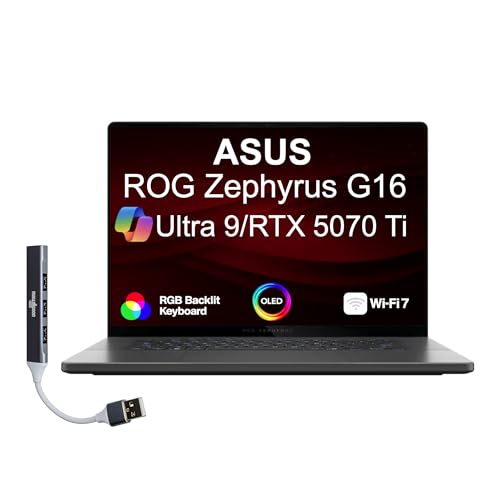
The ASUS ROG Zephyrus G16 proves that you do not have to sacrifice portability to get RTX 5070 Ti performance, delivering a machine that travels like an ultrabook but performs like a full-power gaming rig when you sit down and plug in. Intel's Core Ultra 9 285H processor running up to 5.4GHz across 16 cores pairs with the GeForce RTX 5070 Ti 12GB GDDR7, and the result is a system that handles demanding games, 3D rendering, and professional creative workloads with authority while remaining genuinely portable enough for daily commuting.
The 16-inch OLED WQXGA display at 240Hz is the centerpiece of the Zephyrus G16's appeal, and ASUS has used an exceptionally bright panel that maintains OLED's inherent contrast advantages while pushing brightness high enough for use in well-lit environments — a common weakness of early OLED laptop panels that ASUS has addressed directly. The 32GB of LPDDR5X RAM runs in a configuration that leaves no bottleneck for gaming or content creation, and the 90Whr battery provides enough capacity for meaningful portable use, though sustained gaming will still pull you toward an outlet faster than productivity tasks will.

The included DKZ USB Port Expander addresses one of the common frustrations with slim gaming laptops — limited port selection — without requiring you to carry a separate hub, and ASUS's Armoury Crate software gives you granular control over fan curves, power limits, and RGB lighting from a single interface. If you are looking for a laptop that handles competitive gaming at high refresh rates, creative work in Adobe or DaVinci Resolve, and professional meetings with a webcam, all in a chassis you can carry in a standard backpack, the Zephyrus G16 is the most balanced option in this entire roundup. For users who also work with projectors or external displays in creative settings, our guide to the best DLP projectors covers compatible display equipment that pairs well with a machine at this performance level.
Pros:
- RTX 5070 Ti 12GB GDDR7 delivers excellent gaming and creative performance in a slim form factor
- 240Hz OLED WQXGA display is among the best panels available on a portable gaming machine
- Balanced portability and performance make it genuinely practical for daily carry
Cons:
- 32GB RAM is adequate but less future-proof than the 64GB configurations on competing machines
- RTX 5070 Ti does not match RTX 5080 at maximum performance settings in demanding titles
5. Apple MacBook Pro 14" M4 Pro — Best Compact Powerhouse
The MacBook Pro 14" with M4 Pro is the laptop you buy when you need genuine pro-level performance in the smallest possible package, delivering a 12-core CPU and 16-core GPU inside a 3.5-pound chassis that slips into virtually any bag without occupying meaningful space or weight budget. The M4 Pro's performance per watt ratio remains unmatched by any x86 processor in 2026, which is why this machine achieves results in CPU-intensive tasks — code compilation, data processing, audio mixing — that Windows laptops at similar price points cannot match even with larger, hotter processors drawing twice the power.
The 14.2-inch Liquid Retina XDR display is the same panel technology used in the 16-inch model, meaning you get 1600 nits of peak HDR brightness and factory P3 calibration in a more compact frame that reduces eye fatigue during extended work sessions compared to larger displays, particularly in tight spaces like airplane seats or small desks. With 24GB of unified memory and a 512GB SSD, the base configuration covers most professional workflows comfortably, though you should seriously consider upgrading storage if you work with large video projects or extensive sample libraries, since internal SSD upgrades are not possible after purchase.
Apple Intelligence features arrive fully integrated into macOS on this machine, giving you tools like Priority Notifications, Writing Tools across every application, and the improved Siri with contextual awareness that can act across apps — and all of it processes on-device with no data leaving your machine. The battery life on the 14-inch model consistently reaches 17 to 20 hours under productivity workloads, which is longer than the 16-inch variant achieves due to the smaller display drawing less power, making this the better travel companion of the two MacBook Pros if screen size is not a priority. If you use this machine with an external camera for video calls, our roundup of the best Mac webcams covers every compatible option worth considering.
Pros:
- M4 Pro delivers exceptional CPU and GPU performance in a 3.5-pound chassis
- Industry-leading battery life of 17-20 hours under productivity workloads
- 14.2-inch Liquid Retina XDR display with P3 calibration and 1600 nits peak brightness
Cons:
- 512GB base storage fills quickly with professional projects — budget for the upgrade at purchase time
- macOS incompatibility with Windows-only software remains a real consideration for some workflows
6. Lenovo Legion Pro 7i — Best Value High-Performance Gaming
The Lenovo Legion Pro 7i makes a compelling argument that you do not need to spend at the absolute top of the market to get high-performance gaming that satisfies even demanding players, pairing Intel's Core Ultra 9 275HX processor — running 24 cores for exceptional gaming and content creation headroom — with the NVIDIA GeForce RTX 5070 Ti in a package that delivers elite gameplay without the premium price tag attached to the RTX 5080 machines on this list. The 16-inch 2.5K WQXGA OLED panel at 240Hz provides the same display quality you find on machines costing significantly more, with deep blacks, wide color coverage, and a refresh rate that eliminates motion blur in competitive titles.
Lenovo's Legion Coldfront 5.0 cooling system is one of the most effective thermal solutions in any gaming laptop, using a combination of vapor chamber cooling, multiple heat pipes, and large exhaust vents to give the Core Ultra 9 275HX the sustained thermal headroom it needs to maintain high clock speeds through extended sessions without the aggressive throttling that undermines gaming laptops with inadequate cooling designs. The 32GB of LPDDR5X RAM and 1TB SSD represent the standard configuration for this tier of machine, and while you can argue for more storage, the included three-month PC GamePass subscription adds immediate value that softens the storage limitation for game libraries specifically.
NVIDIA DLSS 4 with Multi Frame Generation transforms the RTX 5070 Ti's already strong raw performance into frame rates that compete with what the RTX 5080 achieves in previous-generation rendering pipelines, meaning the gap between this machine and the Razer Blade 16 in actual gameplay feels smaller than the GPU tier difference suggests. The Legion Pro 7i also maintains better battery life than RTX 5080 machines under balanced workloads, and Lenovo's build quality is genuinely impressive — the chassis feels solid without being heavy, and the Legion TrueStrike keyboard with per-key RGB and dedicated macro keys gives competitive gamers the input precision they expect from a flagship gaming machine. According to Wikipedia's overview of laptop computing, gaming laptops now represent one of the fastest-growing segments of the portable PC market, and the Legion Pro 7i illustrates exactly why that growth is accelerating.
Pros:
- RTX 5070 Ti with DLSS 4 delivers flagship-competitive gaming at a lower price than RTX 5080 machines
- 2.5K OLED 240Hz display matches the display quality of machines costing significantly more
- Legion Coldfront 5.0 provides sustained thermal performance through extended gaming sessions
Cons:
- 1TB SSD fills quickly for users with large game libraries or video production workflows
- RTX 5070 Ti falls behind RTX 5080 in maximum-settings 4K gaming scenarios
7. ASUS ProArt P16 — Best for AI-Powered Creative Work
The ASUS ProArt P16 takes a different approach from every other machine on this list by targeting creative professionals specifically — designers, illustrators, video editors, and AI researchers — rather than gamers or general power users, and it does so by combining AMD's Ryzen AI 9 HX 370 processor with the GeForce RTX 5070 inside a touchscreen OLED laptop that runs Windows 11 Pro and meets Copilot+ PC requirements. The 16-inch 2.8K OLED touchscreen at 120Hz with factory Pantone validation delivers color accuracy that professionals can rely on without external calibration, and the touch interface opens up natural stylus-based workflows in illustration and photo editing applications that no other machine on this list supports.
AMD's Ryzen AI 9 HX 370 running Zen 5 architecture with 12 cores, 24 threads, and a boost clock up to 5.1GHz handles CPU-intensive creative work with authority, and the 50 TOPS of NPU performance qualifies the P16 as a genuine AI PC capable of running Microsoft's full suite of Copilot+ features locally — including real-time background removal, AI-powered photo enhancement, and Recall, which creates a searchable timeline of everything you have worked on. The RTX 5070 with 8GB of GDDR7 handles GPU rendering and AI-accelerated tasks in Adobe Premiere, DaVinci Resolve, and Stable Diffusion with solid performance, though it cannot match the raw throughput of the RTX 5080 machines in this roundup when you push to the absolute limits of GPU rendering.
The 32GB of LPDDR5X RAM and 2TB SSD represent a thoughtful configuration for creative work, giving you enough active memory for large Photoshop compositions and enough storage for substantial project libraries before you reach for external drives. The 90Whr battery provides reasonable portable use time under productivity workloads, and the included Dockztorm Wireless Mouse adds immediate practical value. If you work across devices and pair this machine with a 2-in-1 device for lighter tasks on the go, the ProArt P16 handles the heavy lifting in a workflow that balances portability with power across different form factors.
Pros:
- Factory Pantone-validated 2.8K OLED touchscreen delivers professional-grade color accuracy
- Ryzen AI 9 HX 370 with 50 TOPS NPU supports the full Copilot+ PC feature set locally
- 2TB SSD and 32GB RAM provide a well-balanced configuration for creative workflows
Cons:
- RTX 5070 8GB falls short of RTX 5080 machines in GPU-intensive rendering benchmarks
- 120Hz panel refresh rate lags behind 240Hz competitors for motion-sensitive tasks
Buying Guide: How to Choose the Best High Performance Laptop
Identify Your Primary Use Case Before Anything Else
The single most important decision you make when buying a high-performance laptop in 2026 is identifying whether your primary workload is Windows gaming, macOS creative work, AI-accelerated productivity, or professional creative production — because these use cases pull you toward fundamentally different hardware architectures that cannot be bridged after purchase. If you game competitively on Windows, you need NVIDIA RTX 5080 or 5070 Ti with DLSS 4 support, a 240Hz display, and a chassis with thermal headroom to sustain GPU power limits through extended sessions. If you work in Apple's creative ecosystem with Final Cut Pro, Logic Pro, and Xcode, the M4 Pro or M4 Max MacBook Pro delivers a performance-per-watt advantage that no Windows laptop matches, along with battery life that changes how you work in mobile environments. Define this boundary first, and the rest of the decision tree narrows significantly.
Display Technology Matters as Much as Processing Power
In 2026, the display on your high-performance laptop is not a secondary consideration — it is a core part of the machine's usefulness, and the gap between a premium OLED panel and a standard IPS screen affects every hour you spend working on the machine. OLED displays provide per-pixel contrast ratios that IPS cannot achieve, which means deeper blacks in games and video, more accurate shadow detail in photo editing, and better visual fatigue characteristics during long work sessions because the panel does not emit uniform backlight across inactive areas. Refresh rate matters for gaming — 240Hz is the standard you should demand in this price category — and resolution should be at minimum QHD or WQXGA for a 16-inch machine, because the pixel density difference between FHD and QHD at 16 inches is immediately visible in text rendering and fine image detail.
Memory and Storage: Where to Invest and Where to Compromise
At the high-performance tier in 2026, the minimum acceptable RAM configuration is 32GB, and you should strongly consider 64GB if your workflow involves running local AI models, handling large datasets, working with virtual machines, or managing multiple simultaneous high-resolution media streams. Storage is less critical in terms of raw capacity for most users since fast external NVMe solutions exist, but internal SSD speed matters significantly for applications that stream large assets — video editing software, sample-based audio production, and 3D rendering all benefit from the fastest available PCIe Gen4 or Gen5 storage rather than the slower options found in entry-level configurations. For Apple silicon machines, RAM cannot be upgraded after purchase and is integrated into the chip package, making the configuration decision at purchase time more consequential than on Windows platforms where some machines allow post-purchase RAM upgrades.
Portability vs. Sustained Performance: Understanding the Trade-Off
Every high-performance laptop in 2026 makes a compromise between sustained performance under load and the thermal management required to achieve it in a portable chassis, and you need to understand where your chosen machine falls on that spectrum before you commit. Thinner machines like the Razer Blade 16 and ASUS ROG Zephyrus G16 use aggressive fan curves and may thermally limit under sustained workloads in ways that larger machines like the MSI Titan 18 HX AI do not, because thermal headroom scales with chassis volume and cooling surface area in ways that physics does not allow designers to fully engineer around. If you regularly run sustained GPU or CPU workloads for more than 30 to 45 minutes at a time — rendering, encoding, training models — prioritize machines with larger cooling systems and be skeptical of performance claims from ultra-thin gaming laptops that may not be achievable under sustained real-world conditions rather than short benchmark runs.
What People Ask
What is the best high-performance laptop for creative professionals in 2026?
The Apple MacBook Pro 16" with M4 Max is the top choice for creative professionals who work within the Apple ecosystem, delivering sustained workstation-level performance, the best available portable display, and battery life that genuinely lasts through a full working day. For Windows-based creative professionals who need GPU rendering power alongside CPU performance, the ASUS ProArt P16 with its factory-calibrated OLED touchscreen and Ryzen AI 9 HX 370 processor is the most purpose-built option available.
Is the RTX 5080 significantly better than the RTX 5070 Ti for gaming laptops?
The RTX 5080 delivers roughly 20 to 30 percent higher raw performance than the RTX 5070 Ti in GPU-limited scenarios, which translates to meaningful frame rate advantages at maximum settings in demanding titles, especially at QHD and 4K resolution. For most competitive gaming at 1080p or QHD with DLSS 4 enabled, the RTX 5070 Ti with Multi Frame Generation produces frame rates that match or exceed what the RTX 5080 achieves without AI upscaling, making the performance difference less absolute than the GPU tier naming suggests in practical gaming scenarios.
How long do high-performance laptops last before becoming obsolete?
A high-performance laptop purchased in 2026 at the RTX 5080 or M4 Max tier should remain capable for demanding workloads for at least four to five years, based on historical performance scaling patterns in the industry. The machines on this list are built with current-generation AI acceleration, sufficient RAM for emerging workloads, and display technology that will not feel outdated in the near term. The practical lifespan depends more on battery degradation and software evolution than on raw processing power becoming insufficient for everyday tasks.
Should you buy a MacBook Pro or a Windows gaming laptop for high-performance work?
The answer depends entirely on your software requirements and workflow ecosystem. If your critical applications run natively on macOS — particularly Apple-optimized tools like Final Cut Pro, Logic Pro, and Xcode — the MacBook Pro's performance per watt advantage, battery life, and display quality make it the superior choice for professional creative work. If your workflow requires Windows-exclusive software, you game regularly, or you need NVIDIA CUDA GPU acceleration for machine learning or rendering pipelines, a Windows laptop with RTX 5080 or 5070 Ti delivers capabilities that macOS cannot replicate regardless of Apple silicon's raw benchmark numbers.
What RAM capacity should you prioritize in a high-performance laptop in 2026?
For most professional users in 2026, 32GB represents the practical minimum that handles modern creative and productivity workloads without memory pressure, while 64GB becomes important if you run local large language models, work with virtual machines simultaneously alongside other applications, or handle large batch processing in data science workflows. Apple's unified memory architecture is more efficient per gigabyte than traditional discrete RAM configurations, meaning 24GB unified on the MacBook Pro 14" handles workloads that would require 32GB or more on a conventional Windows laptop with separate CPU and GPU memory pools.
Are 18-inch laptops worth the extra weight and size for performance gains?
An 18-inch machine like the MSI Titan 18 HX AI is worth the size penalty specifically if you need maximum sustained performance under continuous workloads, because the larger chassis provides thermal headroom that allows the processor and GPU to run at or near their rated TDP for extended periods without throttling. If you move the machine between fixed locations rather than commuting daily with it, the weight and bulk become non-factors in daily use, and the larger display combined with sustained performance advantages make it a genuine desktop replacement rather than a compromise. For users who travel regularly with their laptop, a 16-inch machine at this performance tier delivers a far more practical daily experience.
Buy on Walmart
- Apple 2024 MacBook Pro Laptop with M4 Max, 16‑core CPU, 40‑c — Walmart Link
- Razer Blade 16 (2025) Gaming Laptop: NVIDIA GeForce RTX 5080 — Walmart Link
- MSI Titan 18 HX AI 18" 120Hz MiniLED UHD+ Gaming Laptop: Int — Walmart Link
- ASUS ROG Zephyrus G16 AI Gaming Laptop 16.0" 240Hz OLED WQXG — Walmart Link
- Apple 2024 MacBook Pro Laptop with M4 Pro, 12‑core CPU, 16‑c — Walmart Link
- Lenovo Legion Pro 7i – Gaming Laptop - Intel® Core™ Ultra 9 — Walmart Link
- ASUS ProArt P16 AI Powered Laptop 16.0" Touch OLED 2.8K Disp — Walmart Link
Buy on eBay
- Apple 2024 MacBook Pro Laptop with M4 Max, 16‑core CPU, 40‑c — eBay Link
- Razer Blade 16 (2025) Gaming Laptop: NVIDIA GeForce RTX 5080 — eBay Link
- MSI Titan 18 HX AI 18" 120Hz MiniLED UHD+ Gaming Laptop: Int — eBay Link
- ASUS ROG Zephyrus G16 AI Gaming Laptop 16.0" 240Hz OLED WQXG — eBay Link
- Apple 2024 MacBook Pro Laptop with M4 Pro, 12‑core CPU, 16‑c — eBay Link
- Lenovo Legion Pro 7i – Gaming Laptop - Intel® Core™ Ultra 9 — eBay Link
- ASUS ProArt P16 AI Powered Laptop 16.0" Touch OLED 2.8K Disp — eBay Link
Buy for your actual workflow, not the highest benchmark number — the right high-performance laptop is the one that handles your specific tasks without compromise, not the one with the biggest GPU on the spec sheet.
 |
 |
 |
 |

About Priya Anand
Priya Anand covers laptops, tablets, and mobile computing for Ceedo. She holds a bachelor degree in computer science from the University of Texas at Austin and has spent the last nine years writing reviews and buying guides for consumer electronics publications. Before joining Ceedo, Priya worked as a product analyst at a major retailer where she helped curate the laptop and tablet category. She has personally benchmarked more than 200 portable computers and is particularly interested in battery longevity, repairability, and the trade-offs between Windows, macOS, ChromeOS, and Android tablets. Outside of work, she runs a small Etsy shop selling laptop sleeves she sews herself.